- Google Ads
How Performance Marketing Helps Beauty Clinics Scale Beyond Referrals

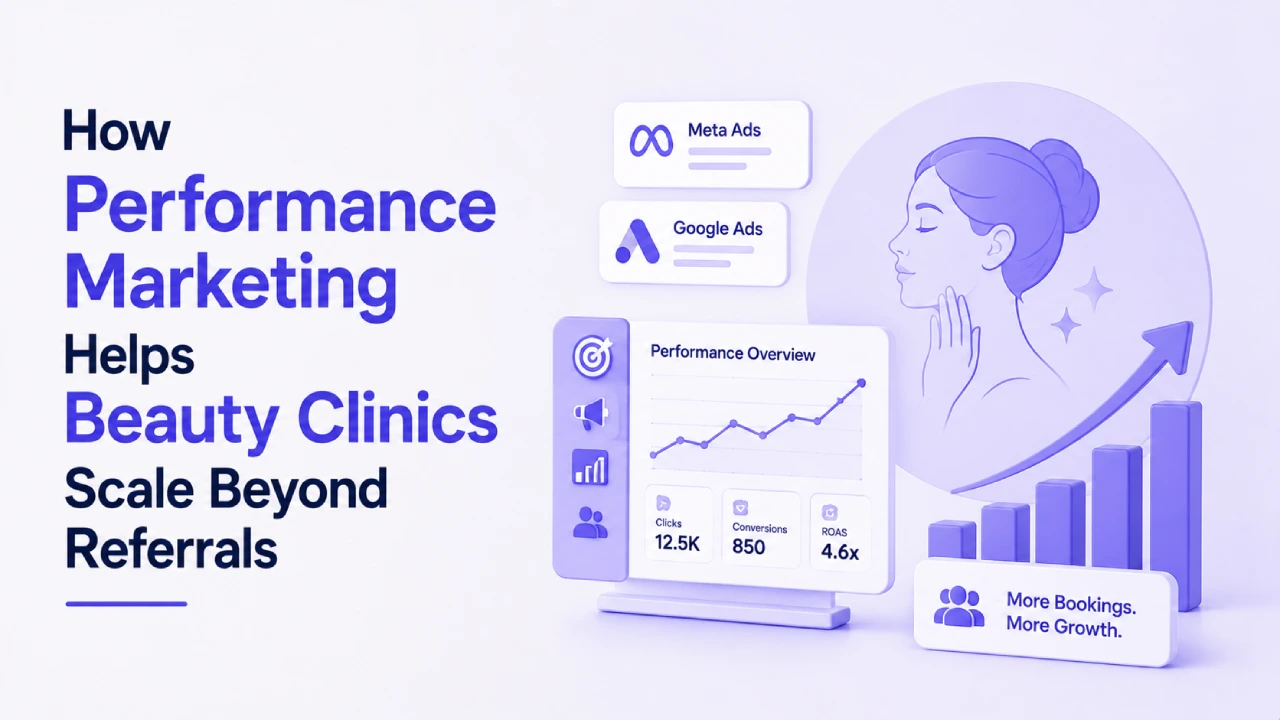
Ask any established beauty clinic owner where their best clients came from and referrals will come up almost every time. A personal recommendation carries something that advertising struggles to manufacture: genuine trust that has already been established before the prospective client even makes contact. It is an extraordinarily efficient way to build a client base in the early years of a clinic, and most owners are understandably attached to it.
The ceiling tends to arrive quietly. A clinic that has grown well through word of mouth for three or four years starts to notice that the appointment book fills to a certain point and stops. New treatments get a polite initial response from existing clients but no real traction beyond that. Losing a handful of regulars to relocation or changed circumstances creates a gap that referrals fill slowly and unpredictably. Nothing has gone wrong with the clinic itself. The model it has been using to grow just has a natural upper limit, and most established beauty businesses hit it sooner than they expect.
Performance marketing is the mechanism that breaks through that ceiling. This post covers how it works, what Google Ads and Meta Ads each bring to a beauty clinic growth strategy, how to measure ROAS accurately, and what a realistic setup looks like for an established clinic ready to grow beyond its existing network.
What Performance Marketing Means for a Beauty Clinic
Performance marketing is paid digital advertising where every pound of spend connects to a specific, trackable outcome. Unlike traditional advertising, where you pay to be seen and then hope something follows, paid digital campaigns record what happens after someone sees your ad. Did they click? Did they fill in a form? Did they call the clinic or complete a booking? Every one of those actions gets attributed back to the campaign that produced it, which means you can assess whether your ad spend is generating revenue rather than guessing.
Contrast that with a magazine ad or a local billboard. Both reach people and generate impressions, but there is no reliable way to trace an impression back to a client who actually walked through the door. Performance marketing leaves a full data trail across the campaign: click behaviour, on-site actions, and whether an enquiry or booking resulted. That data is what allows you to calculate a genuine cost per acquisition, not an estimate based on assumed attribution, but an actual figure tied to a real outcome.
For most beauty clinics, the two platforms worth understanding first are Google Ads and Meta Ads. The way each one works is quite different, and they tend to perform better when used alongside each other than when treated as alternatives. Before getting into the tactical detail, it is worth being clear on what each platform actually does.
Google Ads: Capturing Clients Who Are Already Looking
Google Ads operates on intent. When someone searches “anti-wrinkle injections Belfast” or “hydrafacial near me”, the decision to get a treatment has effectively already been made. They are weighing up which clinic to go with and actively looking for something that convinces them to book. A well-structured Google Ads campaign puts your clinic in front of that person at precisely that moment, before they land on a competitor’s page and make their choice there.
How Google Ads Campaigns Are Structured for Beauty Clinics
The most effective setups for beauty clinics organise campaigns around individual treatments rather than the clinic as a whole. An anti-wrinkle campaign gets its own keywords, its own ad copy, and a landing page built specifically around that treatment. A lip filler campaign gets the same treatment. The reason this structure works better than lumping everything into a single campaign is that it keeps the experience consistent for the person clicking: they searched for something specific and everything they encounter from that point reinforces that they have found what they were looking for.
Coherence across the whole journey is what actually converts clicks into bookings. Someone who searched for a specific treatment, clicked an ad that spoke directly to that treatment, and landed on a page focused on exactly that treatment has had a seamless experience. The decision to enquire feels easy at that point. Without that coherence, campaigns that group all treatments under broad targeting generate traffic that does not convert, which is the most common reason clinics conclude Google Ads does not work when the real problem is how the campaigns were built.
Keyword Strategy and Match Types
The keywords you bid on determine who sees your ads. For beauty clinics, the highest-intent terms are treatment-specific combined with a location modifier: “lip filler Belfast”, “semi-permanent makeup Northern Ireland”, “hydrafacial Lisburn” and similar. Searches like these come from people who have done enough thinking to know which treatment they want and which general area they want it in. They are about as close to a ready-to-book prospective client as paid search can deliver.
Match types control how closely a search query needs to match your keyword before your ad shows. Broad match gives Google discretion to show your ad for loosely related searches and can burn through budget on irrelevant traffic quickly. Phrase match and exact match give you more control. For most beauty clinic campaigns, phrase match as the primary type with a well-maintained negative keyword list to filter out irrelevant searches is the most cost-efficient approach in the early stages.
Negative Keywords: The Part Most Clinics Miss
Negative keywords are search terms you explicitly exclude from triggering your ads. A clinic running lip filler campaigns needs “lip filler training” and “lip filler kit” blocked immediately. Anyone searching those terms is looking for a course or supplies, and no amount of well-written ad copy will turn them into a booking. Running through adjacent searches for each treatment before launch, then adding the irrelevant ones to the negative list, is a task that takes under half an hour and consistently prevents a notable slice of monthly budget from being spent on the wrong people entirely.
Meta Ads: Reaching the Clients Who Are Not Searching Yet
Meta Ads covers Facebook and Instagram and works on a fundamentally different principle. Rather than responding to an existing search, Meta Ads places your clinic in front of people who match the profile of your ideal client based on demographics, location, interests, and behavioural data. The person seeing your ad may not have been thinking about a treatment before they saw it. That is not a limitation; it is an entirely different kind of opportunity.
Audience Targeting for Beauty Clinics on Meta
The targeting options available on Meta are genuinely precise for local service businesses. A Belfast beauty clinic promoting anti-ageing treatments can build an audience of women aged 30 to 55 within a defined radius, layered with skincare and wellness interests. What that precision means in practice is that your budget goes toward people with a realistic chance of booking rather than a broad local population with no qualification at all. Body treatment campaigns work similarly, just with a different interest layer: audiences showing interest in fitness or weight management tend to respond well to treatments in that category, depending on what is being promoted.
Lookalike audiences are one of the most useful targeting tools available for established clinics. By uploading a list of existing client contact details, Meta builds an audience of people in your area who share characteristics with your current clients. Campaigns targeting lookalike audiences typically deliver better cost per acquisition than cold interest-based targeting because the match between your offer and the audience is tighter from the start.
Creative That Performs on Meta for Beauty Clinics
Beauty treatments are inherently visual, which gives clinics a genuine advantage on a platform driven by imagery and video. Before-and-after content, where permitted within Meta’s advertising policies, consistently outperforms generic stock photography because it provides direct evidence of the result a prospective client is considering.
Short video content performs well as Reel-format ads for beauty clinics, and the production standard does not need to be high. The opening two or three seconds are everything: if the first frame is not visually interesting, the viewer has already scrolled past before anything else registers. A mid-treatment facial clip tends to hold attention in a way that a designed graphic with text overlay does not. A genuine client reaction to seeing a result is similarly effective. Production value matters far less than authenticity; the content just needs to feel like it was filmed in a real clinic rather than assembled from a stock library.
Retargeting: Converting Interest Into Bookings
Most people who click a beauty clinic ad do not book on that first visit. They browse the site, check pricing, and leave without completing anything. Retargeting campaigns on Meta exist specifically for this group. Someone who has already visited your treatments page already knows roughly who you are; what they need is a reason to come back and take action. A follow-up ad with a genuine client review tends to be more effective at that stage than a general promotional message, because social proof addresses the hesitation that stopped them booking the first time. The cost per booking from retargeting is typically lower than from cold campaigns for this reason: the audience requires less convincing, just a prompt at the right moment.
Tracking and ROAS: Measuring What Your Campaigns Actually Deliver
Performance marketing only delivers on its name if results are being measured accurately. For a beauty clinic, the metric that matters is cost per booked appointment, and calculating that requires proper conversion tracking set up before campaigns go live.
Setting Up Conversion Tracking for a Beauty Clinic
Conversion tracking works by designating a specific on-site action as a conversion event: a completed enquiry form or a booking confirmation page loading are the most common choices for beauty clinics. Google Tag Manager handles the technical side, firing both the Google Ads conversion tag and the Meta Pixel at the moment that action occurs. Once this is set up correctly, every booking that originates from an ad gets attributed back to the campaign, ad group, and keyword that produced it. Clinics that skip this step are running campaigns without any reliable feedback loop, which makes it genuinely impossible to distinguish what is working from what is consuming budget without producing results.
Without this setup, all you can see is how many people clicked your ad. You cannot tell which ads are generating revenue and which are generating traffic that bounces. Most beauty clinics running campaigns without proper conversion tracking are spending based on assumptions rather than data, and the ones that fix this early are the ones that can scale with confidence.
GEO Targeting: Why Location Precision Drives Better Returns
A beauty clinic draws from a defined local catchment. Unlike an ecommerce business with a national customer base, the majority of your prospective clients live or work within a specific radius, and targeting beyond that radius wastes budget on people who will not travel to you.
Setting the Right Location Radius for Your Campaigns
Most clients travel within a 5 to 10 mile radius for regular maintenance treatments. Brow lamination, a lash appointment, an express facial: these are the kinds of bookings where proximity is a significant factor in the decision. Higher-value or more specialised procedures are different. Clients will travel considerably further for a treatment they cannot easily access locally, particularly if your clinic has a strong reputation for it. Building campaigns with treatment-specific radius settings reflects this reality and avoids the common mistake of applying one broad location setting across every campaign regardless of what is being advertised.
For clinics in Belfast, this also means thinking carefully about specific postcodes and neighbouring towns. A clinic in South Belfast will draw differently from one in North Down or the Lisburn area. Location bid adjustments allow you to increase spend in the postcodes where your existing clients are most concentrated and pull back in areas where clicks are coming in but conversions are not following.
How Creative Sweet Approaches Performance Marketing for Beauty Clinics
We have worked with beauty and wellness businesses across Belfast and Northern Ireland, including Westend Beauty Clinic, on the digital marketing that supports real growth. Performance marketing is not something we apply as a template; it starts with understanding which treatments are most valuable to your clinic and building campaigns around those priorities with proper tracking in place from day one.
In practice, Google Ads campaigns are built around high-intent treatment keywords with tight match types and a properly maintained negative keyword list. Meta Ads get structured around the right audience layers, using real clinic content rather than stock imagery because that is what actually converts on this platform. Conversion tracking goes in before the campaigns go live, not after, so cost per acquisition and ROAS are visible from the first booking rather than something to piece together retrospectively. Each treatment being advertised gets its own landing page, because sending paid traffic to a general clinic homepage is one of the most reliably expensive mistakes in beauty clinic advertising.
Most established clinics we speak to have grown well through referrals and know they are ready to go further. If that describes where your clinic is right now, a conversation with us about performance marketing is worth having. Get in touch at creativesweet.net or book a free discovery call and we can look at what a realistic paid ads setup would involve for your specific treatments and location.
Frequently Asked Questions About Performance Marketing for Beauty Clinics
What is performance marketing for beauty clinics?
Performance marketing is paid digital advertising where every pound of spend connects to a specific, trackable result. For beauty clinics, it typically covers Google Ads targeting people actively searching for treatments and Meta Ads reaching local audiences based on demographics and interests. The fundamental difference from traditional advertising is that results are measurable: you know what each enquiry or booking cost you, which makes it possible to manage campaigns against real revenue targets.
What ROAS should a beauty clinic expect from paid ads?
Once past the initial learning phase of roughly 60 to 90 days, well-structured beauty clinic campaigns typically reach a ROAS of 3x to 5x. The first couple of months tend to sit lower, around 2x to 3x, while the platforms gather enough conversion data to optimise properly. Treatments with higher per-booking values naturally produce stronger ROAS figures: a single semi-permanent procedure or advanced skin treatment generates more revenue per booking than a lower-price introductory treatment, so the return on the ad spend that produced it is proportionally higher.
Should a beauty clinic use Google Ads or Meta Ads?
The honest answer is both, because they serve genuinely different purposes. Google Ads captures demand that already exists: someone searching for a specific treatment in your area is ready to book and you want your clinic to appear when they do. Meta Ads creates demand by introducing your clinic to people who fit the profile of your ideal client but were not necessarily thinking about a treatment before your ad appeared. Running them together means your clinic has visibility at the point someone is actively searching and at earlier stages of the decision journey too.
How do you track results from beauty clinic paid ads?
Effective tracking for a beauty clinic ad campaign requires conversion events to be configured at the point where a prospective client completes an enquiry form or reaches a booking confirmation page. Google Tag Manager connected to Google Analytics and the Meta Pixel should both be installed and tested before campaigns go live. Without this, it is not possible to calculate cost per acquisition or measure ROAS accurately.
Can Creative Sweet run performance marketing for beauty clinics in Belfast?
Yes. Creative Sweet works with beauty clinics and wellness businesses across Belfast and Northern Ireland on Google Ads, Meta Ads, conversion tracking, and landing page infrastructure. Get in touch at creativesweet.net to discuss what a paid ads strategy could look like for your clinic.


Keep reading
- SEO
Walk into a gym that has been open six months and ask the owner about...
- Google Ads, Marketing, SEO
Some chiropractic practices deliver genuinely excellent clinical care, have warm and well-run clinics, and still...

- Development
Your website is often the first thing a potential customer in Belfast sees before they...