- SEO
How to Get Your MSK Physiotherapy Clinic Found on Google

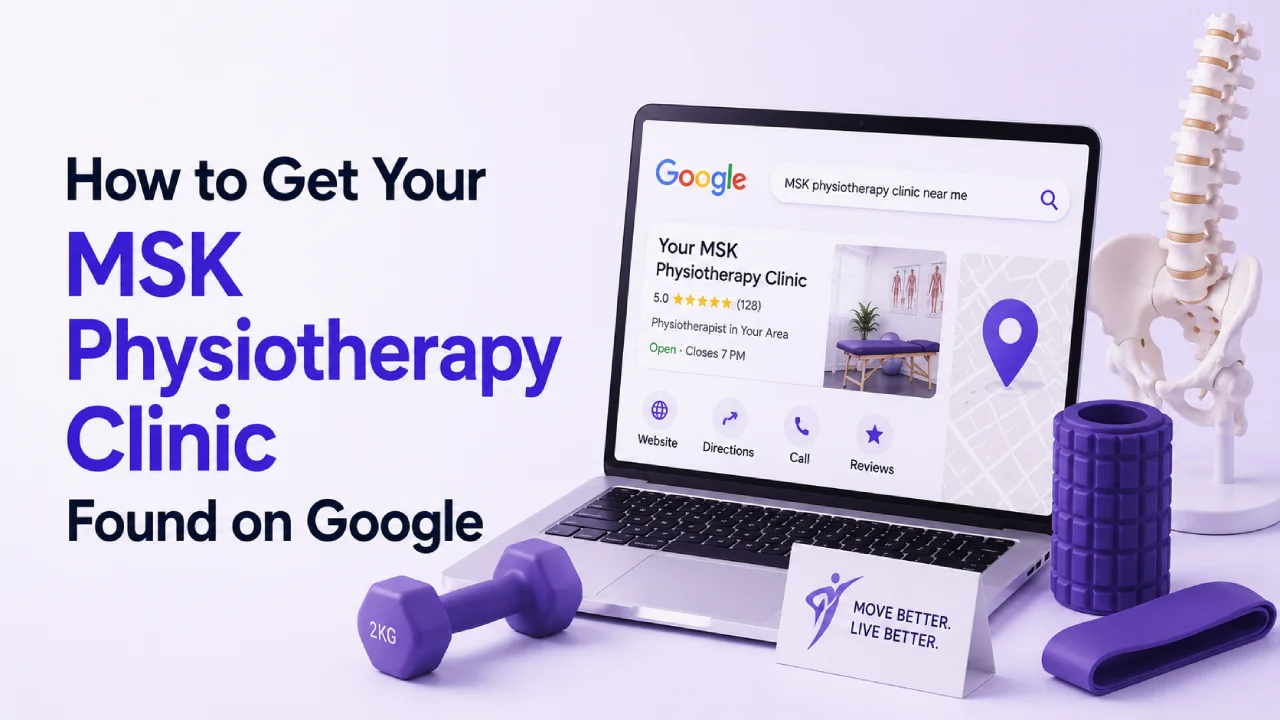
Most MSK physiotherapy clinics are far better at treating patients than they are at being found by them. That is not a criticism. You trained for years to assess a dodgy shoulder, not to wrestle with Google. But here is the uncomfortable truth: the person with three weeks of lower back pain is not asking their GP for a referral anymore. They are on their phone, at half nine at night, typing “back pain physio near me” and tapping whichever clinic looks the part.
Whoever shows up first usually gets the call. And it is rarely the best clinician. It is the clinic that took its online presence seriously.
The good news for MSK clinics specifically is that this is a very winnable game. The way people search for musculoskeletal help, by the condition rather than the profession, plays straight into a smart SEO approach. This guide walks through how to use that to your advantage, from the Google Business Profile right through to the condition pages and schema that most clinics never bother with.
Why MSK Patients Search Differently (and Why That Helps You)
Here is something worth sitting with for a second. Almost nobody wakes up and searches for “MSK physiotherapy”. They do not think in those terms. What they search for is the thing that hurts.
Patients Search for the Problem, Not the Profession
Someone with a trapped nerve types “sciatica treatment”. Someone who tweaked their knee running the Belfast half marathon types “knee pain physio”. A new mum with wrist pain searches for exactly that, in those words. They are describing a symptom and hoping something useful comes back. The word “musculoskeletal” almost never enters into it, and “MSK” even less so.
This matters enormously, because it tells you where the opportunity is. If your website only talks about “MSK physiotherapy services” in clinical language, you are invisible to the people describing their actual pain in plain English. The clinics that win are the ones that meet patients in the words they are already using.
Condition-Based Search Comes With Built-In Intent
There is another gift hidden in how MSK patients search. When someone types “shoulder impingement physio”, they are not browsing. They are in pain, they have probably already self-diagnosed via a worrying half hour on the internet, and they want to book. That is about as high-intent as search gets. A clinic that ranks for these condition terms is not chasing curiosity, it is catching people at the exact moment they are ready to pay for help.
Start With Your Google Business Profile, Because Patients Do
Before we get anywhere near clever condition pages, there is a piece of groundwork that matters more than all of it. Your Google Business Profile. For a local MSK clinic, this single free listing does more for your visibility than almost anything else you could spend time on.
Why the Map Pack Wins Local Healthcare Searches
Run a search for “physio near me” in Belfast and look at what Google puts at the very top. You will not see a list of websites. You will see a map with three clinics pinned on it, each showing its star rating and hours and a tap-to-call button right there. That box has a name, the map pack, and it is where the clicks land for local healthcare searches. Miss out on it and you are left scrapping over the results underneath, which most patients never bother scrolling down to reach.
What an MSK Clinic Profile Actually Needs
The basics take about an afternoon to sort and then pay off for years, so they are worth doing carefully. Your primary category should be “Physical therapist” or “Physiotherapist”, not something vaguer that leaves Google guessing. Double-check that the address and phone number match your website to the letter. When it comes to photos, use real ones of the clinic and the treatment rooms and the team rather than a stock image of a spine that fools nobody. And whatever you do, keep your opening hours current. A patient who drives across town to a clinic that turns out to be shut does not give you a second chance. They leave a one-star review and book elsewhere.
Reviews Are Not Optional in Healthcare
People get understandably picky about who they let treat their body, and reviews are the thing that calms those nerves. Sixty recent reviews sitting at 4.9 stars reads as safe. Four reviews, the most recent from 2022, does the opposite, even if the clinic behind them is excellent. There is a ranking angle too, because Google pays attention to how many reviews you have and how fresh they are. So build a quiet habit of asking happy patients to leave one, ideally a same-day text with the link already in it. That habit turns into an advantage that keeps stacking up the longer you run it.
Build Condition Pages, Not a Single Services List
This is where most MSK clinics leave the biggest opportunity on the table. They have one page titled “Our Services” that lists everything the clinic treats in a tidy bulleted block, and they wonder why it ranks for nothing in particular. The answer is that a page about everything is a page about nothing, as far as Google is concerned.
One Page Per Condition Is the Whole Game
Take lower back pain. A page built around just that, written properly, going into real detail on how your clinic assesses and treats it, will rank for back pain searches far better than a single line buried in a services list. Then you do the same for the next condition, and the one after that. Sciatica gets a page. So does sports injury rehab, post-surgical recovery, plantar fasciitis, whiplash, and whatever else you regularly see through the door. Every common condition you treat earns its own page, written squarely for the patient who has that exact problem and is out there searching for that exact help.
There is no need to build all of them at once, and honestly you should not try. Pick the three or four conditions that bring in your most valuable work, give each one a genuinely useful page, then keep adding over the months that follow. Do it steadily and you end up ranking for dozens of specific, high-intent searches. The clinic down the road with its single tidy services page never gets near any of them.
What a Good Condition Page Includes
A condition page ranks because it genuinely helps someone, and keyword-stuffing does the opposite of that. So explain the condition in plain language, the kind you would use with a patient who is anxious and has just been frightened by something they read online. Walk through how your clinic assesses it. Give them a realistic sense of what treatment looks like and roughly how long recovery tends to take, and deal with the questions every patient asks before they pluck up the courage to ask them. Write the whole thing the way you would explain it across the desk. Google has got surprisingly good at spotting that kind of real, lived expertise, and it tends to reward it.
Get the Local Signals Right
MSK physiotherapy is, at the end of the day, a local business. Nobody is driving ninety minutes each way for a follow-up on a grumpy knee. So your SEO has one job it cannot skip: making it unmistakably clear to Google where you are based and which areas you actually serve, and saying it often enough that there is no ambiguity.
Mention Your Area Like a Real Local Clinic Would
Your website needs to make it plain that you serve Belfast, or whichever town and the areas around it you genuinely cover. Nobody is suggesting you cram “Belfast” into every other sentence until the page reads like a ransom note. Write the way a real local clinic talks. Name the neighbourhoods your patients actually travel in from. Drop in that you are a couple of minutes’ walk from some landmark people will recognise. Make sure your full address sits somewhere a visitor can find without hunting for it. Those little genuine signals quietly add up to something Google trusts.
Local Citations and Healthcare Directories
Your clinic ought to turn up consistently across the directories that patients and search engines both lean on. The big general ones like Google and Bing carry weight, and so do the healthcare platforms where people specifically go looking for registered practitioners. Here is the rule that trips most clinics up, though. Your name, your address, your phone number all have to read exactly the same wherever they appear. Even a small mismatch, a “Road” abbreviated to “Rd” on one listing, leaves Google unsure whether it is dealing with one clinic or two.
Use Healthcare Schema to Speak Google’s Language
This is the technical bit, and it is the part nearly every MSK clinic skips, which is exactly why it is worth doing. Schema markup is a small piece of code that sits behind your pages and tells Google, in a structured way it cannot misread, precisely what your business is.
Why Schema Matters More for Clinics Than Most Businesses
A lot of businesses get away with skipping schema entirely. Healthcare does not get that luxury, because Google handles medical information far more cautiously and genuinely wants to know who is behind it. When you mark your site up with the Physiotherapy or MedicalClinic schema type, you are spelling it out for Google in a format it cannot misread. You are a healthcare provider. Here is where you are. Here is what you treat. That kind of clarity helps you surface properly in local results, and more and more it influences whether your clinic gets quoted in the AI-generated answers now parked at the top of so many searches.
The Schema Types Worth Implementing
At a minimum, a healthcare schema type identifying the clinic as a physiotherapy provider is worth having, alongside FAQ schema on your condition pages so the questions you answer can appear directly in search. A developer or a marketing partner can add these without much fuss, and the visibility they unlock is well out of proportion to the effort involved. We have included a sample Physiotherapy schema block at the foot of this post to get you started.
How Creative Sweet Helps MSK Clinics Get Found
We work with healthcare and physiotherapy businesses across Belfast and Northern Ireland, and the pattern we see again and again is a brilliant clinical team that is almost invisible online. The treatment is excellent. The website just is not pulling its weight, and the Google Business Profile has been left half-finished since the day it was set up.
Closing that gap is the job. It usually kicks off with an honest audit of where the clinic actually stands in local search, and then the unglamorous foundational work that genuinely shifts things. We get the profile properly optimised. We build condition pages around the searches real patients are typing. We tidy up the local signals and add the healthcare schema so Google understands exactly what the clinic is and does. There is no chasing of vanity metrics and no filling a report with busywork, just the handful of changes that bring more of the right patients through the door.
If your clinic is treating fewer new patients than its reputation deserves, the problem is usually visibility rather than ability. Get in touch at creativesweet.net or book a free discovery call, and we will take an honest look at why patients are not finding you and what it would take to change that.
Frequently Asked Questions About MSK Physiotherapy SEO
What is the most important SEO step for an MSK physiotherapy clinic?
Claiming and properly optimising your Google Business Profile comes first, ahead of everything else. It decides how your clinic shows up in local map results and near me searches, and that is exactly where most new patients begin their hunt. Get the profile complete, with details that are accurate, a primary category that actually fits, and reviews that keep arriving, and you have given the clinic the footing it needs before any of the other SEO work can start paying back.
Why do condition-based keywords matter for MSK clinics?
Because patients hardly ever search for “MSK physiotherapy” by name. They search for whatever is hurting them, something like lower back pain treatment or sciatica physio near me. When you build dedicated pages around those condition searches, your clinic starts ranking for the words patients genuinely type into Google. That is high-intent traffic, the people ready to book, and a single general services page tends to let all of it slip straight past.
Does my MSK physiotherapy clinic need healthcare schema markup?
Yes. Healthcare-specific schema, the Physiotherapy or MedicalClinic type, hands Google a clear, structured account of what your clinic does, whereabouts it sits, and which conditions it treats. That extra clarity lifts how the clinic appears in ordinary search results, and it increasingly feeds your visibility in the AI-generated answers and local search features that now play a real part in deciding who patients find first.
How long does SEO take to work for an MSK physiotherapy clinic?
Most MSK clinics see early local improvements within three to four months, usually from Google Business Profile work and the first condition pages going live. More competitive areas can take six months or longer for strong organic rankings. Since the work compounds, clinics that keep at it consistently tend to see results keep building rather than levelling off.
Can Creative Sweet help my MSK physiotherapy clinic rank on Google?
Yes. Creative Sweet works with healthcare and physiotherapy businesses across Belfast and Northern Ireland on local SEO, condition-based content, and healthcare schema. Get in touch at creativesweet.net to talk through what your clinic needs to be found by the patients already searching for help.


Keep reading
- Google Ads
A half-empty class is one of the most frustrating things in the yoga business. The...

- Branding
Here is a pattern we see a lot. A salon opens, the diary is quieter...

- SEO
Plenty of Belfast business owners have a website and assume that covers the online side...