

Here is the honest situation most independent gym owners find themselves in around Belfast and beyond. Meta Ads are getting more expensive by the quarter. Google Ads for gym-related terms have crept up to the point where a decent click can cost several pounds. And the big chains sitting nearby have marketing budgets that quietly make it impossible to outbid them if you go down the paid route. Which is exactly why the smart independent gym owners are quietly winning on a different front entirely, one where money genuinely does not decide the game.
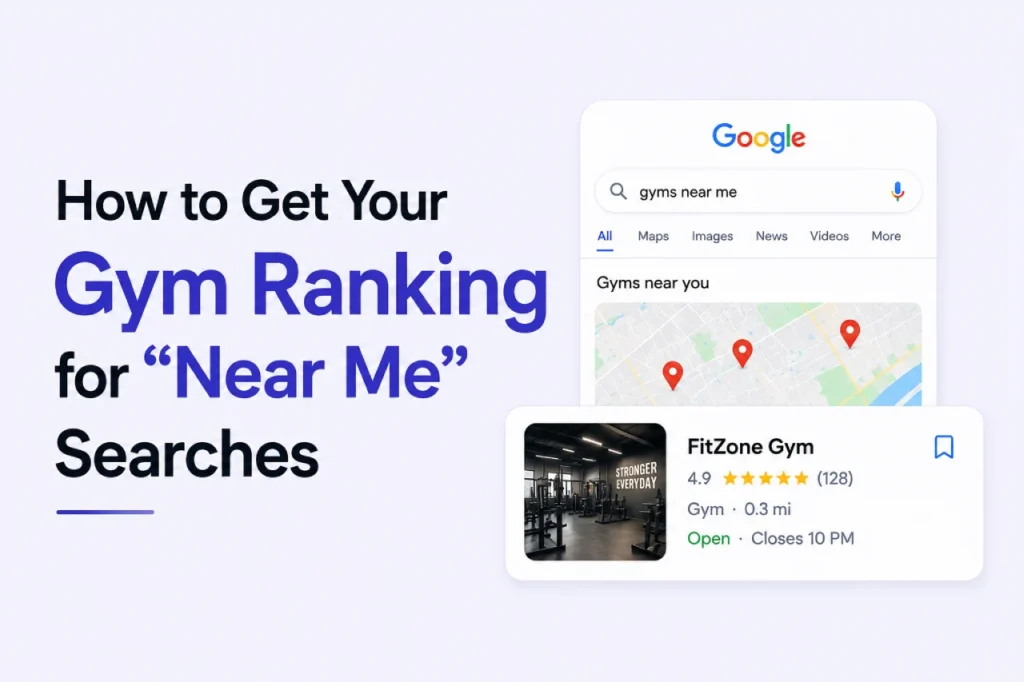
Organic local search is genuinely the most underused growth channel in the fitness industry right now. When somebody nearby types “gym near me” into their phone at 7am on a Monday, Google shows them three specific gyms in a small map at the top of the page. Everybody else on that page might as well not exist. Cracking into those three spots does not require paid ads. It requires doing a fairly specific set of things properly, which is exactly what this post walks you through.
None of what follows is exotic or clever. It is just the practical work most independent gyms have never actually got round to doing, which is precisely why the opportunity for the ones that do it stays wide open in 2026.
Why Organic Rankings Beat Paid Ads for Gyms Specifically
Before diving into the how, it is worth being honest about why organic is the smarter game for gym owners in the first place. Paid ads have their place. But they have particular disadvantages for fitness businesses that make organic local SEO a much better use of most gym budgets.
Paid Ads Stop Working the Moment You Stop Paying
Every pound you spend on Google Ads or Meta Ads for your gym buys you visibility that lasts precisely as long as the campaign is running. Pause the spend for a week to sort out cash flow and your visibility disappears with it. Organic rankings work completely differently. The work you put in during month one keeps paying you back in month twelve, and often for years beyond that. It compounds in a way paid never can.
Members Trust Organic Rankings More Than Ads
When somebody sees your gym at the top of the organic map pack for a “near me” search, there is an implicit endorsement built into that ranking. Google is essentially telling the searcher that your gym is one of the most trusted options in the area. That trust translates directly into higher click-through rates and better conversion than any sponsored result, which most people scroll past by reflex now anyway.
Step One: Get Your Google Business Profile Genuinely Right
The single highest-leverage move for any gym trying to rank locally is a properly optimised Google Business Profile. And yet almost every independent gym we audit has one that was set up years ago and never touched since. Sorting this out costs you nothing, takes about two hours, and unblocks more local rankings than practically anything else on this list.
The Fields Almost Every Gym Gets Wrong
Log into your profile and start with the basics. Your primary category needs to be set specifically as “Gym” or “Fitness Center”, not something vague like “Health Club” that leaves Google guessing. Opening hours have to reflect reality, including any changes for bank holidays, which most gyms forget to update. Your address needs to match exactly what appears on your website, right down to the punctuation. And your phone number should match too.
Photos Are Doing More Work Than You Realise
Old launch-day photography is one of the clearest signs to Google that a gym has gone dormant. Fresh photos uploaded regularly signal an active business. Take a phone out on the floor once a fortnight and grab shots of the equipment, the classes running, the coaches at work, and the members training. Upload them to your profile. Google notices this kind of activity, and it feeds directly into how your gym is ranked against competitors.
The Underused Google Business Profile Features
Google Posts is a feature almost no gyms use, and that alone gives active users a genuine edge. Post updates about new classes, member success stories, or upcoming events. The Services section lets you list specific offerings like personal training, group classes, or nutrition coaching, which Google uses to match your gym against relevant local searches. Every field left blank is a small ranking opportunity handed to whichever competitor did fill it in.
Step Two: Build a Sustainable Review Habit
Reviews are one of the most direct ranking signals for local searches, and the specific thing gym owners tend to miss is that review velocity matters more than total review count. A gym getting one or two fresh reviews every fortnight consistently outranks a gym with three times as many total reviews but nothing new in six months. Google reads recent review activity as evidence that the business is currently trusted, which is exactly what it wants to surface to its users.
The Simplest Review Process That Genuinely Works
Do not overengineer this. The most effective approach is a short text message sent the day after a member joins or completes a first class. Something warm that thanks them and includes a direct link straight to your Google review page. Nothing more complicated. Run that process consistently for three months and your review flow starts producing a natural rhythm of fresh reviews landing every week or two. Members who genuinely enjoyed their experience are almost always happy to write a few lines, provided you have not made them go hunting for where to write them.
Step Three: Build Pages That Match What Members Actually Search
Almost every independent gym website has one single “Services” page listing every class and training option in one long list. Google does not really know what to do with that. What ranks properly is dedicated pages built around the specific things members type into their phones. A dedicated page for personal training. Another for HIIT classes. Separate pages for specific neighbourhoods you serve if you cover a wider catchment.
The trick with these pages is writing them for real humans thinking about joining your gym, not for search engines. Cover what the class or service actually involves. Talk about who it suits. Include real client stories where you can, and answer the questions somebody nervous about joining would silently ask. Google rewards this kind of genuinely useful content in a way that thin marketing copy simply cannot compete with, and each page brings its own trickle of high-intent traffic that no single services page would ever have caught.
Step Four: Sort Out Your Local Citations
Search your gym name on Google and see what comes up beyond your own website. There are almost certainly listings sitting on directories you have forgotten about. Old Yell entries from when the gym first opened. A health directory a previous employee signed up to. Some sports club website your gym once sponsored, still linking to a phone number you changed two years ago.
Every one of those old listings that has slightly wrong information on it quietly sends Google conflicting signals about who your business actually is. The fix is unglamorous but genuinely important. Work through them systematically, updating each one so your business name, address, and phone number read identically across every source. Nothing about this task is exciting, but it removes a category of ranking drag that almost every established gym is carrying without realising.
Step Five: Add Exercise Gym Schema to Your Website
Schema markup is essentially structured code sitting in the background of your website that tells Google and AI search engines exactly what your business is. For gyms, the ExerciseGym schema type is the specific implementation that matters. Adding it properly makes your business easier to categorise correctly, and it is increasingly what gets your gym cited when somebody asks ChatGPT or Perplexity for a recommendation in your area.
This is one bit of work you might genuinely want a developer to help with, unless you are comfortable editing your site’s code. The good news is that it is a one-time job with ongoing benefits that keep compounding. Once the schema is in place and validated through Google’s Rich Results Test, every future page you add inherits the benefit.
How the Whole Approach Compounds Over Six Months
The interesting thing about doing all five of these properly is how the results compound. Month one usually delivers modest visible progress. By month three, most gyms start seeing meaningful movement in the map pack for the searches that actually matter. By month six, gyms that stayed consistent are usually sitting in one of the three pinned spots for their primary catchment area, generating a steady flow of new member enquiries at zero ongoing cost per lead.
Compare that to spending £2,000 a month on paid ads. Even a conservative organic SEO investment usually pays back within the first year and then keeps paying back indefinitely, which is precisely why gym owners who have done this properly rarely go back to leaning heavily on paid.
How Creative Sweet Helps Gyms Rank Locally
We work with gyms and fitness studios across Belfast and Northern Ireland on organic local SEO, and the pattern we see is genuinely consistent. The gyms themselves are usually excellent. The coaching is good, the community is real, and the members who do find their way in tend to stay. The problem sits earlier in the funnel, at the point where potential members are searching and cannot see the gym at all because the local SEO foundations have never been properly built.
Closing that visibility gap is the work. That means fixing the Google Business Profile properly, setting up a review process the team can actually maintain, building the service and neighbourhood pages that catch real search intent, cleaning up citations, and getting schema live. It is not glamorous, but it consistently moves gyms into the local map pack and keeps them there.
If your gym is doing brilliant work behind the doors but not seeing enough new faces coming through them, that gap is almost always a visibility issue rather than a coaching one. Get in touch at creativesweet.net or book a free discovery call, and we will take an honest look at where your gym currently ranks and what would realistically move it forward inside the next few months.
Frequently Asked Questions About Ranking Your Gym Locally
How do I get my gym to show up in near me searches on Google?
Ranking a gym for near me searches comes down to five connected pieces of work. A fully optimised Google Business Profile is the foundation, followed by a steady habit of member reviews arriving weekly, dedicated service pages on your website matching what members actually search for, consistent citations across local directories, and proper ExerciseGym schema markup. Doing all five well consistently beats being brilliant at one and ignoring the rest.
How long does it take a gym to rank locally without paid ads?
Most gyms getting started with proper local SEO work begin seeing meaningful ranking improvements within the three-to-four-month window. Stronger rankings in properly competitive urban areas can take six months or longer to lock in. The compounding nature of local SEO means results tend to keep building for months and years afterwards, rather than plateauing the way paid ads eventually do.
Do gym reviews really affect Google rankings?
Yes, significantly. Review volume plays a role, along with your star average and how recently reviews have been arriving. All three are direct ranking signals in local search. A gym generating one or two fresh reviews every week will consistently outrank a gym with more total reviews that have gone stale, because Google reads active review activity as a sign the business is currently trusted by its members.
Can a small independent gym compete against big chains locally?
Yes, more easily than most independent owners realise. Big gym chains often have poorly maintained Google Business Profiles because head office manages them centrally without local input. Independent gyms actively managing their own local SEO regularly outrank chain competitors on near me searches within their specific catchment area, sometimes within a single quarter of getting the work started.
Can Creative Sweet help my gym rank locally without paid ads?
Yes. Creative Sweet works with gyms and fitness studios across Belfast and Northern Ireland on organic local SEO, covering Google Business Profile optimisation, review systems, on-page content work, citation cleanup, and schema implementation. Get in touch at creativesweet.net to discuss what your gym currently needs to start ranking properly.