When someone searches for a physiotherapist, a dentist or an aesthetic clinic, they rarely stick to just one. A few tabs open, a few forms get filled in, and it becomes a waiting game to see who replies first. Whoever gets back to them usually wins the conversation, and that’s not always down to better reviews or a shorter waiting list. It’s often just down to who answered first. Ten minutes can be the difference between a booked consultation and a lead that quietly drifts to a competitor down the road.
This is the problem clinic lead follow-up automation solves. Automation isn’t going to replace a receptionist’s judgement, or a practitioner’s clinical opinion. What it’s actually useful for is closing the gap between an enquiry landing and someone doing something about it: catching it the moment it arrives, sending a quick acknowledgement, and flagging it to whoever needs to see it, so the person following up isn’t starting cold. None of this is meant to automate the relationship. It’s meant to protect the window in which a human can build one.
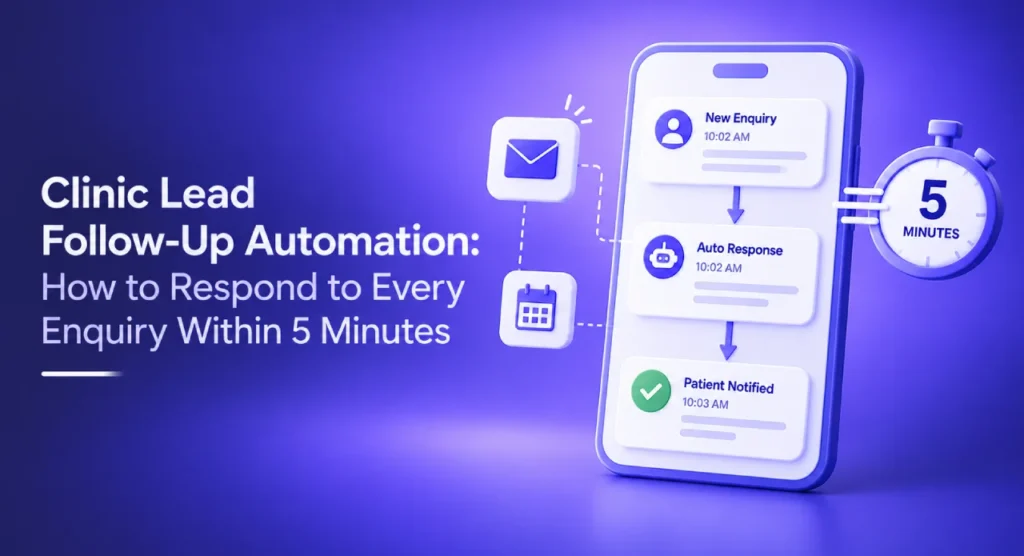
Five minutes is the benchmark we’ll use throughout this guide for a clinic’s first response. That doesn’t mean a human has to reply inside five minutes every time. It means the enquiry gets captured, acknowledged and routed to the right person within that window, so whoever picks it up next is working a warm lead, not a cold one.
How quickly should a clinic respond to a new enquiry?
There’s no legal or clinical standard for an exact response time. What lead response research consistently shows is that the chance of making contact and converting falls the longer it waits, with the steepest drop in the first hour or so.
The most cited figures come from a 2007 study led by Dr James Oldroyd at MIT’s Sloan School of Management with InsideSales.com. Across six companies and over 15,000 leads, contacting a web enquiry within five minutes rather than thirty made a business roughly 100 times more likely to reach the person, and around 21 times more likely to qualify them. A follow-up study the same author published with Harvard Business Review in 2011 audited 2,241 US companies directly: only 37% responded within an hour, 23% never responded at all, and the average response time among those who did reply was 42 hours. Firms that made contact within the hour were roughly seven times more likely to land a useful conversation than those who waited one hour longer, climbing to over 60 times more likely against firms that waited a full day. A more recent 2026 benchmark from Blazeo, covering 573 service businesses, found that same gap persists. None of this is healthcare-specific, and clinics shouldn’t assume the exact multipliers transfer directly. What does transfer is the pattern: response speed has a measurable relationship with whether an enquiry turns into a conversation, and most organisations, healthcare included, are slower than they assume. Five minutes is the operational target this guide works towards, not a figure any study proved for clinics specifically.
It’s also worth separating four things that get lumped together as “responding fast”:
- Immediate automated acknowledgement: a message confirming the enquiry has landed. This can happen within seconds.
- Automated qualification: gathering basic details, such as service and preferred location, so a human isn’t starting from nothing. This can often happen within a minute or two.
- Human response: a real member of staff engaging with the person. This is what actually moves someone toward booking, and should happen as soon as realistically possible, ideally within the same five minute window during opening hours.
- Booking: the enquiry converting into a confirmed appointment. This usually still needs a person involved, or a self-service option that’s genuinely well built.
An automated email sent within five minutes isn’t the same as a person responding within five minutes, even though the two often get talked about as if they were interchangeable. It buys the clinic time, not a finished conversation.
The 5-Minute Clinic Lead Follow-Up Workflow
| Time | Action | Automated or human? |
|---|---|---|
| 0 to 1 minute | Enquiry captured from the website, phone tracking or booking widget | Automated |
| 1 to 2 minutes | Acknowledgement sent confirming receipt and setting expectations | Usually automated |
| 2 to 3 minutes | Basic qualification and routing to the right clinic, service or clinician | Often automated, sometimes human |
| 3 to 5 minutes | Notification reaches the right staff member, who begins follow-up | Human |
| Ongoing | If there’s no response from the patient, a structured, appropriately spaced follow-up sequence begins | Mostly automated, with human check-ins |
The automated steps buy the clinic time. The human steps are what actually convert the enquiry.
The Clinic Enquiry Funnel, and Where Automation Fits
Traffic lands on the website, and some of that traffic becomes an enquiry, which then moves through several stages: capture, acknowledgement, qualification, human follow-up, booking, the appointment, then whatever follow-up happens afterwards.
Automation does most of the heavy lifting at either end of that chain, capturing the enquiry, sending the acknowledgement, notifying staff and sending reminders, then later prompting a review or a rebooking. The middle is where it gets weaker, mostly because that’s where an actual conversation needs to happen, and a person needs to be doing the talking, not a workflow.
Capture, Acknowledge, Route, Respond, Book, Follow Up, Measure. It’s the same funnel, broken into the actions a clinic actually needs to manage day to day.
What Can a Clinic Automate?
| Process | Can it be automated? | Example |
|---|---|---|
| Enquiry capture | Yes | Website form or online booking submission logged automatically |
| Immediate acknowledgement | Usually | Confirmation email or SMS sent on submission |
| Lead notification | Yes | Alert to reception or the assigned clinician |
| Basic qualification | Sometimes | Service, location or preferred appointment time |
| Appointment booking | Often | Online booking calendar with real-time availability |
| Reminder | Yes | Appointment reminder by SMS or email |
| Complex clinical question | No, usually human | Practitioner or trained reception response |
| Sensitive medical discussion | Human-led | Appropriate, appropriately trained staff member |
What Should Never Be Automated
Can automation replace reception staff? No. It removes repetitive admin work so reception staff spend less time chasing forms and more time speaking to patients. It isn’t a substitute for their judgement.
Marketing automation is an administrative and communication tool, not a clinical one. Automated workflows should route straight to a human, without a scripted response, when an enquiry involves:
- A clinical question, a request for diagnosis, or treatment advice
- Anything describing urgent or worsening symptoms
- A complaint of any kind
- A safeguarding concern
- Highly sensitive personal information the person has volunteered
- A complex or unusual patient circumstance that doesn’t fit a standard enquiry
None of this makes automation unsafe. The workflow needs a clear exit into a human conversation, and staff should know that’s part of the job, not an edge case.
Why Clinics Lose Leads
| Problem | Consequence | Automation opportunity |
|---|---|---|
| Slow response | Prospective patient contacts a competitor first | Instant capture and acknowledgement |
| Enquiries sitting in a shared inbox | No one takes ownership until it’s too late | Automatic routing to a named person |
| No lead ownership | Everyone assumes someone else is dealing with it | Assignment rules by service or location |
| No alerts | Staff only see enquiries when they happen to check | Real-time notification |
| Staff unsure who should respond | Delay while the enquiry gets forwarded around | Predefined routing logic |
| No follow-up after the first contact | Interested people are never chased again | Scheduled, appropriately spaced follow-up |
| Forms not connected to a central system | Enquiries scattered across email, DMs and voicemail | Centralised capture across channels |
| Booking system disconnected from marketing | No visibility of what actually converts | Integrated booking and reporting |
| Leads arriving from multiple channels | No single view of total enquiry volume | Unified lead log |
| No measurement of response time | Slow patches go unnoticed | Basic response-time reporting |
| No distinction between qualified and unqualified enquiries | Staff time spread thin across everyone equally | Simple qualification step before routing |
| No escalation process | Complex or sensitive enquiries get the standard reply | Defined human escalation triggers |
A GDPR-First Framework for Clinic Automation
This is general marketing practice guidance, not legal advice. UK GDPR and PECR (the Privacy and Electronic Communications Regulations) both apply here, and the ICO has been actively updating its direct marketing guidance following the Data (Use and Access) Act 2025, with more due in 2026. Get your own data protection advice before building or changing a workflow.
1. Collect less data. Ask only for what’s needed. That’s usually a name, a way to contact them, and the service they’re interested in. Avoid open text fields inviting symptoms or medical history on a marketing form. The ICO takes a broad view of what counts as health data, and even a list of appointments at an osteopath clinic can count by inference. The safer approach is to keep marketing forms free of clinical detail and leave that conversation for a clinician.
2. Explain how the data is used. Say it in plain terms, right where the enquiry is made, rather than three clicks deep in a cookie banner.
3. Separate service communication from marketing. Under PECR, messages sent for administrative purposes, such as acknowledging an enquiry or confirming a booking, aren’t direct marketing. Newsletters or offers are a separate activity needing their own basis for contact. Don’t assume a first enquiry grants permission for future marketing.
4. Use the appropriate lawful basis and consent route. PECR’s “soft opt-in” lets a business email or text existing customers about similar products without fresh consent, given a clear opt-out at collection and in every message. It’s narrower than it sounds, and doesn’t cover prospective customers or bought-in lists. Whether a first-time enquirer who hasn’t booked counts as a “customer” here is genuinely uncertain, so it’s safer to treat new enquiries as needing specific opt-in consent. Separately, health information is special category data under Article 9, needing both an Article 6 basis and a distinct Article 9 condition, not consent by default.
5. Secure the workflow. Access controls, encrypted storage, and a proper data processing agreement with any automation, CRM or SMS provider.
6. Build in human escalation. Every automated sequence needs a visible, easy route to a person, particularly for clinical questions, complaints, or anyone who doesn’t want to be in an automated flow.
7. Review retention. Don’t keep enquiry data indefinitely. An enquiry that never converted doesn’t need the same retention period as an active patient record, and that should be a deliberate decision.
An Illustrative Automation Example
This is an illustrative walkthrough showing how the pieces fit together. It isn’t a real case study, and there’s no conversion figure attached to it.
A prospective physiotherapy patient submits a website enquiry at 10:02am.
- 10:02 Enquiry captured automatically from the website form
- 10:02 Automated acknowledgement sent, confirming the enquiry has been received and someone will be in touch shortly
- 10:03 Reception team notified by an internal alert
- 10:04 Enquiry assigned to the clinician or team member covering that service
- 10:05 Staff member begins follow-up by phone or email
- Later, if unanswered An appropriate, clearly signposted follow-up message goes out, rather than the enquiry simply sitting unactioned
How This Looks Across Different Clinic Types
Physiotherapy
Take an enquiry like “Do you treat sports injuries and how soon can I get an appointment?” It can be tagged automatically by service and urgency. From there it’s routed to whichever clinician has the earliest slot, and a human takes over to confirm timing.
Chiropractic
New patient enquiries here tend to be about availability, location, and whether the practice is even taking new patients. Automation can confirm the enquiry’s landed and share general availability. The booking conversation itself is still one for a person to have.
Aesthetic
Consultation requests need particular care. Automated replies should stick to logistics and route treatment-specific or price-sensitive questions to a trained team member. ASA and CAP rules apply to automated messages here too, including a ban on urgency-driven discounting (“book by Friday”) for cosmetic treatments.
Dental
Appointment requests can be captured and acknowledged automatically, with online booking handling routine slots. Anything describing pain, swelling or a possible emergency should be flagged for immediate human triage.
Wellness
Service and package enquiries suit automated information and straightforward booking, with a human involved for anything more tailored, such as programme recommendations.
None of the above is medical advice, and none of it replaces a clinician’s judgement.
Before and After: What a Well-Designed Workflow Changes
| Without automation | With a well-designed automation workflow |
|---|---|
| Enquiry arrives in a shared inbox | Enquiry captured instantly in one place |
| Staff notice it whenever they next check | Staff receive an immediate notification |
| Acknowledgement sent manually, if at all | Immediate, appropriate acknowledgement sent automatically |
| Ownership of the lead is unclear | Lead automatically assigned to a person |
| Follow-up depends on who remembers | Follow-up process is standardised |
| Little or no tracking of response time | Response time and conversion are measured |
Automation doesn’t guarantee a better conversion rate. It removes the delays and gaps that quietly reduce one.
What to Measure
qualified enquiry, booking, attended appointment, patient value.
Worth tracking alongside response time:
- Average and median response time
- Percentage of enquiries contacted within five minutes
- Lead-to-contact rate
- Contact-to-booking rate
- Lead-to-booking rate
- Appointment attendance rate
- Cost per qualified lead and cost per booked appointment
- Lead source
- Automation failure rate (messages that didn’t send, notifications that didn’t arrive)
- Follow-up completion rate
A clinic that’s quick to respond but weak on conversion has a different problem than one that converts well once it gets there. You won’t know which situation you’re in until you’re measuring both.
The 5-Minute Clinic Lead Follow-Up Checklist
- Is every enquiry captured automatically, regardless of channel?
- Does the clinic receive an immediate notification?
- Does the patient receive an appropriate acknowledgement?
- Is every lead assigned to a named person?
- Can staff see where the enquiry came from?
- Is the next action clear, without anyone needing to ask?
- Can suitable enquiries move directly to booking?
- Are unanswered enquiries followed up appropriately, rather than left?
- Are sensitive or clinical questions escalated to a human?
- Is response time actually being measured?
- Are GDPR and privacy requirements built into the workflow, not added afterwards?
Automation Doesn’t Fix a Lead Problem
Most clinics don’t have a lead volume problem first. They have a follow-up problem. The chain runs lead generation, lead capture, response speed, follow-up, booking, and a weak link anywhere in it limits everything after it.
Automation strengthens the follow-up and response speed links. It cannot fix a website that doesn’t convert, an offer that isn’t compelling, or leads that were poorly targeted. Fixing the workflow behind existing enquiries is usually the faster, cheaper win before spending more on generating new ones.
Frequently Asked Questions
What is clinic lead follow-up automation?
It’s the use of automated systems to capture, acknowledge and route new patient enquiries the moment they arrive, so staff can follow up quickly without manually monitoring every channel.
How quickly should a clinic respond to a new enquiry?
As quickly as realistically possible. A five minute target for capturing, acknowledging and routing the enquiry is a reasonable operational benchmark, but the automated acknowledgement isn’t a substitute for a human response, which should follow as soon as staff are available.
Can clinics automate lead follow-up?
Yes, for the administrative parts: capturing enquiries, sending acknowledgements, notifying staff, basic qualification and reminders. Clinical conversations, complaints and sensitive enquiries should still go to a person.
Is healthcare marketing automation GDPR compliant?
It can be, if it’s designed with data minimisation, an appropriate lawful basis, clear privacy information and human escalation built in from the start. Compliance depends on how a specific workflow is built, so this should be reviewed with a data protection adviser rather than assumed.
Can automated messages replace human follow-up?
No. Automated messages buy time and keep the enquiry warm. Converting that enquiry into a booking is still, in almost every case, a human job.
What should a clinic automate first?
Enquiry capture and immediate acknowledgement. These have the biggest impact on whether a lead is still warm by the time a human gets to it, and they’re usually the simplest to set up.
How can clinics stop losing leads because of slow response times?
By making sure every enquiry is captured centrally, notified to a named person immediately, and followed up on a standard timeline, rather than depending on whoever happens to check the inbox next.
Ready to See Where Your Enquiries Are Actually Going?
If your clinic is generating enquiries but staff can’t respond consistently within minutes, the problem may not be lead volume. It may be the workflow behind each lead.
At Creative Sweet, we work with physiotherapy, chiropractic, aesthetic, dental and wellness clinics across Northern Ireland and the wider UK to close that gap. Not by selling another piece of software, but by mapping how enquiries move from first contact to booked appointment, and fixing what’s costing you patients.
A Clinic Lead Follow-Up Automation Audit reviews your enquiry sources, response times, routing, follow-up process, CRM or booking setup, and where GDPR-appropriate automation could genuinely help, then hands you a clear, practical plan.
Book a free discovery call and we’ll tell you honestly where you’re losing enquiries, and what’s worth fixing first.