- Marketing
How to Get Your Beauty Salon Ranking for “Near Me” Searches on Google

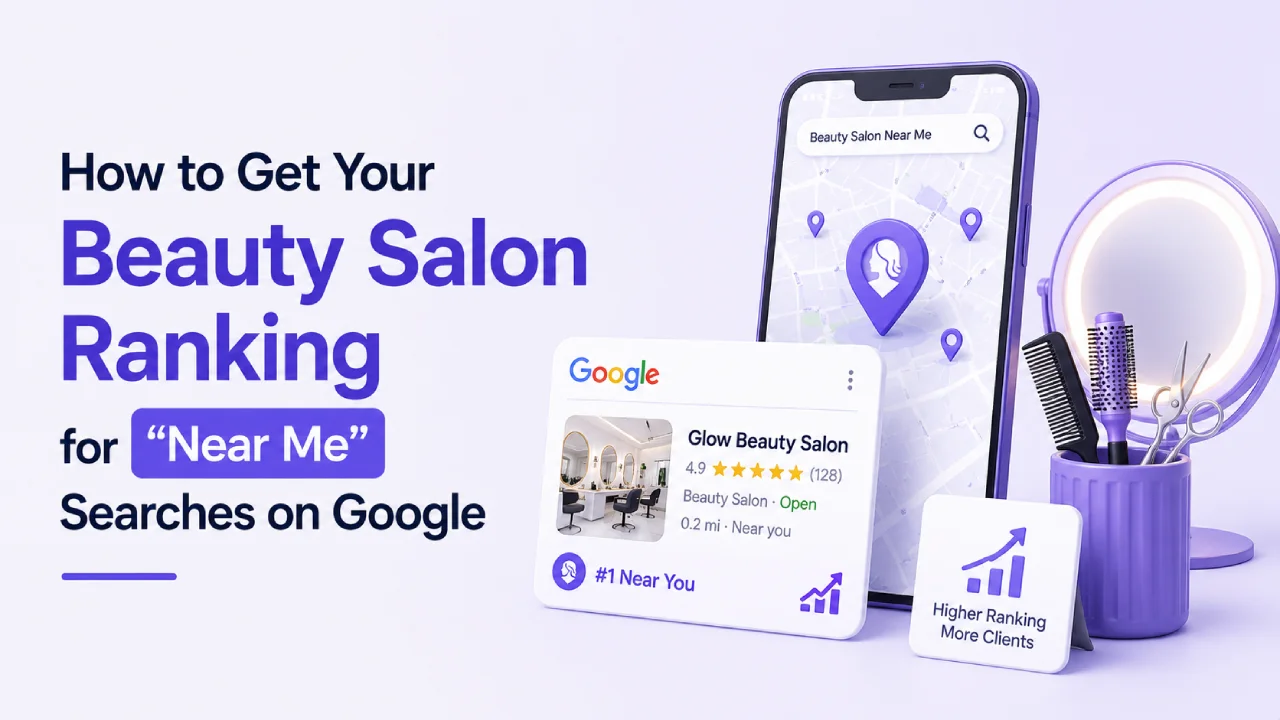
Someone in your town picks up their phone and searches “beauty salon near me”. In the space of about thirty seconds they have looked at the map pack, identified whoever seems most credible, skimmed the reviews, and made a decision. The whole process wraps up before most salon owners have any idea it happened. Near me visibility tends to matter far more to actual booking behaviour than most other forms of local marketing, precisely because this is where decisions get made.
Near me searches account for a meaningful chunk of new client enquiries for local beauty businesses. The people running those searches are not in research mode. A treatment decision has already been made; what they are looking for is somewhere local to book it. That kind of ready-to-act intent is genuinely difficult to replicate through other forms of online discovery, which is why this particular slice of local SEO deserves more attention than most salon owners give it.
What follows covers the practical steps for improving your beauty salon’s visibility in near me searches. It starts with the Google Business Profile because that is where the biggest gains tend to be, then moves through to what your website needs to be doing and how citations and reviews factor in. Generic local SEO advice is easy to find; this is specifically about what moves the needle for a beauty salon competing in a local market.
Step One: Understand How Near Me Results Actually Work
Before diving into individual ranking factors, it is worth understanding what Google is actually doing when it serves near me results. The map pack is not a simple proximity list ordered by distance. Google applies a relevance and quality filter before deciding which salons appear and in what order. That filtering is what allows a salon slightly further away to rank above a closer competitor, provided its profile and wider online presence make a stronger case for relevance.
The Three Factors Google Uses for Local Map Pack Rankings
Google’s local algorithm uses three broad signals when deciding which businesses appear in the map pack. Relevance covers whether your business actually matches what the person searched for. Proximity is about physical distance from the searcher’s location, which you have no control over. Prominence is the third, and the most actionable: it reflects how well-known and trusted your salon looks online, based on review quality, link presence, and whether your business information is consistent across the web.
Proximity is the one factor completely outside your control. A client searching two streets from a competitor gives that competitor a distance advantage that no amount of profile work will overcome. Relevance and prominence are the two signals worth putting your energy into. Both are directly shaped by how well your Google Business Profile is built and maintained, and by what your website tells Google about where you are and what you offer.
Why Near Me Searches Prioritise the Map Pack
When Google detects location intent in a search, whether from the phrase “near me” or a location modifier like “Belfast”, it surfaces the map pack above organic website results. For beauty salons, this changes where the real SEO work needs to happen. Getting into the map pack matters far more than chasing organic positions that sit below it. A salon with a well-maintained profile and solid review signals will routinely appear above one whose website is technically better built but whose profile was set up once and never touched again.
Step Two: Claim and Complete Your Google Business Profile
Your Google Business Profile is the foundation of near me visibility. The map pack draws everything it displays from it. Business name, address, photos, and reviews all come from the profile, as do the opening hours a prospective client checks before deciding whether to visit. Google also uses it when assessing where to place the salon in local results, reading it for relevance signals and prominence cues. An unverified or half-finished profile is one of the most common reasons salons fail to appear locally despite having a functional website.
Verifying and Setting Up Your Profile Correctly
The first step is searching your salon name on Google Maps. If an unclaimed listing exists, click “Claim this business” and work through the verification process. Most accounts receive a postcard with a verification code at the business address, though phone or email options are available in some cases. Nothing else in this guide will have any real effect until verification is done, because an unverified profile gives you no control over what is displayed.
Once verified, the business category is the most important field to get right. The primary category should be “Beauty salon” rather than something broader like “Health and wellness”. Secondary categories can be added where the salon focuses on specific treatments: “Nail salon” works for a nail-focused business, “Waxing hair removal service” makes sense for somewhere that does a lot of lash and brow work. The primary category carries the most weight as a relevance signal, so specific beats generic every time.
Completing Every Section of the Profile
Completeness matters considerably more than most salons realise when it comes to local ranking. The business name needs to match exactly what appears on the shopfront and website. Address and phone number should be formatted the same way everywhere they appear online. Opening hours deserve particular care: clients check them before visiting and make decisions based on them, so any inaccuracy costs real bookings. Holiday closures and seasonal changes need updating the moment they are confirmed rather than being left for a client to discover when they arrive at a locked door.
Services: The Section Most Salons Leave Empty
The services section of a Google Business Profile is one of the most under-used features available to beauty salons. Adding individual services with descriptions gives Google additional content to match against specific searches. A salon that lists “gel nails Belfast” as a named service with a brief description is considerably more likely to appear for that search than one with a generic paragraph about what the salon offers. Every treatment worth ranking for needs its own individual entry: spray tan, lash extensions, brow lamination, and anything else the salon actively promotes. Putting them all in a single block leaves Google with very little to work with when matching against specific treatment searches.
Photos: Quantity, Quality, and Consistency
Google Business Profiles with more photos consistently perform better in local search than those with few or none. Real imagery works far better than stock photography for beauty salons. Interior shots that capture the feel of the space, treatment result photos, and pictures of the team at work all give prospective clients something genuine to look at. Stock images are a poor substitute: Google is reasonably good at identifying them, and they add no authenticity signal whatsoever.
A reasonable starting target is fifteen to twenty photos. Cover the exterior so people recognise the building, show the interior so they get a sense of the atmosphere, include some team photos, and add treatment result examples where you have good ones. Once that foundation is there, adding a couple of new images each month is worth building into the routine. It takes very little time and tells Google that the business is active rather than abandoned.
Step Three: Build a Consistent Review Presence
Google reviews are one of the most direct factors in local ranking prominence. The total review count, posting recency, and average rating all feed into how Google assesses a salon’s standing relative to nearby competitors. A salon with forty well-distributed recent reviews will typically sit above one with the same star average but only eight older ones. Recency carries real weight here. A cluster of old reviews looks quite different to Google than a steady flow of new ones arriving month after month, even if the total count is similar.
How to Generate Reviews Without Feeling Pushy
The most reliable review generation approach for a beauty salon is a text message sent a few hours after the appointment. A quick thank-you note with a direct link to the Google review page takes seconds to write and consistently generates more responses than any in-person request. Most salons that try this approach and get poor results skipped the link. Without a direct URL, a client who genuinely intends to leave a review will typically never find their way to the right place and the intention quietly disappears.
For salons running on a booking system, many platforms support automated post-appointment messages with a review link built in. Getting this set up once removes the need for any manual follow-up, which is where most review request processes break down in practice. Whoever is on the desk that day stops being the deciding factor, and the requests go out consistently regardless of how busy the salon is.
Responding to Reviews and What It Signals to Google
Responding to reviews, positive and negative, is a local SEO signal most salons overlook. Google reads response activity as a sign that the business is engaged and current rather than dormant. A profile with regular owner responses, even brief ones, consistently looks more active in Google’s assessment than one where reviews accumulate without any acknowledgement.
Negative reviews deserve more thought than positive ones in the response. A calm, professional reply that acknowledges what the client experienced and offers to put it right tells prospective clients considerably more about the salon’s character than the original complaint does. An unanswered negative review, or a defensive reply, tends to do more cumulative damage to conversion than the review itself, because it is the response that prospective clients read most closely.
Step Four: Optimise Your Website for Local Search Signals
Map pack visibility comes primarily from the Google Business Profile. The website takes care of the organic results below the map and reinforces the geographic relevance signals Google needs to understand where the salon is and what it offers. When these two assets are aligned, near me visibility tends to be consistent. When the profile is strong but the website sends weak or missing location signals, the salon often appears in the map pack sporadically rather than reliably, which limits the benefit of the profile work considerably.
NAP Consistency: Name, Address, and Phone Number
NAP refers to your salon’s name, address, and phone number. Every platform where these details appear needs to show them identically: the website, the Google Business Profile, Facebook, Instagram, directory listings, and anywhere else the salon is mentioned online. Even small discrepancies create conflicting signals. A slightly different phone number on Facebook from the one on the website, for example, is enough to create the kind of inconsistency that suppresses local rankings in ways that are genuinely difficult to trace without checking citation data directly.
The simplest way to implement this consistently is a sitewide footer carrying the full salon name, address, and phone number in plain readable text. Search engines pick up plain text more reliably than the same details embedded in images or rendered through JavaScript, so it is worth making sure the footer content is not locked inside a graphic or loaded dynamically. A Google Maps embed on the contact page adds an additional geographic confirmation signal that costs nothing to implement.
Location Pages and Service Pages for Specific Searches
A single-page website, or a homepage that briefly lists every service without dedicated pages for each, will rank for very few near me searches beyond the salon’s own name. Gel nails, lash extensions, and spray tans all compete for different searches. A salon that treats all of them as one “Services” page is effectively invisible to anyone searching for a specific treatment locally.
Take a “gel nails Belfast” page as an example. It needs to describe the service in genuine detail, mention Belfast and the local area naturally in the copy, show pricing or at least a starting price, and make booking easy from the page itself. A lash extensions page needs the same approach applied to lash extensions. None of these pages have to be long. But they do need enough real detail that Google understands exactly what treatment is being offered and exactly where, rather than treating the page as a vague service mention and defaulting to the homepage for local match.
Title Tags and Meta Descriptions for Local Intent
Each service page title tag should include both the treatment name and the location. “Gel Nails Belfast | [Salon Name]” does considerably more work in local search than a generic “Nail Services” title, because it matches the actual phrasing people search for. The meta description needs to describe the page clearly and give the searcher a reason to click, with location mentioned naturally rather than appended awkwardly at the end. Neither of these requires a developer to implement or test, which makes them two of the most accessible on-page improvements available to a salon owner.
Step Five: Build Citations Across Local Directories
A citation is any mention of your salon’s name, address, and phone number on another website. Not all of them need to link back to the site to carry value, though a link always adds something when present. Consistency matters more than volume here. A broad citation presence with inconsistent details is less useful than a smaller set of citations where every listing shows exactly the same information, because Google weighs both the consistency and the breadth when assessing local prominence.
Which Directories Matter Most for Beauty Salons in Belfast
For a beauty salon in Belfast and Northern Ireland, the directories worth prioritising are those with genuine local traffic and reasonable domain authority. Yelp UK and Yell.com are good starting points. Thomson Local adds value alongside them. Treatwell carries more specific weight for beauty businesses than a general business directory would, because Google recognises it as a category-appropriate source rather than a generic listing site. Facebook and Instagram business profiles work as citation sources too, making consistent NAP details on those platforms worth the same attention as any directory listing.
Booking platforms like Treatwell and Fresha deserve particular attention for beauty businesses. Google reads them as category-specific sources rather than generic directories, which means a listing on one of these platforms carries a more targeted relevance signal than a listing on a general business directory does. Keeping the salon name and address consistent on both adds to the citation value they provide.
Checking and Correcting Existing Citations
Most salons already have some citations across the web, created automatically from registration data or added by previous owners. Running the salon address through a tool like Moz Local or BrightLocal shows where the business is currently listed and flags any detail mismatches. An address formatted differently across two directories, or a previous phone number that is still showing up somewhere, is worth fixing before investing time in building new listings. Adding more citations on top of inconsistent existing ones compounds the problem rather than solving it.
Step Six: Track Your Near Me Visibility and Adjust
Local SEO needs ongoing attention rather than a one-time setup. A competitor salon that starts actively working on its profile can move above you in the map pack within a matter of weeks. Google’s own weighting of local signals shifts periodically. Review counts change. Without some basic monitoring in place, it is difficult to know whether your visibility is improving, holding steady, or quietly declining.
Using Google Business Profile Insights
The Insights section of your Google Business Profile breaks down how many people found the salon by searching for the name specifically, versus those who discovered it through category or near me searches. The latter number is the one worth watching most closely. A near me or treatment search that generates a decent number of profile views but very few clicks through to the website is a signal worth investigating. The gap between views and clicks usually points to a profile element that is weaker than competitors in the area, most commonly the photo total or the review count.
Checking Your Map Pack Position Regularly
Searching for your most important local terms from a phone, using a private browsing window to reduce personalisation effects, gives a practical view of where the salon sits in the map pack. Doing this monthly for five or six key search terms and noting the position each time builds a simple picture of whether the optimisation work is moving things in the right direction. It takes ten minutes and tells you more than most analytics reports.
How Creative Sweet Helps Beauty Salons Win Near Me Searches
Near me visibility for a beauty salon is not conceptually complicated, but keeping each element properly maintained takes more time than most salon owners have available while running a full booking schedule. The Google Business Profile needs regular attention to stay current. Review generation needs a process behind it or it becomes inconsistent. Citation details drift across directories over time unless someone is checking them. None of it is technically demanding, but the cumulative time commitment is real and tends to fall away when the salon gets busy.
We work with beauty salons and independent therapists across Belfast and Northern Ireland on exactly this kind of local SEO work. Every engagement starts with an audit. What does the current Google Business Profile look like? Where are citations inconsistent? What is the website communicating to Google about location and services, and what is it failing to communicate? The answers to those questions determine where the work goes, focusing on the gaps that are genuinely suppressing visibility rather than producing activity that looks useful in a report but does not move rankings.
Most salon owners we speak to already have a sense that something is off with their local visibility, whether that is not appearing in the map pack at all, showing up inconsistently, or sitting below competitors with fewer reviews. If any of that sounds familiar, get in touch at creativesweet.net or book a free discovery call. We can take a look at what is currently happening with your local presence and tell you what the most impactful fixes would be.
Frequently Asked Questions About Beauty Salon Near Me SEO
How do near me searches work on Google?
When someone searches “beauty salon near me”, Google uses their device location to surface businesses that are physically close. The map pack ranking comes down to three things: how relevant the business is to what was searched, how near it is to the searcher’s location, and how prominent it looks online based on review quality and information consistency. Proximity is the only one of those you cannot directly influence. Relevance and prominence both improve through deliberate work on the Google Business Profile and website.
What is the most important thing a beauty salon can do to rank for near me searches?
Claiming and fully completing a Google Business Profile is the single most impactful action for near me visibility. That means accurate address and phone details, opening hours that are genuinely current, individual services listed with descriptions, a decent set of real photos, and recent client reviews coming in on a consistent basis. A salon with an incomplete profile will struggle to appear in the local map pack regardless of how well-built the website is.
How do Google reviews affect near me rankings for beauty salons?
Google reads review signals as part of its local prominence assessment: how many reviews a salon has, how recently they arrived, and what the overall rating looks like. A salon with fifty recent reviews tends to sit above one with eight older ones in the same area, even when other profile details are similar. Responding to reviews regularly also signals to Google that the business is active rather than dormant.
Does my beauty salon website need to mention my location to rank locally?
Yes. Location signals on the website help Google confirm the geographic relevance of a salon to local searches. The salon name, full address, and area name need to appear naturally throughout the site content rather than just in a footer that nobody reads. Service pages should mention the location within the body text. A Google Map embed on the contact page reinforces the geographic signal, and keeping NAP details identical across the whole site avoids creating the conflicting signals that suppress rankings.
Can Creative Sweet help my beauty salon rank for near me searches in Belfast?
Yes. Creative Sweet works with beauty salons and independent therapists across Belfast and Northern Ireland on local SEO, Google Business Profile optimisation, and website improvements that increase near me visibility. Get in touch at creativesweet.net to discuss what your salon currently needs.


Keep reading

- Web Design
Booking a web design project with anyone is a slightly nerve-racking thing. You are about...
- SEO
Right now, somebody two streets away from your gym is opening Google and typing “gym...

- Web Design
Every business owner hits this fork in the road sooner or later. The website that...