- Web Design
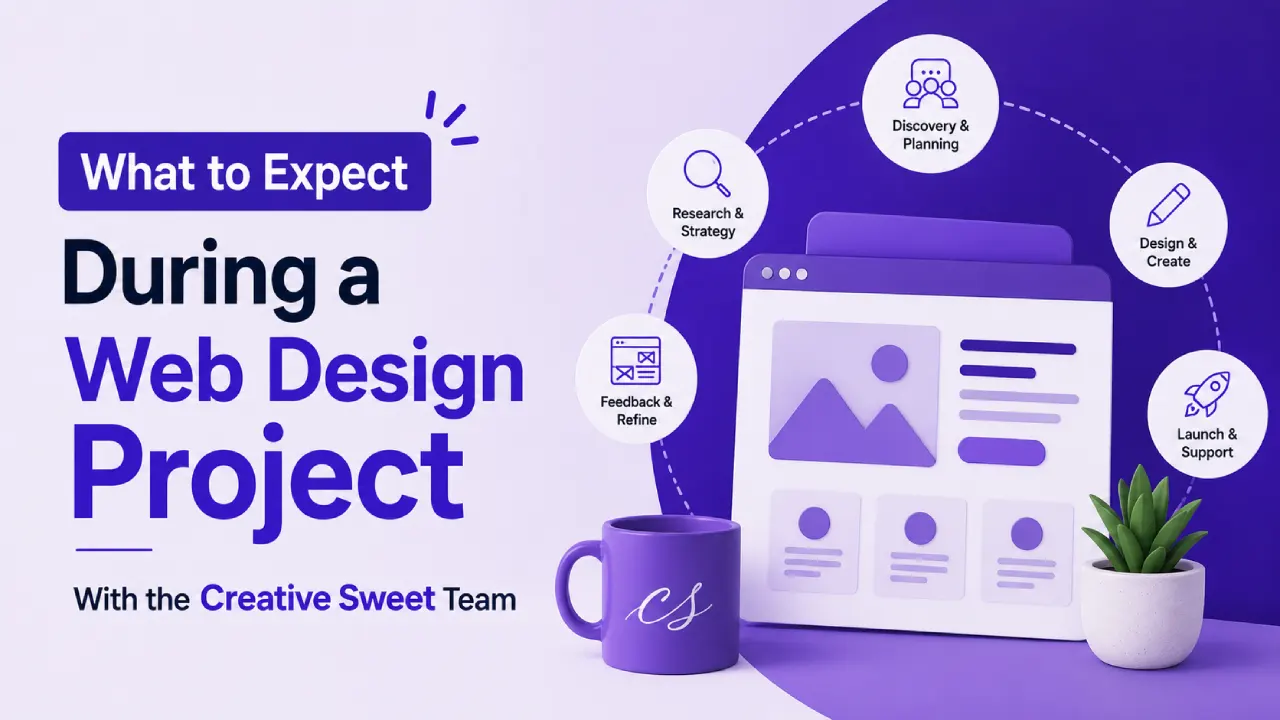
What to Expect During a Web Design Project With the Creative Sweet Team

Booking a web design project with anyone is a slightly nerve-racking thing. You are about to part with a meaningful chunk of money and trust a team you do not know all that well to do justice to the business you have built. We get it. The whole industry is full of agencies that promise the world in the sales call and then disappear into a black box for ten weeks until the launch reveal, which is a terrible way to do this work.
So we wrote this for the people thinking about working with us. Not the polished sales version. The actual one. What happens in the kick-off, what we will ask you for, what you will see and when, where the project usually gets sticky, and what landing day really looks like when nothing is on fire. If you have read agency process pages before and felt like you were being handed a brochure, this is the opposite of that.
Every project is its own thing and we shape the process to suit, but the shape below is roughly what most clients can expect from start to finish.
Stage One: Discovery, or Why We Talk Before We Design
Every project starts here, and we genuinely refuse to skip it. The discovery stage is the bit where we work out what we are really building, and just as importantly why. Most of the worst web design disasters we have seen across the industry got baked in at this point, before anybody had so much as opened a design tool.
The Kick-Off Conversation
First proper meeting is a conversation rather than a presentation. We want to understand the business in its own words. What you do, who buys from you, what makes a good client versus a painful one, where the current site is letting you down, and what would have to be true at the end of this project for it to feel like money well spent. Sometimes that takes an hour. Sometimes it takes three. Either is fine.
The Quiet Research Bit Most Agencies Skip
After the meeting, we spend a chunk of time just looking around quietly. We pull up your existing site if there is one and take it apart. We dig into the competitors you mentioned and a few you did not. We watch how your customers actually describe your sector in their own words when they are searching online. That research is what separates a site that looks lovely on launch day from one that genuinely performs over the next two years, because the design ends up grounded in how your audience really behaves instead of what we guessed about them in the kick-off.
What You Get at the End of Discovery
A proper written brief lands in your inbox before a single design choice gets made. Inside it sits everything we have agreed on so far: what the site is meant to do for the business, the audience it is being built for, what the structure looks like at a high level, and the scope of what is actually being built. Reading through that document and signing it off is one of the dullest-feeling moments of any project, and one of the most important. The catalogue of web project disasters we have watched over the years almost always traces back to a brief that nobody actually read carefully.
Stage Two: Design, or Where the Pixels Start Moving
Clients tend to be most excited about this stage, which makes sense. The ideas from discovery finally start showing up as something you can look at on a screen. Design also happens to be the most collaborative part of any project we run, because we share what we are doing as it develops, rather than vanishing for a fortnight and producing a big reveal at the end that nobody is allowed to change.
Wireframes Before Visuals
Almost every project we run starts with wireframes. These are stripped-back grey-box layouts that show where everything sits on a page, before anyone worries about how it looks. A few clients are surprised by this stage and would rather jump straight to colours and fonts. Honestly, do not. The whole reason wireframes exist is that they catch structural problems while a fix still takes an hour. Catch the same problem inside a polished, fully designed mockup and the fix becomes a week of rework.
Visual Design and First Reactions
With the structure signed off, the visual design phase begins. We will usually share a first design direction for the homepage, normally one or maybe two options, and then refine it from your feedback. Honest reactions are what we want at this point. The slowest possible route to a design you actually love is polite agreement on a Tuesday that turns into quiet doubt the following fortnight. If anything feels off, please say so right away.
How Many Rounds of Revisions to Expect
Most design phases land somewhere between two and three rounds of revisions before everyone is genuinely happy. When a project starts running through more rounds than that, it almost always points to a brief that drifted off-track somewhere earlier. Catching the drift and resetting the conversation tends to work out better for both sides than just grinding through another round of edits. The aim is to wrap design within three or four weeks of kick-off, though the actual pace ends up shaped by how quickly your side can review and respond.
Stage Three: Development, or Turning Design Into a Real Website
Once design is signed off, the build kicks in. Things go quieter from our end at this point, simply because the team is heads-down inside code rather than sharing daily files. You will still get regular updates, of course, but development genuinely benefits from focused stretches of work, where someone can spend three hours solving a problem properly. Constant check-ins tend to break that focus and slow the build down for everyone.
Building the Site Properly From the Foundations Up
We do not build on a free theme tarted up to look bespoke. Every Creative Sweet site sits on a foundation chosen to actually fit the project. Sometimes that is a WordPress build configured the way we know holds up over time. For clients who need something more bespoke, it might be a custom solution. When ecommerce sits at the heart of the brief, a platform like Shopify usually makes more sense. Those decisions all get made earlier in discovery, so by the time development starts, the team is putting the site together rather than still arguing about how it should be put together.
Where Performance and SEO Get Built In, Not Bolted On
Performance and search-friendly markup get baked into the build itself rather than sprinkled on at the end as an afterthought. A site that loads in under two seconds on a phone gets there through development decisions made early. Try to engineer that on launch day and you are in for a rough afternoon. The same goes for getting URL structures clean, heading hierarchy properly nested, images optimised before they slow anything down, and accessibility basics built in from the start. Handling that work during the build itself saves you a much more expensive retrofit a year down the line, by which point the site is already live and quietly underperforming.
Stage Four: Review, Where You See It All Come Together
Before launch, we hand you a staging link, which is a private working version of the site at its real URL, that only you and the team can see. This is your chance to walk through everything end to end and tell us what needs adjusting before it goes live.
What to Look for During Your Review
Our approach is to guide you through a structured review, instead of dropping the staging link in your inbox and crossing our fingers. The walkthrough means going page by page on a real phone as well as on a laptop. Every link gets clicked. Every form gets a test submission run through it. Every line of copy gets read with fresh eyes. Plenty of small issues slip through unnoticed when no one is checking systematically, so the whole point of this stage is making sure someone genuinely is.
The Honest Truth About Last-Minute Changes
A lot of last-minute changes are genuinely quick and we will happily absorb them at this stage. Other requests are trickier than they sound, especially something like rethinking the structure of a key page at the eleventh hour, which can quietly push the launch date back by a week or two. We will tell you straight up which category any given change falls into. Sorting that out together up front sidesteps the awkward “but I thought that was a small change” conversation that has derailed plenty of otherwise smooth launches.
Stage Five: Launch, Which Is Less Dramatic Than It Sounds
Launch day, when it goes the way it should, is genuinely the dullest day of the project. The site simply switches over from staging to your live URL, the DNS updates work their way through the internet, and within an hour or two the new website is what visitors are seeing. No drama, no firefighting, no late-night panics. That quietness is exactly what we are aiming for.
What Happens in the First 48 Hours
For the first day or two after launch, we keep a close eye on the site, on the lookout for anything that catches us off guard. Every page gets rechecked. Forms get real test submissions run through them to make sure leads actually arrive. Analytics gets a proper verification to confirm the tracking is firing the way it should be. Anything that looks unusual gets caught on our end before you ever notice.
Handover and What Comes Next
Within a few days of launch, we hand the site over properly. That includes a walkthrough of the CMS so you can update the things you need to update yourself, written documentation you can refer back to later, and a defined support window so you know exactly when our included support runs to. Clients who want ongoing care can move onto a maintenance package at that point. Plenty of clients prefer that, since websites genuinely benefit from regular attention rather than being left to drift.
How Long the Whole Thing Takes, Honestly
A typical Creative Sweet web design project runs eight to twelve weeks from kick-off through to launch. Smaller refresh projects, where we are working with an existing site rather than rebuilding from scratch, can complete in three to five weeks. Larger builds with ecommerce or significant custom functionality run longer, often twelve to sixteen weeks. The pace is largely set by how quickly the client side can review and approve work, which is the single biggest variable in every project we have ever run.
Why Clients Choose Creative Sweet for Their Web Design
We work with businesses right across Belfast and Northern Ireland, and the clients we tend to do our best work for are the ones who actively want to be involved as the project moves along, instead of being handed a finished thing they had no real input into. Discovery is important to us partly because it tends to be important to them too. Same with the honest design conversations along the way. Nobody wants to land at a website that they have quietly accepted while inwardly wishing certain things were different.
What you will not get from us is a black-box ten-week silence ending in a big launch reveal that nobody can actually change without writing another cheque. You get a team that genuinely shares its work as it develops. We take feedback on board properly when it arrives. And honestly, we treat your business like one we would quite like to still be working with three years from now, not just on this one project.
If you are thinking about a web design project and would like to know what it would actually look like for your specific business, get in touch at creativesweet.net or book a free discovery call. We will ask you the right questions during it. The answer you get back will be a realistic one, not an inflated quote dressed up as ambition. And honestly, we will only suggest a project if going ahead with one is the genuinely right thing for your business right now.
Frequently Asked Questions About Working With Creative Sweet on Web Design
How long does a web design project with Creative Sweet take?
A typical project runs eight to twelve weeks from kick-off through to launch. Smaller refresh jobs that work with an existing site can wrap up in three to five weeks. Larger builds, particularly those involving ecommerce or significant custom functionality, tend to run twelve to sixteen weeks, with the actual pace mainly driven by how quickly the client side can review and approve work along the way.
What happens in the discovery stage of a web design project?
Discovery is the foundation stage where we get to know the business properly, the audience it serves, the competitors it sits against, and what the website genuinely needs to achieve. There is usually a kick-off meeting, an audit of any existing site, some quiet audience research on our side, and then a written brief that informs every stage that comes after it.
How much input does the client provide during the design process?
Clients stay properly involved right the way through, and especially during discovery, the design review stage, and content sign-off. Work gets shared as it develops, rather than disappearing into a big launch reveal at the end. Feedback is gathered openly along the way, and the work gets refined based on what you actually tell us. The exact level of involvement gets shaped to fit each client. Most projects end up needing somewhere between fifteen and thirty hours of client time across the full run, though.
What happens after a Creative Sweet website launches?
Once the site is live, we hand it over properly. That handover comes with a walkthrough of the CMS so you can confidently make the kinds of updates you want to handle yourself, along with written documentation to refer back to whenever something slips your memory. There is also a defined support window for any post-launch issues that crop up. Beyond that window, clients who would rather have continuing care can move onto an ongoing maintenance package, where updates and ongoing improvements keep rolling forward over time.
Can I see examples of web design work from Creative Sweet?
Yes, of course. We have a portfolio of recent web design projects across Belfast, Northern Ireland, and the UK that we are happy to share. Get in touch at creativesweet.net to see relevant case studies and have an honest chat about what a project for your specific business would actually look like in practice.


Keep reading

- SEO
Right now, somebody two streets away from your gym is opening Google and typing “gym...
- Web Design
Every business owner hits this fork in the road sooner or later. The website that...

- Google Ads
A half-empty class is one of the most frustrating things in the yoga business. The...