- Web Design
Website Refresh vs Redesign: What’s Right for Your Brand?

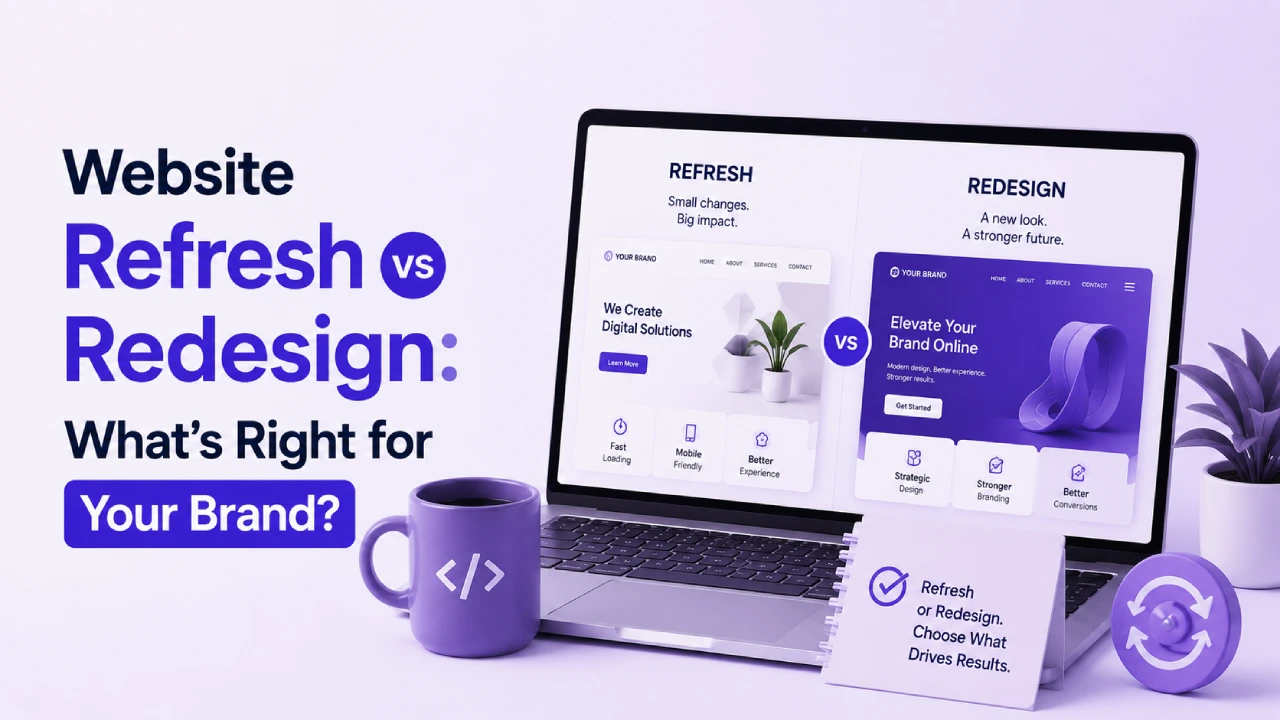
Every business owner hits this fork in the road sooner or later. The website that felt sharp three years back has quietly started to look its age. The colours feel dated now. There was always something a bit off about how it behaved on a phone, you just never had time to deal with it. And then somebody mentions in passing that it loads slowly, and that one little comment is the moment you cannot unhear it. The question lands not long after. Tidy this up, or scrap it and begin again?
That one question can turn into a surprisingly tense board meeting, because the gap between a refresh and a full redesign is the gap between a couple of grand and ten times that. Mistakes here cut both ways. Pay for a rebuild when a refresh would have done the job and you have just torched budget that should have gone into ads. Cheap out on a refresh when the site genuinely needed gutting and rebuilding, and what you have actually done is renovate a house with a cracked foundation. The visible problem comes back within a year, dressed up in a fresh coat of paint.
This is a guide to working out which side of that fork you should actually be standing on. We will get into what each option really means in practice, what they cost, how long they take, and the signs that point you towards one or the other.
What a Refresh Actually Means
There is a lot of fuzzy use of the word “refresh” in the web design world, and it pays to be precise about what we mean. A refresh keeps the bones of your site intact and works on the surface. The structure stays. The pages mostly stay. The platform you are on, whether that is WordPress or Squarespace or Shopify, almost certainly stays. What changes is the look and the feel.
What Changes in a Refresh, in Plain Terms
A proper refresh updates the visual layer of the site, which usually means new colour scheme, new typography, refreshed photography, tidied-up layouts, and a general modernising of how things look. The copy might get an editorial polish where it has aged poorly. Buttons might be redrawn. Hero sections might get a rework. By the end, the site looks noticeably more current, but if you peek at the underlying structure it is recognisably the same website it was before.
What Stays the Same
The pieces that stay are the ones that take real time and money to change. Your information architecture, meaning how your pages are organised and linked together, does not get rethought. The technical platform stays put, so you are not migrating to anything new. Your domain, your hosting, your SEO history, all untouched. That continuity is the whole reason a refresh costs what it costs and ships when it does.
What a Full Redesign Means (and Why It Costs So Much More)
A redesign is a different animal entirely. This is the option where you treat the existing site as a starting point for thinking, not something to preserve. Everything is on the table, including the things you have got used to over the years that maybe never really worked.
Where Redesigns Take Time and Budget
A real redesign starts before any pretty visuals appear, with strategy work. Who is the site really for? What needs to change about how visitors move through it? Which pages are pulling their weight and which have been quietly dragging the whole thing down? From there comes the structural work, where information architecture is rebuilt, copy is rewritten properly rather than touched up, and the technical platform may well change to whatever fits better. Only then do you get to design, build, test, and launch.
That is why a redesign takes eight to twelve weeks for a small business site and costs several times what a refresh does. You are not just changing how the site looks. You are rebuilding what it does and how it does it.
Why Bolting On Is Not Always Cheaper Long Term
Some owners try to redesign in pieces, adding a new page here, a new feature there, hoping to avoid the bigger spend. It is an understandable instinct and occasionally it works. More often it ends up costing more than a clean redesign would have done, because each new addition has to wrestle with old structure and old code that never anticipated it. After a couple of years of bolt-ons, the site is a patchwork that is harder to maintain than the rebuild you were trying to avoid.
The Honest Cost and Timeline Comparison
Numbers help here, so let us get specific about money. The ranges below shift around depending on who is quoting and how complicated the build is, but they are roughly what a UK small or medium business should expect to see on the proposals it receives.
What a Refresh Typically Costs and How Long It Takes
For a typical small business already running a functional site, a refresh tends to land somewhere between £1,000 and £3,000, depending on how much scope creeps into the project. Three to five weeks from sign-off to launch is the usual window. Most of those weeks are spent on design choices and content updates. Actual development hours are small, because the underlying build is staying put. When this kind of project goes well, the result is a site that no longer feels three years old, but everything that was quietly working before the refresh is still working after it.
What a Redesign Typically Costs and How Long It Takes
A full redesign for that same small business typically opens around £4,000 to £6,000 for a basic build and climbs from there. Where it climbs to depends on how complex the build is, how many pages need designing, and how much strategy work is built into the front of the project. Larger sites that include ecommerce or any meaningful custom functionality can move into five-figure territory without anyone trying particularly hard. Eight to twelve weeks is a sensible timeline to plan for. Anyone telling you they can compress a proper redesign into a fortnight is either cutting corners you will pay for later, or doing something other than a real redesign.
The Cost Most People Forget to Factor In
Whichever route you go down, the cost most owners forget is their own time. Every project of this kind needs the brand owner inside it, weighing in on decisions, giving feedback on proofs, signing things off, and sometimes writing the copy nobody else can really write. A refresh will probably eat ten or fifteen hours of your own time over its run. For a full redesign, you are looking at three or four times that figure, simply because there are more decisions to actually make. Build that into how you choose, because the single biggest reason these projects drag is a busy owner who genuinely has not had a free hour to look at what the designer sent over.
When a Refresh Is the Right Choice
There is a fairly clear list of conditions under which a refresh is the smart move, and another list pointing towards a full rebuild. Let us start with the refresh side, because it is the cheaper option and most businesses lean towards it by default.
Your Site Works, It Just Looks Tired
The single best reason to choose a refresh is that the site is functionally sound. It loads reasonably quickly, works on a phone, is easy enough to update, generates a steady trickle of enquiries, and accurately describes what you do. The only real issue is that the visual design has not aged well and is starting to undercut the credibility of the business. A refresh fixes the credibility problem without touching the things that are quietly working.
You Have Limited Budget and Time
Pragmatism counts. If the budget for this year is two grand and you need the site looking presentable for a campaign in six weeks, a refresh is the option that exists for you. A redesign you cannot afford or cannot wait for is not really an option at all. Better to refresh well than to half-redesign and run out of road.
Your Brand Has Evolved But Not Transformed
Sometimes the brand itself has shifted a little. Perhaps the colour palette has moved on, the logo got a quiet tweak last year, and the tone of voice has sharpened up since the founder stopped writing all the copy personally. None of which means the business has actually changed. You serve the same people, doing more or less the same thing, you just present yourself slightly differently now. A refresh is the easy way to bring the website into line with where the brand has drifted to, without rebuilding everything that already worked underneath.
When You Genuinely Need a Full Redesign
The other side of the fence. There are situations where pouring money into a refresh is the wrong call, and the only honest advice is to bite the bullet on a proper rebuild.
The Site Is Built on Something That Cannot Be Saved
Some platforms have aged into corners that are simply not worth painting. Picture a site running on a discontinued builder that no longer gets security patches. Or a custom CMS built by a developer who left five years ago and that nobody at the new agency can confidently make sense of. Or a WordPress install so badly out of date that hitting the update button would knock half the pages offline. In any of those cases, what you are calling a refresh is really just propping up something that has reached the end of its useful life. A rebuild on a modern platform is the genuine answer, even though the cheque is bigger.
The Business Has Changed Direction
Maybe you used to be a single-service consultancy and now you offer six things. Maybe you pivoted to a different market entirely. When the business the site describes is not really the business you are running anymore, no amount of new fonts will fix that gap. The information architecture itself needs rethinking, which is redesign territory by definition.
Performance and Conversion Are Genuinely Broken
When the site is slow to load on a decent connection, awkward to navigate even for people who know it, falls apart on a phone, and is not pulling in the enquiries it ought to be, you are not looking at a surface problem anymore. The issues sit in the structure of the thing. A refresh that paints over those problems without ever touching them will just put fresher-looking lipstick on the same broken site. It is almost always the redesign, the unpleasant-sounding one, that actually shifts the conversion rate where the previous version refused to budge.
How to Choose When You Are Still Not Sure
There are plenty of cases where the answer is honestly not obvious, and that is fine. When you find yourself stuck between the two options, a few specific questions tend to clear the air pretty quickly.
Three Questions That Cut Through the Indecision
Start with this one: if a complete stranger landed on your current site tomorrow, would they get what you actually do and find the way to enquire without thinking about it? A confident yes leans you towards a refresh. Hesitation, or a no, leans the other way. Then there is the question of the site’s technical innards. Would they embarrass a competent developer asked to work on them? If the honest answer is yes, that is a redesign signal. And the last one is about the business itself. Has it shifted noticeably since the site was last built, in what you sell, who you sell to, or how you go to market? Two yeses out of those three almost always means a rebuild is the right call.
How Creative Sweet Helps Businesses Choose the Right Path
We work with businesses across Belfast and Northern Ireland on both refreshes and full redesigns, and to be candid, we have talked plenty of clients out of redesigns they did not actually need. Selling somebody a £6,000 rebuild when a £2,000 refresh would have got them where they wanted to go is bad business for everyone involved. The client overpays, the agency builds a reputation it will eventually regret, and nobody really wins. Being straight about that earns trust that turns out to be worth a lot more than any single bigger invoice would be.
Every project we take on starts with a proper honest look at the existing site, where it needs to get to, and whether the distance between those two places is really a surface-level problem or a structural one. The recommendation then drops out of the answer, instead of being squeezed to fit whichever service we would rather sell. Sometimes a refresh is the right call and that is what we recommend. Sometimes only a redesign will really shift things, and then that is what we recommend instead.
If your website has reached the point where you know something has to give, but you are not sure how far to go, that is exactly the conversation worth having. Get in touch at creativesweet.net or book a free discovery call, and we will take an honest look at what you have got and tell you which path makes sense.
Frequently Asked Questions About Website Refresh and Redesign
What is the difference between a website refresh and a redesign?
A refresh updates how the existing site looks, while leaving its underlying structure and most of its content and code in place. A redesign goes deeper than that, rebuilding the site from the foundations up. That usually means a new information architecture, pages written from scratch rather than touched up, and sometimes a completely different technical platform underneath the whole thing. Refresh is the faster, cheaper option of the two. Redesign tends to deliver change that genuinely lasts longer than the next style trend.
How much does a website refresh cost compared to a redesign?
For a small business, a typical refresh comes in between £1,000 and £3,000 and is usually finished inside a few weeks. The redesign side is a different conversation. Most full redesigns begin somewhere around £4,000 to £6,000 for a basic build and rise considerably from there once the site grows in size or complexity. Eight to twelve weeks is the realistic timeline to plan for if you go down that route.
When should I choose a website refresh instead of a redesign?
A refresh is the right call when the site you have already does most of its job well. It loads quickly enough, brings enquiries through the door, and reads correctly on a phone, but the visual design has slipped into looking dated. If the foundations underneath are sound and the only real issue is how the whole thing looks on screen, a refresh delivers what you need without the cost of starting again from a blank page.
What are the signs my business needs a full website redesign?
There are a handful of giveaways. The site might be slow to load on a normal connection. It might be painful to update without breaking something. Maybe it falls apart on a phone, or it sits on a stack of outdated technology that nobody wants to touch. Sometimes the simplest sign is that the site no longer accurately describes what the business actually does anymore. If the brand has shifted significantly since the build, or the site has simply stopped generating enquiries the way it used to, a redesign is usually the answer worth biting the bullet on, rather than yet another round of patches.
Can Creative Sweet help me decide between a refresh and a redesign?
Yes. Creative Sweet works with businesses right across Belfast and Northern Ireland on web design, and that includes the upfront honest audits that help owners work out whether a refresh is enough or a full redesign is genuinely what their goals and budget call for. Get in touch at creativesweet.net to walk through what your current site is doing and what would actually move it forward from here.


Keep reading
- Web Design
Booking a web design project with anyone is a slightly nerve-racking thing. You are about...

- SEO
Right now, somebody two streets away from your gym is opening Google and typing “gym...

- Google Ads
A half-empty class is one of the most frustrating things in the yoga business. The...