- AI, WordPress
AI Agents for Ecommerce: How to Build an Automated Customer Service System That Converts

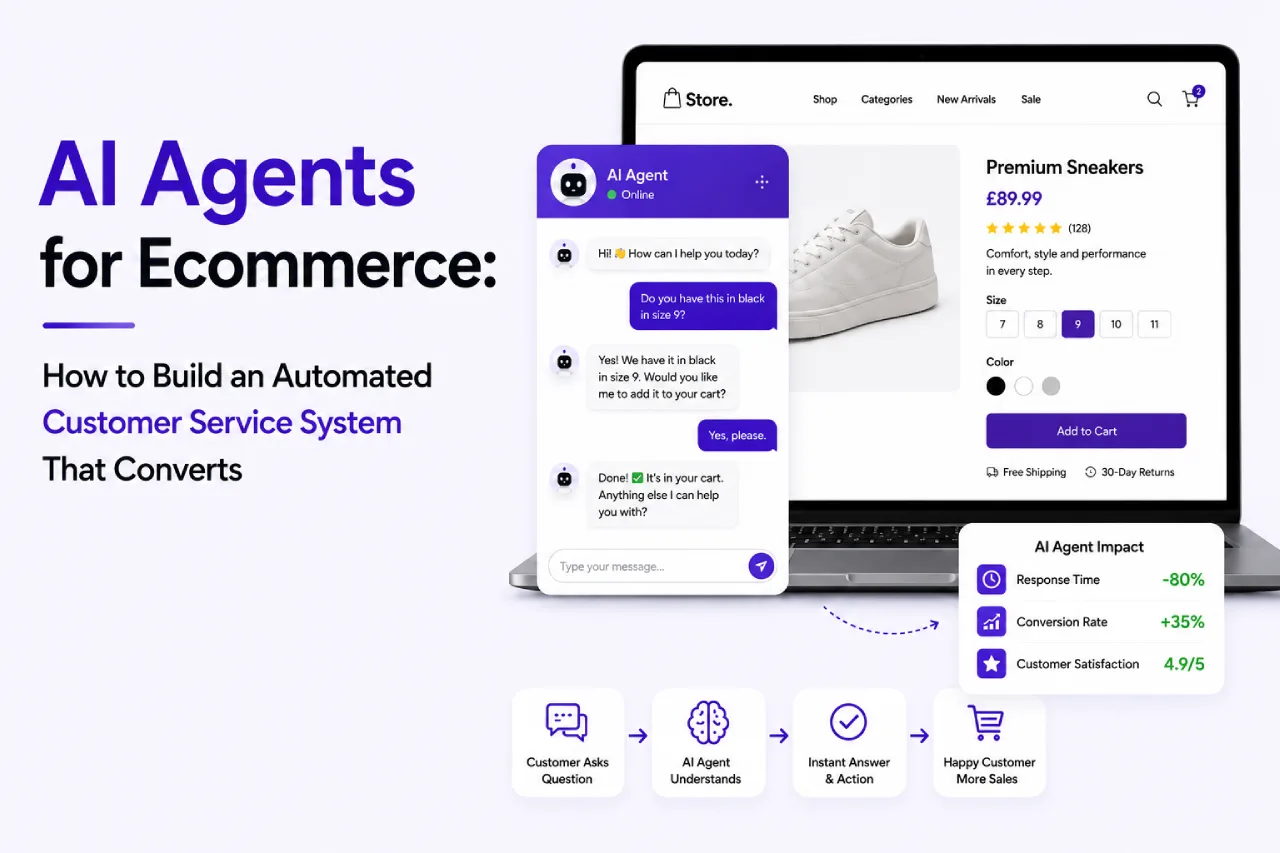
Ecommerce customer service has quietly become one of the biggest cost centres for growing online stores in recent years. The enquiries come in at all hours of the day and night, and honestly most of them boil down to the same handful of questions repeated in different words each time. A customer wants to know where their order actually is. Another asks whether you ship to Ireland yet, or if the blue version of a product is genuinely coming back in stock, or whether they can return the item they bought two weeks ago. Every single one of those messages costs real money to answer, and the total volume scales alarmingly the moment the store starts genuinely growing.
AI agents have finally reached the point where they can properly handle the bulk of this without embarrassing your brand. Not the clunky chatbots of five years ago that pattern-matched keywords into wrong answers. Actual agents that understand context, check real order status, and know when to hand off to a human. Ecommerce businesses building these systems properly in 2026 are quietly running customer service operations at a fraction of the historic cost, with genuinely higher customer satisfaction scores than the manual approach delivered.
What follows walks through how to actually build one of these systems for a real ecommerce business, written for owners rather than for developers. It covers what the agent should be handling on your behalf. It also gets into where a proper handoff should happen, what the whole thing costs to run in practice, and how to avoid the specific mistakes that quietly turn AI customer service from an asset into an active liability for the business.
What AI Agents Actually Are, Beyond the Marketing Language
Every software vendor is calling their product an AI agent right now, which has made the term nearly meaningless. Some quick disambiguation is worth doing before spending any money.
The Difference Between Old Chatbots and Modern Agents
Old-style chatbots followed decision trees. If the customer typed keyword A, the bot returned response B. Anything that fell outside the pre-programmed tree hit a dead end, which is why interacting with those systems felt like arguing with a filing cabinet. Modern AI agents work in a fundamentally different way. They use large language models to actually understand what the customer is asking in plain language. From there, they check live data pulled from your business systems, and then generate a genuine response for the customer, instead of picking a pre-written line from a list somewhere. The gap between those two categories of tool is honestly enormous once you see it in practice.
What “Agent” Actually Means in Practice
The word agent implies the tool can take action, not just answer questions. A properly built ecommerce agent looks up the actual order status from your fulfilment system, initiates a refund if the customer qualifies, updates the shipping address on an unshipped order, or reorders a subscription product on the customer’s request. This ability to actually do things is what separates useful agents from expensive chat widgets.
Where AI Agents Genuinely Win for Ecommerce
Not every customer service task genuinely benefits equally from being automated. The specific areas where AI agents actually shine in ecommerce are worth being clear about up front, because aiming the tool at the wrong problems tends to produce genuinely disappointing results for everyone involved.
Order Status and Shipping Enquiries
This is genuinely the highest-value use case for most ecommerce stores, because it also happens to be the highest-volume question type. Something like sixty percent of typical customer messages boil down to “where is my order” in various forms. Where an AI agent has been properly connected to your fulfilment platform, it answers questions like this in seconds using real live tracking data. The customer walks away happier as a result than they would have been if left waiting two hours for a human to eventually say the exact same thing.
Product Questions Before the Sale
The other genuinely valuable use case sits before the purchase rather than after. A shopper on a product page has questions the product description does not quite answer. Does this fit an average adult. Is it dishwasher safe. Will it arrive before Saturday. Getting those specific questions answered in the moment is genuinely what separates a real conversion from an abandoned cart later that day. An AI agent that has been trained properly on your catalogue handles this kind of pre-sale question instantly, and the resulting lift on your conversion rate ends up meaningfully bigger than most store owners tend to expect going in.
The Hidden Conversion Lift Nobody Talks About
Ecommerce stores adding a properly built AI agent to their product pages tend to see conversion rates lift by somewhere between five and fifteen percent, depending on the category. That lift comes almost entirely from answering questions that would otherwise have gone unanswered while the shopper closed the tab. Recovering even a fraction of those lost conversions genuinely pays for the whole system many times over across a year.
Returns and Refunds Where the Rules Are Clear
If your return policy is simple and consistent, an agent can handle most refund requests entirely without human involvement. Verify the order date. Check whether the item qualifies. Generate the return label. All of that flows automatically for the common cases, freeing humans to focus on the awkward edge cases where judgement actually matters.
Where Automation Should Explicitly Stop
Knowing where AI genuinely helps only really matters if you are equally clear on where it should not be used at all. Ecommerce businesses pushing automation too far tend to damage their brand reputation faster than the underlying cost savings can ever justify. Drawing the right line between the two categories is honestly a real skill.
Emotionally Loaded Complaints Need Humans
When a customer lands in the chat feeling frustrated at something the business did, or upset about a delivery going wrong, or genuinely angry about a whole situation, an AI response is honestly almost always going to make the situation worse. The customer at that moment wants to feel heard by a real person. An obviously automated reply signals exactly the opposite of that to them. Building your escalation logic so any emotional language triggers an immediate handoff to a human is genuinely one of the most important design decisions in the entire system.
Anything Legal, Compliance, or Sensitive
Some categories should really never touch the AI at all. Payment disputes are one of them, alongside chargebacks and anything hinting at possible fraud coming from either side of the transaction. Product safety concerns fall in the same bucket. Situations like these carry real legal weight, along with reputational risk that no AI agent should be handling autonomously, however capable the underlying model happens to be. Route them all straight to a human every single time.
The Uncertainty Threshold Matters Too
A properly built agent knows when it is not confident about the right answer. When confidence drops below a set threshold, the agent should hand off to a human rather than guessing. Getting this threshold right is honestly the difference between an agent that quietly helps and one that occasionally embarrasses you.
How to Actually Build an AI Customer Service System
The abstract stuff out of the way, the practical build process is more manageable than most business owners expect. It genuinely does not require a data science team or a six-figure budget.
Step One: Audit What You Actually Answer Today
Pull three months of customer service history and categorise the messages. Most stores end up discovering that somewhere around seventy or eighty percent of their total customer service volume falls into just five or six recurring question types. That kind of distribution tells you exactly what the AI genuinely needs to handle brilliantly at launch. It also gives you a real baseline for measuring later whether the finished system is actually working the way it should be.
Step Two: Pick a Platform That Actually Integrates With Your Stack
Native integration honestly matters more than raw capability at this stage of the build. An AI platform carrying a first-party Shopify or WooCommerce app saves you weeks of custom development work compared to bolting something on through generic APIs. Worth taking a look at a few options. Intercom Fin is one, and Zendesk AI sits in the same category. Gorgias is specifically strong for Shopify stores, alongside more specialised platforms such as Ada. Every option carries its own trade-offs, and the right choice for you really depends on your existing stack more than which vendor happens to look nicest in the demo video.
Why Shopify Owners Have More Options
Because Shopify is a closed ecosystem, most modern AI platforms have built dedicated integrations for it. Order lookups, refund workflows, and product recommendations all work out of the box on Shopify stores. WooCommerce integrations tend to require slightly more custom work, though the flexibility on offer once you have that setup running is genuinely broader.
Step Three: Train the Agent on Your Actual Business
This is where most implementations either succeed or fail. Generic training produces generic responses that read as obviously robotic. Loading your specific product catalogue into the agent is where the real personalisation starts. From there, layering on your return policies, along with shipping information and the brand voice guidelines your business already uses, is what actually creates responses that sound like your particular business rather than a generic template. Spending an extra week getting this piece of the work right at setup honestly ends up saving months of quiet embarrassment down the line.
Step Four: Test With Real Scenarios Before Launch
Run at least a week of realistic customer conversations through the agent internally before letting a real customer near it. Feed it awkward questions. Try edge cases. Ask it something it should not know. Every wrong answer surfaced during testing is one that never reaches an actual customer, and this stage tends to reveal exactly where the training gaps sit.
The Realistic Cost of Running an AI Customer Service System
Cost is honestly one of the areas where most business owners either wildly overestimate the figure, or equally wildly underestimate it going in. The realistic numbers for a moderate-volume ecommerce store in 2026 are worth being properly honest about. Setup fees usually land somewhere in the £1,500 to £5,000 bracket, depending on how complex the integration is and how bespoke the initial training needs to be. Monthly running costs typically sit around £100 to £300 for stores handling low-to-moderate conversation volume, scaling upward from there as usage grows. That monthly figure covers a few things at once. The platform licence itself is one part. The underlying model costs sit inside it, alongside the ongoing tweaks based on how real customer conversations are actually flowing through the system.
For any store already spending £2,000 or more each month on human customer service, the payback period on a proper AI system usually lands somewhere inside the first quarter of running it. Everything after that point is essentially straight upside for the business.
How Creative Sweet Builds AI Agents for Ecommerce
We build AI agent solutions for ecommerce businesses across Belfast and Northern Ireland, and the work we do sits genuinely at the intersection of our ecommerce and AI chatbot specialisms. Every build starts with an audit of the store’s actual customer service load, because pointing the agent at the wrong problems produces disappointing results however good the underlying technology happens to be.
Our approach with ecommerce specifically leans heavily on native platform integration. For Shopify clients that usually means dedicated apps talking to the store’s internal APIs. For WooCommerce clients the integration work is more bespoke, though the resulting system tends to be more flexible in exchange. Either way the goal is the same. An agent that actually knows your business, handles the boring stuff invisibly well, and hands off gracefully whenever a human touch is what the situation really needs.
If your ecommerce store is drowning in repetitive customer service messages, or you have never really committed to automation properly and want that to change, the conversation is worth having. Get in touch at creativesweet.net or book a free discovery call. We will take an honest look at your current customer service load and let you know exactly what a properly built AI system could realistically deliver for your business.
Frequently Asked Questions About AI Agents for Ecommerce
What is an AI agent for ecommerce?
An AI agent for ecommerce is essentially a conversational tool that handles customer questions on your behalf. The scope covers order enquiries, alongside product recommendations and the routine support tasks that fill your inbox all day. Modern AI agents genuinely understand natural language, and they integrate directly into your ecommerce platform. That combination lets the tool check real order status against your fulfilment system, alongside processing simple returns and answering product questions in the moment, with no human involvement needed in any of it.
How much does an AI customer service system cost for ecommerce?
AI customer service systems for ecommerce typically start in the £100 to £300 per month range for setups handling moderate conversation volume. Setup fees somewhere between £1,500 and £5,000 usually cover the integration work along with the initial training pass. The exact figure you end up paying comes down to how deep the integration needs to go, how much conversation volume flows through the system, and whether your escalation logic sits at the sophisticated end of the spectrum.
Will an AI agent hurt my customer relationships?
Not when the system has been implemented properly. A well-built AI agent handles routine enquiries genuinely faster than any human ever could. When something sensitive comes up, that same agent knows to escalate it straight to a real person. Most ecommerce customers actually prefer fast automated answers on the simple questions like tracking, provided the agent knows exactly when to hand off to a human.
Does an AI agent work with both Shopify and WooCommerce?
Yes. Modern AI agent platforms integrate with both Shopify and WooCommerce, either through native connectors or through more standard APIs. On the Shopify side, integrations tend to be smoother in practice, because of the closed platform ecosystem sitting behind the store. WooCommerce leans the other way, offering deeper customisation across the board, which suits stores carrying more unique setups underneath.
Can Creative Sweet build an AI customer service system for my store?
Yes. Creative Sweet builds AI agent solutions for ecommerce businesses right across Belfast and Northern Ireland, integrated with your existing store platform and business processes. Get in touch at creativesweet.net to discuss what your business currently needs.


Keep reading
- SEO
Somebody in Belfast wakes up on a Tuesday morning with lower back pain that has...
- WordPress
This post is general educational guidance for SME website owners and does not constitute legal...

- Business, SEO
Your Google Business Profile is honestly the highest-leverage marketing asset most SMEs already own, and...