- Development, Web Design
Shopify vs WooCommerce in 2026: Which Platform Is Right for Your Northern Ireland Business?

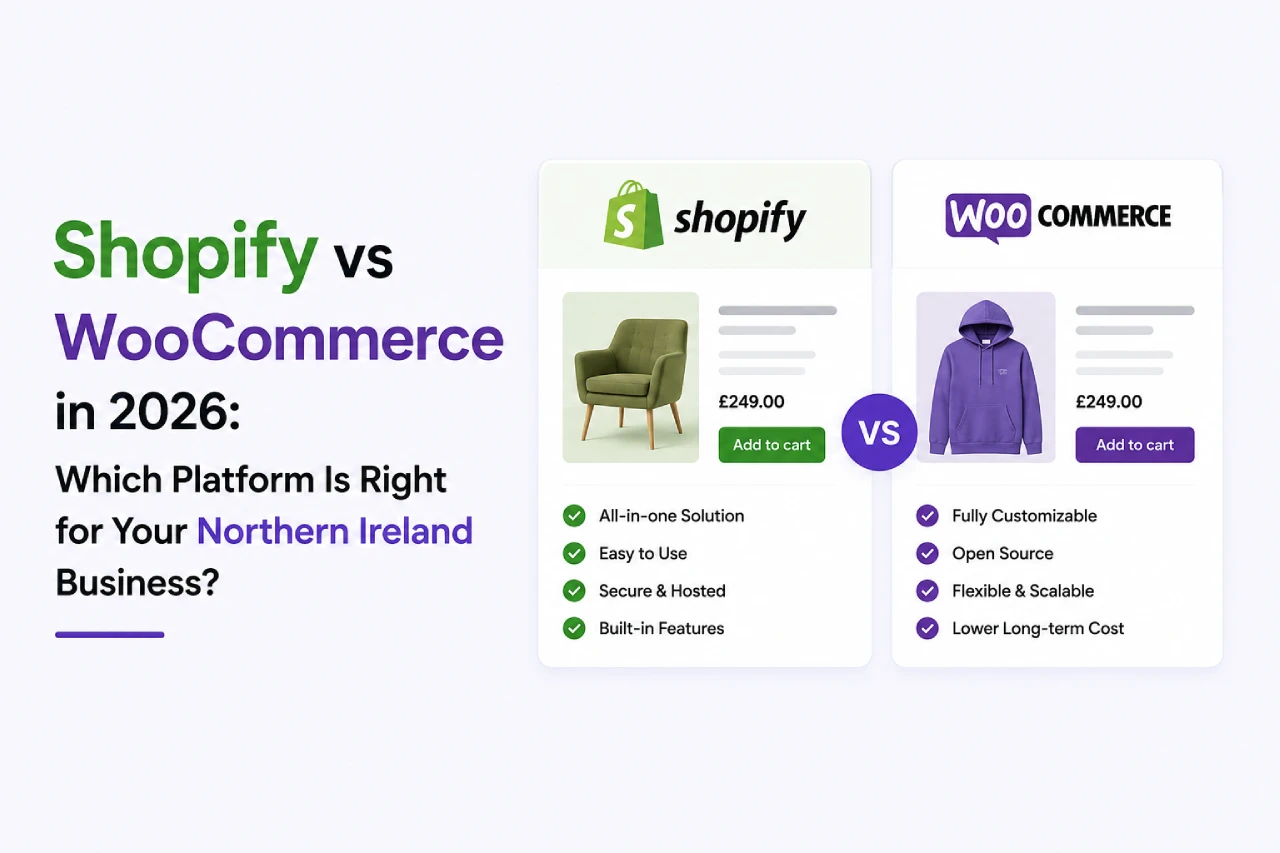
Anyone launching or replatforming an ecommerce business in Northern Ireland tends to arrive at the same underlying question somewhere along the way. Shopify or WooCommerce, which should we actually pick. Both platforms are excellent in different ways, and both attract obsessive fans who will happily explain to you why the other option is quietly wrong for your business. The honest answer is genuinely different for different businesses, and that reality is what the noise around this decision so often ends up obscuring.
At Creative Sweet we build ecommerce sites on both platforms, and we have watched enough businesses make good and bad decisions in each direction to have a fairly clear view on when each one fits. What follows is a proper walkthrough of the actual differences that matter in 2026, written for business owners rather than developers, ending with a genuine answer on which one is likely right for your specific situation.
The Fundamental Difference Between the Two Platforms
Before getting into features or pricing tables, it genuinely helps to be clear about what each platform actually is at the fundamental level. A lot of the downstream trade-offs really just flow out of this one core distinction.
What Shopify Really Is
Shopify is a fully hosted platform, and that framing matters. What the company handles on your behalf is genuinely wide-ranging. The hosting servers your store actually runs on sit under their control. So do the security patches keeping the store safe from attacks, along with all the software updates happening behind the scenes and the infrastructure work that keeps things online when you catch a proper sales spike. You pay a monthly subscription, and Shopify handles all of it in return. The trade you make in exchange is that you get genuine simplicity, at the cost of losing some flexibility over how the underlying setup works.
What WooCommerce Actually Is
WooCommerce is not really a standalone platform in the same sense as Shopify. It is a free open-source plugin that installs on top of your own WordPress website, and doing so transforms that site into a working ecommerce store. Because the whole thing sits on your own hosting infrastructure under your own control, you keep complete flexibility over how every piece of the setup works. The trade you make in return is that responsibility shifts back onto you for the hosting side, the security work, ongoing updates, and the general upkeep that Shopify would otherwise have been handling quietly behind the curtain.
Where Shopify Genuinely Wins
There are clear scenarios where Shopify is the honest right answer for a Northern Ireland business, and pretending otherwise just wastes the client’s time.
When Speed to Market Genuinely Matters
A Shopify store can go from empty account to live selling in a matter of days if the person setting it up moves quickly. Themes install cleanly. Payment processing is essentially plug-and-play. There is no separate hosting decision to work through. For businesses trying to get selling before Christmas, or launching a seasonal product, or testing whether an idea will actually get traction at all, that speed advantage genuinely matters.
When You Do Not Want to Think About Technical Maintenance
This is honestly the underrated benefit of the whole Shopify proposition. Plenty of ecommerce owners really do not want to spend their evenings worrying about whether a plugin update just broke their checkout at 2am on a Saturday. Shopify essentially removes that entire category of anxiety by handling all the infrastructure themselves in the background. For any business owner who would rather spend their brain cycles on marketing or product decisions than on quiet server administration, this benefit tends to be worth more than the platform price difference in most real-world cases.
The Hidden Cost Saving of Managed Infrastructure
One thing that quietly gets missed inside the pricing comparison is what your own time is genuinely worth as the business owner. A WooCommerce store running on cheaper hosting will honestly eat somewhere in the region of two to four hours out of your month keeping it healthy, and considerably more than that whenever something actually breaks. That specific time cost more or less disappears on a Shopify store, because Shopify is doing the work in the background. Once you plug a realistic hourly rate for yourself into the calculation, the apparent pricing gap between the two platforms narrows quite a bit, and in some cases closes up entirely.
When Your Selling Strategy Leans Heavily on Third-Party Tools
Shopify has genuinely become the default ecommerce platform under the hood for most modern retail tools. Take a look at what your marketing strategy involves. If you are planning to sell through TikTok Shop, that is a Shopify-first integration. Same story for running Meta Ads with proper catalog integration behind them, or leaning on Klaviyo to handle email marketing, or working with any of the modern retail services in that space. Shopify tends to have a first-party integration ready to go. WooCommerce usually reaches the same destination in the end, though it often takes an extra plugin, some more configuration, and sometimes a developer to bridge whatever gap remains.
Where WooCommerce Genuinely Wins
There are also equally clear situations where WooCommerce turns out to be the genuinely right platform choice. This tends to be true particularly for businesses whose priorities happen to point away from the specific trade-offs Shopify has decided to make.
When SEO and Content Marketing Sit at the Heart of the Strategy
This is honestly the single biggest reason serious ecommerce businesses still opt for WooCommerce over Shopify in 2026. Because WooCommerce is built on WordPress underneath, you effectively inherit the deepest content management system in existence, along with essentially every SEO tool ever built for WordPress over the years. That translates into properly deep URL control, alongside full schema markup flexibility, plus a blog architecture that genuinely competes on organic search. For businesses whose growth plan leans heavily on ranking well in Google, rather than pouring cash into paid advertising, the resulting technical advantage compounds pretty significantly across the years.
When You Need Genuine Customisation
WooCommerce sites really can be built to do almost anything you can think of, because you have full access to the underlying code. Say you need a bespoke checkout flow that does something specific to your business. Or a properly complex product configurator with dynamic options. Or unusual pricing rules that a standard platform cannot easily accommodate, alongside membership tiers running quietly beside the store, or a custom integration hooking into your existing back-office system. Every one of these is genuinely doable inside WooCommerce, whereas on Shopify these things tend to end up somewhere between fiddly and expensive to build, and occasionally just outright impossible without jumping to the highest-tier plan.
The Transaction Fee Consideration
A quiet but genuine advantage of WooCommerce is that you own the store outright, which means no ongoing platform fees taking a percentage of your sales beyond the standard payment processing costs. On Shopify, using anything other than Shopify Payments means additional transaction fees on every sale. For a store doing serious volume, this cost adds up meaningfully over the course of a year.
When You Already Run WordPress
Where your business already has a WordPress website ranking well, and that site represents years of accumulated SEO equity built up piece by piece, adding WooCommerce into that same install lets you build the store as an organic extension of what already exists. Starting fresh on a new domain would throw all of that equity away. The SEO advantages of keeping the whole operation on a single domain are honestly often significant, particularly for businesses whose blog or wider content library is already pulling meaningful traffic to the site.
The Real Cost Comparison for Northern Ireland Businesses
This is the bit most comparisons handle badly, because the true cost of either platform depends heavily on choices made along the way.
What Shopify Actually Costs to Run in 2026
Shopify Basic sits at around £25 per month at the time of writing. From there, the standard Shopify plan lands closer to £65 per month, and Advanced comes in around the £300 per month mark. A few things sit on top of that base subscription cost. There are transaction fees to consider unless you happen to be using Shopify Payments, alongside the cost of any paid apps you install for extra functionality, and theme costs if you decide to go beyond the free options. All in, a realistic monthly figure for a growing Northern Ireland Shopify store tends to land somewhere in the £80 to £200 bracket for most cases.
What WooCommerce Actually Costs to Run
The WooCommerce plugin itself costs nothing, but the real costs live elsewhere in the stack. Getting properly managed WordPress hosting appropriate for an ecommerce store tends to run between £25 and £80 per month, depending on your traffic volume. A quality theme lands somewhere between £60 and £250 as a one-off cost, and the essential plugins covering payment processing, along with security and backups, add another £15 to £40 per month across the stack. Your total realistic running cost broadly ends up matching a comparable Shopify store, in that same £80 to £200 monthly range, though the balance between one-off and ongoing spend is genuinely different.
Where the Cost Story Diverges
The two platforms end up diverging on cost mostly at the extremes rather than in the middle. Take a very small store just testing whether an idea works. That kind of setup can technically run WooCommerce cheaper than Shopify by cutting some corners on the hosting side. Once you get up to a very large store operating at real scale, the picture flips. Shopify Plus economics often work out better than trying to keep scaling WooCommerce infrastructure up to match. In the middle ground where most Northern Ireland ecommerce actually sits, the total cost of ownership is honestly close enough that the platform decision really needs to be made on other factors instead.
How to Actually Decide Which Platform Fits Your Business
The honest answer to which platform fits your business tends to become fairly obvious once you actually work through a handful of specific questions about your own situation, rather than trying to reason it out from generic comparison content.
Start with speed to market. Are you actively trying to get this launched inside a single month, or building steadily for the long term. Then move to technical control. Does your product need something reasonably standard, or something genuinely unusual behind the scenes. Consider how much organic search performance really matters inside your growth plan compared to your paid channels, along with how much time and inclination you personally have for the ongoing technical maintenance side of things. When the answers point overwhelmingly toward simplicity and speed, Shopify tends to be the honest recommendation. If instead they point toward SEO depth, deep customisation, or already having an existing WordPress footprint, WooCommerce is where the actual value ends up sitting.
How Creative Sweet Helps Northern Ireland Businesses Choose and Build
We build ecommerce sites on both Shopify and WooCommerce over here at Creative Sweet, and we honestly do not carry a preference for either platform outside of whichever one actually fits the specific client sitting in front of us. The very first conversation on any ecommerce project is really about properly understanding the business itself first, because that platform decision genuinely needs to happen before anything gets chosen or built. Talking any client into whichever platform we would rather build on would be doing them a real disservice.
Where clients care most about speed to launch, or where the ongoing technical maintenance side is genuinely unwelcome for them, we tend to recommend Shopify and build it properly for them. Other clients arrive with serious ambitions on the organic search side, or complex product setups, or existing WordPress infrastructure that is worth building onto rather than replacing. In those cases WooCommerce is usually the honest recommendation, and we build those well too. Where the answer sits genuinely in the middle between the two platforms, we say so out loud and help the client work through the trade-offs honestly.
If you have a new ecommerce build coming up, or you are replatforming from something that quietly stopped working for you, the platform choice is genuinely worth getting right at the start rather than discovering later that it does not fit properly. Get in touch at creativesweet.net or book in a free discovery call. We can take an honest look at your business, and give you a straight recommendation on which platform actually fits your specific situation best.
Frequently Asked Questions About Shopify vs WooCommerce
What is the difference between Shopify and WooCommerce?
Shopify is a fully hosted ecommerce platform, meaning the platform provider handles all the hosting infrastructure on your behalf, along with the security work and general upkeep for a set monthly fee. WooCommerce sits at essentially the opposite end of that spectrum. It comes as a free open-source plugin that runs on top of your own WordPress site, and that gives you full control over the underlying setup. In exchange you pick up responsibility for arranging your own hosting and handling the maintenance side of things.
Which is cheaper, Shopify or WooCommerce?
WooCommerce genuinely carries a lower entry cost, since the plugin itself is completely free. That said, the true monthly cost ends up depending heavily on your hosting choice, alongside your theme, the plugins you install, and the payment processing setup you pick. Shopify typically starts around the £25 per month mark at the Basic tier, and scales upward from there through the higher plans. Once you factor in all of the realistic running costs on either side of the comparison, WooCommerce actually ends up matching Shopify pricing pretty closely for most stores.
Which platform is better for SEO?
WooCommerce generally offers more SEO flexibility, mostly because it runs on WordPress underneath as the base layer. That gives you deeper control across a few things at once. URL structures on the site is one. Schema implementation is another, alongside overall content architecture and the more technical optimisation work SEO consultants tend to want access to. Shopify does handle the SEO basics well right out of the box, though it constrains the advanced SEO work in ways that genuinely start mattering once you get into competitive niches.
Can I switch between Shopify and WooCommerce later?
Yes, though platform migrations are honestly non-trivial to run in either direction. What they typically involve is rebuilding certain parts of the store from scratch, on top of importing product and customer data across cleanly, and then preserving whatever SEO equity has been built up by putting proper redirects in place at go-live. Most Northern Ireland ecommerce businesses end up budgeting somewhere between £4,000 and £12,000 for a properly handled platform migration.
Can Creative Sweet help me choose and build the right ecommerce platform?
Yes. Creative Sweet works with ecommerce businesses right across Belfast and Northern Ireland on both Shopify and WooCommerce builds, and we help clients pick the right platform for their specific business before any development actually starts. Get in touch at creativesweet.net to discuss what your business needs.


Keep reading

- SEO
Somebody in Belfast wakes up on a Tuesday morning with lower back pain that has...

- WordPress
This post is general educational guidance for SME website owners and does not constitute legal...

- Business, SEO
Your Google Business Profile is honestly the highest-leverage marketing asset most SMEs already own, and...