

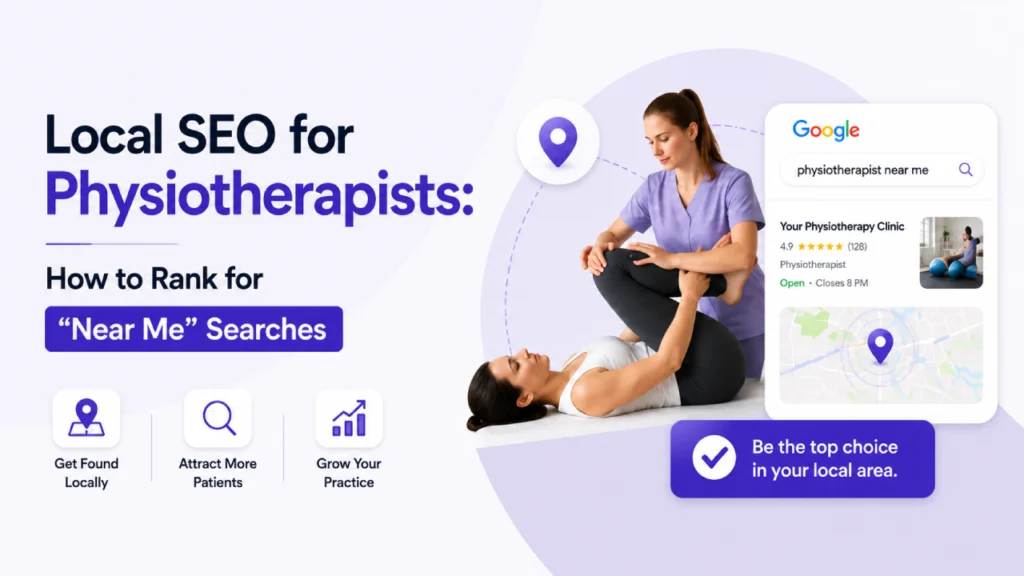
Picture a Sunday evening. Somebody has just woken from an awkward nap with a properly stiff neck and the dread of the working week creeping in. They are sore. There is a thread of anxiety underneath the soreness, the way pain you cannot explain always carries one. Within about ninety seconds they have decided they want to see a physio this week, and the first move is reaching for the phone and typing “physio near me”. Whichever three clinics come up at the top are basically the shortlist. The rest of the local physiotherapy market may as well not even exist.
Now think about whether your clinic is reliably one of those three. If the honest answer is no, or you are not even sure, this post is for you. Near me searches have become the front door for most new physiotherapy patients, and the clinics being chosen are very often the ones doing better SEO rather than the ones offering better treatment.
What follows is a practical walkthrough of how to fix that. Not theory. The things that actually move clinics into the local map pack and keep them there, written for clinic owners who already know how to treat a frozen shoulder and would now quite like Google to start sending them more of them.
Why Local SEO Is the Single Biggest Lever for a Physio Clinic
A physiotherapy clinic is about as local as a business gets. Nobody is driving forty minutes for their second appointment on a tight hamstring. Patient catchment for most clinics sits inside a fifteen-minute drive, which means visibility within that fifteen-minute radius is genuinely the whole game. Local SEO is the lever that controls it.
How Patients Actually Find Physios Now
Once upon a time the path was a GP referral. Now it is a phone. Patients who would have patiently waited a week for a GP slot now pick up Google the moment the pain gets in the way of their day, and they expect to be in a clinic within a few days at most. The clinic that wins their booking is whichever one turns up first, looks credible at a glance, and can squeeze them in early enough that the pain has not already started easing on its own. None of which involves them ever having heard of your clinic before that one search.
The Map Pack Is Where Local Healthcare Searches End
Run a local physio search on your phone right now. Before any websites show up, Google displays a map with three pinned clinics, complete with ratings and a call button. That trio is the map pack, and it scoops up the lion’s share of taps for any near me search. A clinic outside that map pack is competing for the leftovers on the page below, and those leftovers get a tiny fraction of the attention.
Why Most Physiotherapy Clinics Are Quietly Missing Out
Here is the slightly uncomfortable truth from doing local SEO audits across the healthcare sector. Almost every physiotherapy clinic we look at has the same handful of gaps. The Google Business Profile was claimed once and never properly finished. Old directory listings are floating around with slightly wrong information. Patient reviews have gone quiet since the launch push two years ago.
Half-Finished Profiles Are the Norm, Not the Exception
A surprising number of clinic owners genuinely believe their profile is sorted because they claimed it back in 2023. Look at it now and there are four photos from the launch event, opening hours that have not been updated since a timetable change last winter, and a primary category set to something vague like “Health”. Google reads all of that as evidence the clinic might not even be active anymore, and quietly pushes more current-looking competitors above it in the rankings.
The Quiet Drag of Inconsistent Information
Most clinics have ended up listed somewhere they have forgotten about. There might be an old Yell page from when the clinic first opened, plus a health directory a previous receptionist signed up to, plus a listing on the website of a sports club the clinic once sponsored. The trouble starts when the business name or the phone number sitting on any of those listings has drifted from what is on the live website. Google then gets handed conflicting information about who you actually are. Nothing visible happens at this point, no error message and no warning email. The clinic just slides down the local rankings while everyone at reception scratches their heads wondering why enquiries have dipped.
How Google Picks the Three Clinics for the Map Pack
Before getting into specific fixes, it is worth pulling back the curtain on what Google is actually weighing every time a patient runs one of these searches. There is genuinely less mystery to it than people assume. Once the inner workings make sense, a lot of the practical local SEO advice you have read elsewhere suddenly fits together properly instead of feeling like a checklist of unconnected jobs.
Relevance, Proximity, and Prominence
Three factors get weighed against each other every single time somebody runs a search. Relevance is whether your profile genuinely matches what the patient was looking for. Then there is proximity, which is just the physical distance between your clinic and whoever is searching, and that one is mostly out of your hands. Prominence is the broader trust signal Google takes from your overall online presence. It pulls in your review activity, your citations across the web, the links pointing at your site, and how consistent your business details look wherever they appear. Proximity is locked in for any given search. The other two are very much yours to work on, and most clinics have not even properly started.
Why the Closest Clinic Does Not Always Win
There is a reassuring myth among clinic owners that whoever is physically closest to the searcher always takes the top spot. It just does not hold up in practice. Plenty of clinics get pushed out of the map pack in their own postcode by a competitor a few streets further away whose profile happens to look more credible. Given the choice, Google will show a patient a slightly less convenient clinic with two hundred fresh reviews and a complete profile over a closer one whose listing looks abandoned. That gap is exactly where a well-run clinic can outrank rivals who happen to be nearer.
What Actually Moves the Needle for Physio Near Me Rankings
None of this is glamorous, and none of it is a clever growth hack. The work that gets physiotherapy clinics into the map pack is the work most of their competitors have not bothered to do properly. Doing it consistently is the entire competitive advantage.
Finish the Google Business Profile Properly
Open the profile and approach it the way you would set one up for the first time, even if it was claimed years ago. Start with the address and phone number, which need to match what is written on your website right down to the punctuation. Your primary category needs to sit at “Physiotherapist” or “Physical therapist”, not anything woollier that leaves Google guessing about what kind of business you are. Opening hours have to reflect what is actually true today, including any festive or bank-holiday closures that are coming up. And before you close out of the profile, get the launch-day photos out of there. Replace them with recent shots of the clinic itself, plus the treatment rooms, plus the team. None of this work is glamorous in the slightest. It just happens to unblock more local rankings than any clever tactic you could pay for.
Build Pages Around the Conditions Patients Actually Search
Patients hardly ever search for “physiotherapy” by name. What they search for is whatever is hurting them at that moment. The clinic that ends up winning the booking is the one with dedicated, properly written pages for the specific conditions it treats most often, written in plain English for somebody in pain rather than in clinical language fit for peer review. So sciatica earns its own page. The same goes for lower back pain, for post-operative knee rehab, and for plantar fasciitis. Every page pulls traffic from people typing those specific terms into Google, and the cumulative effect is a clinic that quietly racks up rankings for dozens of high-intent searches that a single tidy services page would never touch.
What a Good Physio Condition Page Includes
A condition page rises in the rankings because it is genuinely useful to a patient, and stuffing it with keywords does the opposite of that. The voice to aim for is the one you would naturally use to explain something across the desk to a nervous patient who has just been frightened by something they read online. Cover what the condition really is, in plain language. Talk through how your clinic assesses it. Give them a realistic picture of what treatment involves and roughly how long recovery typically takes. And handle the questions every patient asks before they have built up the courage to actually ask them. Google has become impressively good at recognising real, lived expertise, and it tends to push that kind of writing up the rankings.
Build Real Patient Review Momentum
Reviews work much better when you treat them as a quiet weekly habit, instead of running them as a one-off campaign every couple of years. The easiest version of the habit is a brief text message that goes out the day after a patient has had their first session. Something warm that thanks them and slips in a direct link straight to your Google review page. Run that little message consistently and it turns into a steady drip of fresh reviews coming in. That is the exact rhythm Google reads as evidence of a clinic that is currently active and trusted. Patients who genuinely benefited from their first session are usually more than happy to write a few lines, as long as you have not made them go hunting around for where to do it.
Why Review Velocity Beats Review Volume
A clinic with seventy reviews where the most recent was eight months ago looks dormant to Google compared with a clinic on thirty reviews getting one or two new ones every fortnight. Recency carries real weight. A consistent trickle of new reviews tells Google the clinic is active and currently trusted, which is a stronger signal than a one-off pile from a launch push two years back. Most clinics think they have done their reviews. What they have actually done is one campaign, then nothing.
Clean Up Your Citations and Local Listings
Search your clinic name on Google and see what comes up beyond your own website. There will almost certainly be old listings sitting on directories you had forgotten existed, with slightly outdated information on them. Going through and updating those, so your business name, address, and phone number read identically wherever they appear, removes the conflicting signals quietly suppressing your rankings. Dull, important work that almost always pays off.
How Creative Sweet Helps Physio Clinics Get Found Locally
We work with physiotherapy and healthcare businesses across Belfast and Northern Ireland, and the same pattern shows up nearly every time. The clinical team is genuinely excellent. Patients who do find the clinic become loyal regulars. The problem is that not enough patients are finding the clinic in the first place, because the local SEO foundations have never been completed properly.
Closing that gap is the work. That usually means getting the Google Business Profile properly finished and actively maintained, building condition pages around the searches real patients use, setting up a patient review process that produces fresh reviews every week, and cleaning up the citation mess that almost every long-running clinic has quietly accumulated. The unglamorous foundational stuff. The kind of work that pulls a clinic into the map pack and keeps it there.
If your clinic is treating fewer new patients than its reputation deserves, the bottleneck is almost always visibility, not the quality of the work happening inside the treatment rooms. The fix is rarely as dramatic as it sounds. Get in touch at creativesweet.net or book in a free discovery call. We will take a properly honest look at why your clinic is currently invisible in local search, and walk you through what could realistically shift that within the next few months.
Frequently Asked Questions About Local SEO for Physiotherapists
How do I get my physiotherapy clinic to show up in near me searches?
It starts with getting your Google Business Profile properly optimised, then keeping your local citations consistent across the web, building a steady habit of patient reviews, and adding pages to your website around the conditions your clinic actually treats. Most physiotherapy clinics miss out simply because none of the basics have been finished properly, which is exactly why the opportunity is so big for the ones that decide to.
What keywords matter most for physiotherapy local SEO?
Patients search by whatever is hurting them, not by the profession itself, so the keywords that move the needle the most pair a specific condition with the local area. Things like “sciatica physio Belfast” tend to perform brilliantly. So does a search like “sports injury physiotherapist near me”, or “knee pain treatment Belfast”. Those phrases are where real patient intent lives, because they are the exact words people type once they have got their phone out and are genuinely ready to book a session.
Do patient reviews really affect physiotherapy clinic rankings?
Yes, considerably. The number of reviews matters. Your average star rating matters too. And in some ways the most important factor of all is how recently new reviews have actually been landing. A physiotherapy clinic that is getting fresh reviews every couple of weeks will tend to rank above one sitting on the same star average but older reviews, because Google reads steady ongoing review activity as a sign the clinic is currently active and currently trusted by the people walking through its doors.
How long does local SEO take to work for a physiotherapy clinic?
Most physiotherapy clinics start seeing early local visibility improvements within three to four months, usually off the back of the Google Business Profile work being done properly and the first condition pages going live. Stronger rankings in more competitive parts of a town can take six months or longer to come through fully. The useful thing about local SEO is that it compounds. Clinics that stay consistent with the work tend to see the gains keep building over time, instead of plateauing the way some marketing channels do.
Can Creative Sweet help my physiotherapy clinic rank locally?
Yes. Creative Sweet works with physiotherapy and healthcare businesses across Belfast and Northern Ireland on local SEO, Google Business Profile optimisation, condition-based content, and patient review systems. Get in touch at creativesweet.net to talk through what your clinic needs to be found by the patients already searching for help.