

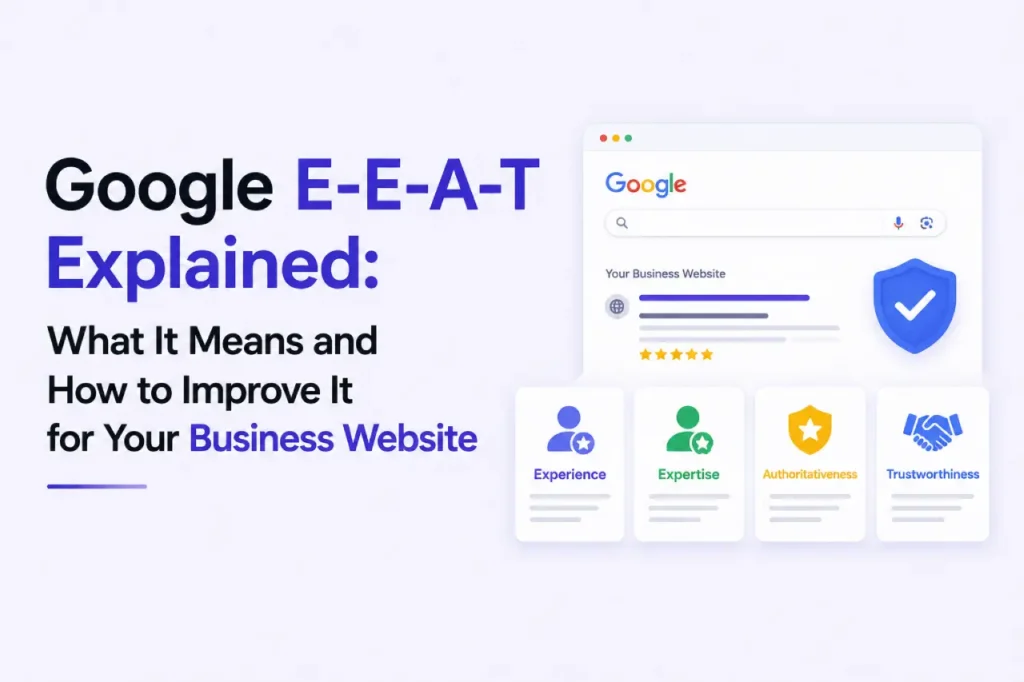
If you have spent much time reading about SEO over the past couple of years, chances are you will have run into E-E-A-T somewhere along the way. It tends to get treated like insider knowledge across a lot of blog posts, and it gets buried under a wall of jargon that makes the whole idea sound more complicated than it really is. The reality of E-E-A-T is actually pretty useful. It is essentially Google’s way of asking a fairly straightforward question about your website, and the moment you understand what question Google is really asking, improving your answer to it turns into a genuinely practical piece of work rather than staying as some abstract SEO puzzle in your head.
For SME owners across Belfast and beyond, taking the time to understand E-E-A-T properly is worth doing because it quietly decides whether Google trusts your site enough to rank it well. Two websites can cover identical topics and end up sitting at completely different positions in the results, and the invisible difference that determines which one wins is almost always sitting somewhere inside E-E-A-T. That is what this post gets into, without the jargon layer.
What E-E-A-T Actually Means
E-E-A-T is Google’s shorthand for four specific qualities it wants to see on any website before ranking that site highly in the results. Each of the four letters carries its own slightly different meaning behind it, and Google looks at all four together instead of judging any single one in isolation. Getting a handle on what sits behind each individual letter is where the practical improvement work actually starts.
The First E: Experience
The first E stands for Experience, and it was added to the framework relatively recently. Google added this letter specifically to reward content written by somebody who has actually done the thing being written about, rather than content written by somebody who has only read about it. A gym owner writing about running a gym has experience. A freelance writer paid to research and write about running a gym does not. Google is genuinely getting better at telling the difference.
The Second E: Expertise
Expertise is about formal knowledge in the topic being covered. Where Experience asks whether you have lived it, Expertise asks whether you actually know what you are talking about at a deeper level. A physiotherapist writing about back pain brings expertise. Somebody without medical training writing the same article does not, no matter how well-researched the piece happens to be. Both experience and expertise matter, and the strongest content tends to have both sitting behind it.
The A: Authoritativeness
Authoritativeness is about how the wider web treats your business as a source. If other trusted websites link to yours, mention you by name, or cite your work in their own content, that builds authoritativeness in Google’s eyes. It is essentially reputation, seen through the specific lens of what other credible sources say about you. This is the letter that tends to take longest to build, because it depends on external recognition rather than internal effort.
The T: Trustworthiness
Trustworthiness is arguably the most important of the four letters, and Google itself has publicly said as much on record. It covers whether visitors and search engines can honestly trust the information your website is putting out. A few different things end up feeding into trustworthiness. Accurate content sits near the top of that list. Honest claims are another piece, alongside clear ownership of the business, secure hosting on the technical side, and transparent contact details throughout the site. Get any one of those wrong and the whole trustworthiness picture starts to slip.
Why Google Cares About E-E-A-T So Much
Google’s whole business runs on giving people trustworthy answers to their questions. Every low-quality result that manages to rank on page one damages that trust slightly, and the collective effect of enough poor results over time would send users elsewhere. E-E-A-T is essentially the framework Google uses to protect its own product by ensuring the sites it recommends are actually worth recommending.
YMYL Topics and Why They Matter More
There is a specific category of content that Google labels YMYL, which is short for Your Money or Your Life. It covers topics where wrong information could genuinely damage somebody in real ways. So anything touching on somebody’s health falls in here. Financial decisions too, along with legal matters, personal safety questions, and any major life choices where bad information could cause real harm. Google applies E-E-A-T standards particularly strictly against YMYL content. If your business sits inside one of these categories, particularly if you are in healthcare, or finance, or legal services, then meeting E-E-A-T standards becomes something closer to table stakes for ranking at all, not an optional optimisation on top.
How to Actually Improve E-E-A-T on Your Website
This is where most explanations of E-E-A-T stop being useful. The theory is fine, but SME owners want to know what to actually do on their websites tomorrow. The practical work breaks down into a few connected areas, and none of it requires specialist SEO knowledge to get right.
Write Proper Author Bios for Everyone Producing Content
If your website runs a blog, every post ought to carry a proper byline that links through to a genuine author bio page. That bio needs to establish the person as a real human with relevant background sitting behind their name, rather than existing as an italicised name at the top of an article that leads nowhere. Include a decent photo of the person. Their credentials should be listed clearly on the page. Years of experience in the field matter, and any external evidence of their work is worth including too, such as speaking events they have run or professional memberships they hold. Google reads this kind of author-level information as one of the single clearest signals of Experience alongside Expertise on any site.
Sort Out Your About Page Properly
The About page on most business websites is honestly weak. What typically shows up on it is some stock photography off the shelf, followed by a paragraph of corporate-sounding copy that could apply to any business, and nothing on the page would actually help a visitor or Google conclude that the business behind it is real. Rewriting your About page properly to cover who actually owns the business, going into when it was founded and where it operates from today, along with what qualifications sit behind the team and how any visitor can go and verify all of that independently, ends up making a bigger E-E-A-T difference than most of the tweaks in the standard SEO handbook.
The Overlooked Value of a Real Address and Phone Number
A surprising number of business websites out there quietly bury the address and phone number away, or default to using a contact form as the only real route through to the business. From an E-E-A-T angle, this is genuinely bad. Showing a physical address visibly on the site matters. A working phone number people can dial is another piece of it, and having a real email address available on top of those two collectively tells Google the business actually exists in the physical world and holds itself accountable to the customers it serves. Businesses hiding this kind of information tend to rank lower for reasons the owners themselves never quite work out.
Build Trust Signals Visibly Into the Site
Various trust signals across the site quietly reinforce trustworthiness in aggregate. Real testimonials from named clients count for a lot. Case studies with actual measurable outcomes attached to them do the same, and so do professional accreditations displayed openly. Media mentions add to the picture, along with any relevant industry certifications and awards worth showing off. The key with all of these is putting them somewhere visible across the site itself, instead of tucking them away on a hidden page nobody clicks. Client-facing pages benefit the most from having these trust signals sitting nearby, because those pages are where the actual trust decision by a visitor tends to happen.
Publish Content That Actually Reflects Experience
The single strongest E-E-A-T move for most SME websites is publishing content that only somebody actually working in the industry could have written. Case studies drawn from real client projects. Blog posts examining specific mistakes you have watched other businesses make. Practical guidance based on what you have personally learned across years of doing the work. Content of this kind reads completely differently to generic industry writing, and Google is remarkably good at spotting the difference now.
The E-E-A-T Signals That Take Longest to Build
Some of what improves E-E-A-T happens quickly on your own website. Some of it takes longer because it depends on external recognition, and shortcutting that side rarely ends well. Backlinks from other credible sites in your industry are the classic example. So are mentions in reputable publications, or having your work cited by other businesses. None of that arrives overnight, and any agency promising to shortcut it with paid link schemes is almost certainly setting you up for a Google penalty.
The healthier long-term approach is genuinely a slower one. It involves producing content that is actually worth other people citing. Being generous with your expertise in local business communities matters alongside that, and from there the trick is really just letting your reputation build the way any reputation naturally builds over time. A local business that is genuinely known for being helpful and knowledgeable ends up getting mentioned across all kinds of places over the years, and the E-E-A-T benefits tend to follow that reputation rather than driving it.
Why E-E-A-T Matters Even More in the Age of AI Search
AI search engines rely heavily on the exact signals E-E-A-T captures when they are working out which businesses to actually cite inside a generated answer. ChatGPT does this, Perplexity does the same thing, and Google’s own AI Overviews are doing it now too. When somebody asks ChatGPT for a physiotherapist recommendation in Belfast, the AI is not really choosing at random. It is pulling on signals of trust from across the web, alongside signals of expertise and authority, and the businesses actually winning citations are the ones whose E-E-A-T story has been quietly built up properly over years.
This shift is honestly one of the more important things happening across SEO right now. Improving E-E-A-T does not just lift your traditional Google rankings anymore. It is increasingly the thing that decides whether your business gets to show up at all inside the AI-generated summaries that more people are relying on with each passing month. Businesses treating E-E-A-T seriously in 2026 are quietly laying the visibility foundations for what search will look like across the next five years.
How Creative Sweet Helps Businesses Build E-E-A-T
We work with SME clients across Belfast and Northern Ireland on the practical work of building E-E-A-T into their websites properly. The starting point is usually a proper audit of where the site currently sits against each of the four letters, because you cannot improve what you have not properly measured. Most sites we look at have obvious gaps in one or two areas and are quietly strong in the others.
From there the actual work varies quite a bit depending on the business in question. Existing content often needs proper author bios written and attached to it. About pages generally want rebuilding around real information, whereas trust signals sitting on the site tend to need surfacing back up from wherever they got quietly buried. Content strategy meanwhile typically needs a shift toward pieces that only your team could genuinely have written. Nothing about any of this is glamorous work, but the compounding effect on rankings across six to twelve months tends to end up significant.
If your business site is not ranking quite as well as the quality of the actual business deserves, an E-E-A-T gap is honestly one of the most common underlying reasons behind that mismatch. Get in touch at creativesweet.net or book in a free discovery call. We can take an honest look at where your site currently sits against each of the four letters, and give you a straight answer on what would realistically move the needle fastest for your business.
Frequently Asked Questions About Google E-E-A-T
What does E-E-A-T stand for in Google SEO?
E-E-A-T stands for Experience, Expertise, Authoritativeness, and Trustworthiness. This is the framework Google uses to work out whether a website actually deserves to rank for particular topics. The E-E-A-T concept appears throughout the Google search quality guidelines, which are the documents used to train the underlying algorithm on what genuinely good content looks like.
Is E-E-A-T a direct Google ranking factor?
E-E-A-T is not really a direct ranking factor in the sense of carrying a specific score against it. That said, it heavily influences how the algorithm actually evaluates content quality across the board. Google uses various signals that map back to E-E-A-T when it is deciding which sites deserve to rank at all. This becomes particularly pronounced on topics affecting somebody’s health, or their financial decisions, or their personal safety, since accuracy is the thing that matters most on those subjects.
How can a small business improve its E-E-A-T?
A small business improves its E-E-A-T through a handful of connected pieces of work sitting alongside each other. Detailed author bios are usually the starting point on that list, followed by properly rebuilt about pages. From there you are looking at real client testimonials on the site, evidence of relevant qualifications sitting on show, an active habit of generating fresh reviews, backlinks earned from trusted local sources over time, and consistent updates being made to the existing content across the site. Small businesses actually tend to improve their E-E-A-T faster than large brands can, mostly because they can move quickly on this kind of thing.
Does E-E-A-T matter for AI search engines like ChatGPT?
Yes, absolutely. AI search engines lean pretty heavily on the same underlying trust signals that shape E-E-A-T when they are deciding which businesses to cite in the generated answers they hand back to users. That means improving E-E-A-T lifts your traditional Google rankings alongside your AI search visibility at the same time, which is exactly why the framework carries more practical weight in 2026 than it has done in previous years.
Can Creative Sweet help improve E-E-A-T on my website?
Yes. Creative Sweet works with businesses across Belfast and Northern Ireland on the practical work of building E-E-A-T into a website, covering everything from author bios and about pages through to structured data and trust signal audits. Get in touch at creativesweet.net to discuss what your site currently needs.