
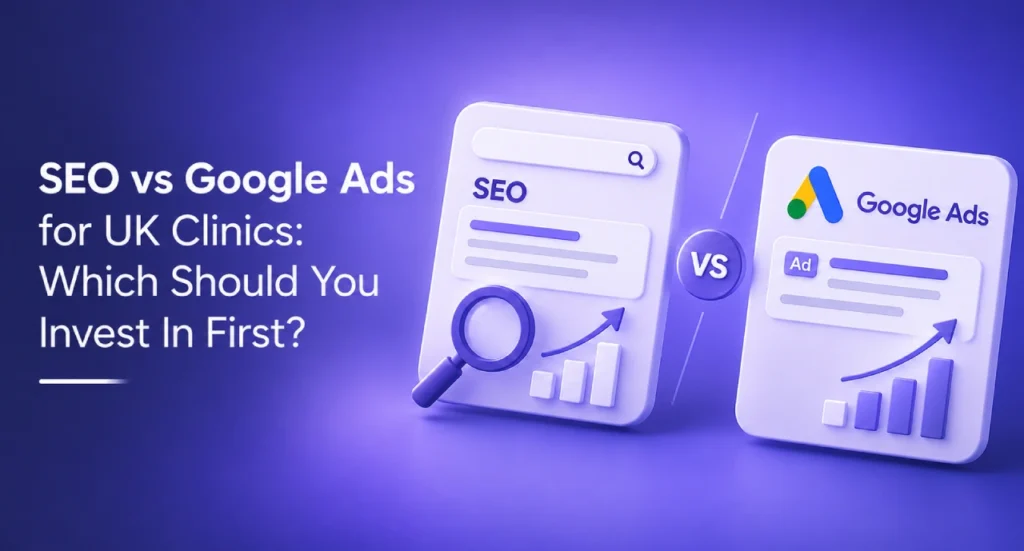
Most UK clinics should start with Google Ads if they need bookings within weeks, have a limited budget to test with, or operate in a market with strong existing search demand. SEO tends to make more sense first when a clinic already has reasonable organic visibility, isn’t under immediate pressure to fill the diary, and can invest consistently over six months or more. Neither answer holds in every case, and the right starting point depends on urgency, budget, competition and how the clinic’s website is performing today.
This isn’t a case for picking a side. SEO and Google Ads solve different problems, and most established clinics end up using both. The question worth answering first is which one addresses what’s actually holding the clinic back right now.
UK Clinic Decision Framework: SEO, Google Ads, or Both?
Use this table as a starting point, then check it against the reasoning in the sections that follow.
| Clinic Situation | SEO | Google Ads | Recommended First Step |
|---|---|---|---|
| Needs bookings quickly | No | Yes | Google Ads |
| Limited budget | Depends | Depends | Whichever fits the budget without spreading it too thin |
| Brand-new website | No | Yes | Google Ads while the site builds authority |
| Strong website, poor rankings | Yes | Depends | SEO, since the groundwork is already there |
| Highly competitive city | Depends | Yes | Google Ads, with SEO started in parallel |
| High-value treatments | Yes | Yes | Both, with careful budget split |
| Established clinic | Yes | Depends | SEO for compounding value, Ads for gaps |
| Wants long-term acquisition | Yes | No | SEO as the primary long-term investment |
Our UK Clinic Channel Selection Framework
This isn’t a generic rule of thumb. It comes down to eight factors that genuinely change the answer for a specific clinic, and the list below walks through each one. Weigh them against each other and a clearer picture usually emerges.
- Urgency: an empty diary next month points toward Google Ads. A twelve-month growth plan points toward SEO.
- Budget: SEO needs sustained monthly investment before it produces much. A smaller, flexible budget can still generate enquiries through Google Ads almost immediately.
- Competition: in a market with many established competitors, ranking organically can take considerably longer than winning visibility through paid search.
- Search demand: if very few people search for a clinic’s core treatments locally, neither channel will manufacture demand that isn’t there.
- Existing visibility: a site already ranking on page two for relevant terms is much closer to page one than a brand-new domain starting from nothing.
- Patient value: treatments with high lifetime value can often justify a higher cost per click, which changes the maths on Google Ads considerably.
- Conversion rate: a website that converts visitors poorly will underperform on both channels until that’s fixed, regardless of where the traffic comes from.
- Growth objective: a clinic aiming to reduce reliance on paid media over time needs SEO in the plan from early on, even if Ads leads in year one.
Is SEO Better Than Google Ads for a Clinic?
Neither is universally better. SEO tends to produce lower cost per enquiry over time and keeps generating traffic without ongoing media spend. It just takes months to build first. Google Ads produces visibility almost immediately, at a cost that continues for as long as the campaign runs. A clinic judging “better” purely on speed will favour Ads. One judging it on long-term cost efficiency will usually favour SEO.
Cost: Comparing the Real Investment
Google Ads has two cost layers: the media spend paid to Google, and any management fee on top. UK clinic-sector cost per click typically runs higher than the general cross-industry average, though published 2026 benchmarks vary considerably between sources. Treat any single figure quoted to you as an estimate, not a guarantee.
SEO pricing is, if anything, even less standardised. Published 2026 UK SEO pricing guides quote retainers anywhere from roughly £300 a month for light local SEO up to £5,000 or more a month for a fuller strategy. That wide range reflects real differences in scope, not one publisher simply getting it wrong. On top of any retainer, budget for setup work, content production and occasional technical fixes, since these rarely sit inside a bare-minimum package.
Total investment matters more than the headline figure for either channel. A cheap SEO retainer that never produces content is poor value at any price, and a well-managed Google Ads account can be efficient even at a higher monthly spend if it’s converting well.
How Long Does Clinic SEO Take?
Most independent SEO sources converge on a similar window: early movement in rankings within three to six months, with more substantial results typically appearing between six and twelve months. Local SEO, which matters most for a single-location clinic, can move somewhat faster than national campaigns because the competition pool is smaller. Google Ads, by contrast, can generate clicks and enquiries within days of a campaign going live, though it takes its own few weeks to settle into efficient bidding.
Control: What Each Channel Lets You Adjust
Google Ads gives a clinic close to immediate control. Budget, geographic targeting, keywords and ad copy can all be changed the same day, and a campaign can be paused entirely with no lasting penalty. SEO offers a different kind of control. A clinic decides what content to build and which terms to target, though Google’s own algorithm decides how that translates into rankings, on a timeline the clinic doesn’t control. Pausing SEO doesn’t switch results off instantly. Rankings built without ongoing upkeep can still drift down over time as competitors keep publishing and improving.
Long-Term Value: Why SEO Can Compound
A page that ranks well organically can keep generating enquiries for years without further media spend, and each new piece of content or improved page adds to that base instead of replacing it. Google Ads doesn’t work that way. Visibility exists only while the budget is active, and stopping the campaign generally means the enquiries stop too, sometimes within days. This is the core argument for treating SEO as a long-term asset and Google Ads as a channel that needs to keep earning its spend every month it runs.
Conversion: Why Traffic Alone Doesn’t Fill a Diary
Neither clicks nor organic visits automatically become bookings. Both channels feed a patient through the same basic journey. A search leads to a click, the click lands on a page, that page hopefully produces an enquiry or a call, and only then does it become a booking and a new patient. A campaign or SEO strategy can succeed at the first step and still fail to produce patients further down that chain. A weak landing page loses people. An unclear call-to-action loses more. And enquiries that don’t get followed up quickly lose the rest. Whichever channel a clinic invests in first, it’s worth checking that the website itself can convert traffic before spending more to generate additional traffic.
What Should a Clinic Measure?
The right metrics differ by channel, but the end goal is the same for both.
| Channel | Track |
|---|---|
| Google Ads | Clicks, impressions, cost per lead, cost per booked appointment, and total spend against bookings generated |
| SEO | Rankings for target terms, organic traffic, organic leads and calls, and how that traffic converts once it lands |
| Both | Cost per acquired patient and the revenue or value that patient represents, since this is what makes either channel genuinely worth the spend |
UK Clinic Examples
These are illustrative scenarios to show how the decision shifts by situation, not case studies or guaranteed outcomes.
A physiotherapy clinic with a decent, several-year-old website that still ranks on page two for “physiotherapist” plus its town name is a strong SEO candidate. The groundwork already exists, and a focused push could realistically move it onto page one within a few months.
A chiropractic clinic that opened three months ago, with a brand-new website and an empty afternoon diary, is a clearer case for Google Ads first. SEO on a new domain in a competitive niche would likely take too long to fill that gap.
An aesthetic clinic offering high-value treatments in a competitive city probably needs both from early on. Google Ads can capture existing demand for specific treatments, and SEO builds toward the broader, lower cost-per-click terms that take longer to rank for.
A well-established dental practice with strong local reviews and steady patient numbers, but almost no organic visibility beyond its own name, is a good SEO investment. There’s little urgency, but a lot of achievable long-term upside sitting untapped.
When SEO Should Come First
SEO tends to make sense as the first investment when a clinic already has a reasonably solid website, isn’t under pressure to fill appointments within weeks, and is planning to operate for years, not just months. It also fits well when the goal is reducing long-term dependency on paid media, since every month of SEO investment adds to an asset the clinic keeps.
When Google Ads Should Come First
Google Ads fits best when a clinic needs enquiries now. It also fits a brand-new or weak website with no organic visibility to build from, and a market so competitive that ranking organically would take far longer than the clinic can realistically wait. It also suits testing: a new treatment or new location can be validated with a paid campaign well before an SEO strategy would show any signal at all.
When to Use Both
Most clinics eventually run SEO and Google Ads together, and the two can genuinely support each other instead of competing for the same budget. Google Ads captures demand immediately, so the diary isn’t empty during the months SEO needs to start working. Search term data from Google Ads campaigns can also inform which keywords are actually worth targeting organically, since it shows real search behaviour, not an estimate. Retargeting and brand campaigns can reinforce a clinic’s name for people who found it organically but didn’t enquire on the first visit. A clinic offering several treatments might reasonably run Ads on high-value, immediate-demand services and build organic visibility for broader or lower-competition ones at the same time. Landing page and conversion data gathered from either channel, what wording converts, what put people off, is often just as useful applied to the other.
If it’s not obvious which of these situations best describes your clinic, that’s usually a sign worth getting a second opinion before committing a budget to either channel.
Which Is Cheaper, SEO or Google Ads?
It depends on the time horizon. A small budget can still generate some enquiries from Google Ads straight away, which makes it cheaper in month one. SEO usually needs several months of investment before it produces comparable results. Over a longer period, SEO frequently ends up cheaper per enquiry, because traffic keeps arriving without continued spend, whereas Google Ads costs roughly the same to sustain in month twelve as it did in month one.
Choosing between SEO and Google Ads without a clear picture of your own numbers usually means guessing. A proper digital strategy assessment looks at your current visibility, competition, budget and goals together, and gives a specific recommendation rather than a generic rule of thumb. Get in touch if you’d like your clinic’s situation assessed against this framework directly.
Should a clinic invest in SEO or PPC first?
It depends on urgency and existing visibility. A clinic needing bookings quickly, or starting from a weak website, generally benefits from Google Ads first. A clinic with reasonable existing visibility and no immediate urgency can often start with SEO.
Is Google Ads worth it for a physiotherapy clinic?
Often yes, particularly for a new or under-visible clinic, since physiotherapy search intent tends to be immediate and local. Whether it’s worth it in practice depends on the clinic’s website converting that traffic into bookings.
Is SEO worth it for a dental clinic?
Usually yes over the medium to long term, especially for an established practice with existing patient trust and reviews but limited organic visibility. It’s a weaker fit for a brand-new practice needing patients within weeks.
Can SEO and Google Ads work together?
Yes, and for most established clinics they eventually do. Google Ads can cover immediate demand as SEO builds in the background, and data from one channel, particularly search terms and landing page performance, can usefully inform the other.
How much should a clinic spend on Google Ads?
This varies by treatment type, location and competition, so there’s no single figure that applies to every clinic. It should be treated as a planning question specific to the clinic’s own market, not a fixed rule.