
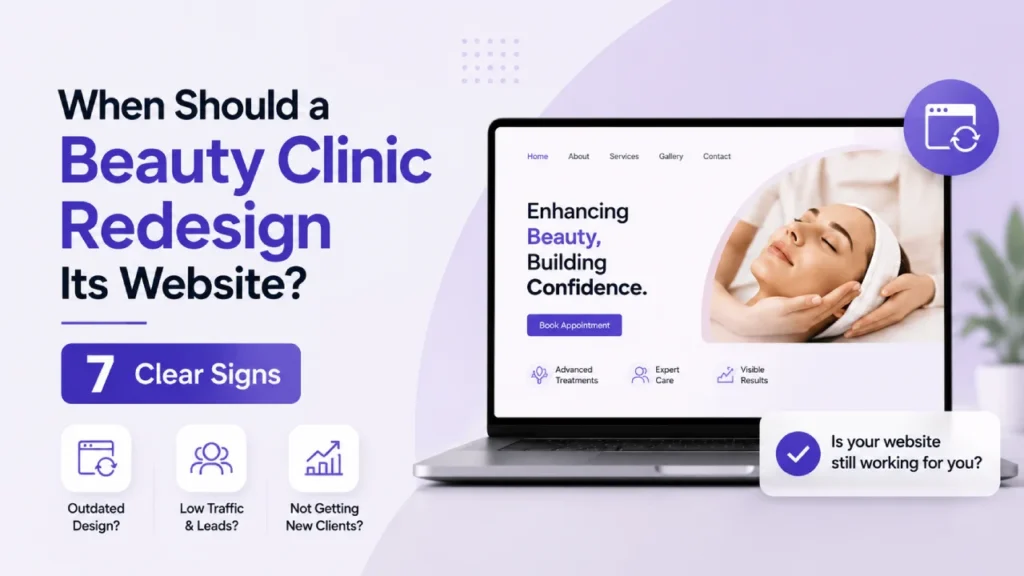
Most beauty clinic owners can sense something is off with their website without quite being able to put their finger on what. Enquiries have got a bit softer over the past year, the phone is ringing slightly less than it did a while back, and the new clients walking through the door these days tend to have arrived via Instagram or a friend’s recommendation rather than the website doing the work itself. The site, meanwhile, is just sitting there looking tired while the actual business has moved on around it.
The tricky bit is working out whether the site needs a proper rebuild, a smaller refresh, or honestly just a bit more patience while you focus elsewhere. So what follows is a working checklist. Seven of the clearest signals we tend to see when a beauty clinic website has genuinely reached the end of its useful life. Hit two or three of these and you are probably due a refresh. Hit four or more and you are almost certainly looking at a redesign.
The Seven Signs Your Clinic Site Needs Rebuilding
Sign 1: Your Bounce Rate Has Crept Above 70 Percent
Bounce rate, in case the term is new, just measures the percentage of visitors who land on your site and leave again without doing anything else on it. On a beauty clinic website, anything sitting north of about 70 percent on your key pages is a genuine warning sign. People are arriving, taking one look, and clicking straight back out. Usually it comes down to one of a few culprits. Maybe the page is too slow to hold them. Maybe the design immediately telegraphs that the site has been left alone for a while. Or the information they actually came for is buried somewhere they cannot find in three seconds flat. Whichever it is, a high bounce rate is the site quietly telling you something underneath the surface is broken, and patching the surface rarely fixes that.
Sign 2: The Site Falls Apart on a Phone
Open your own website on a phone right now, and ideally use a phone that is not the one you usually build the site on. See how easy it is to actually read a treatment page in real conditions. Have a go at finding your prices, then go through the motions of booking an appointment. The moment any of that turns into squinting at tiny text, or scrolling sideways because something has overflowed the screen, or fighting with a menu that does not behave properly, you have a mobile problem. More than 70 percent of beauty clinic traffic now reaches the site from a phone. A site that punishes mobile users is quietly haemorrhaging the bulk of its potential clients before those people have so much as understood what you do. Mobile failure on its own is enough reason to justify a full redesign.
Sign 3: Loading Speed That Makes People Wait
On mobile, you get about three seconds before an impatient visitor leaves. Five seconds, six, eight, and you are bleeding traffic by the time most of the page has even rendered. What makes this particularly frustrating is that owners almost never notice the problem themselves. Their own browser has every page cached, so it loads in a blink for them. New clients arriving cold get the real experience of a slow site, and they walk. The honest way to check is to run your homepage through Google PageSpeed Insights yourself. Anything scoring under 50 on the mobile side, and speed by itself is reason enough to bump a redesign up the priority list.
Sign 4: Booking That Takes More Than Three Taps
Clients expect to book a beauty appointment online now in the same offhand way they book a restaurant table. The clunky old booking journey, where somebody has to fill in an enquiry form first, wait around for a callback, and only then pick a slot, is haemorrhaging conversions. Every additional step in that process quietly loses you a slice of the people who started it. The clinics doing this best run proper booking software in the background, something like Phorest or Fresha or Timely, which lets a client choose a treatment, see what is actually available, and confirm the booking in under thirty seconds. Ask for noticeably more effort than that and you will be losing bookings that should have been yours.
Sign 5: Trust Signals Are Missing or Outdated
Beauty and aesthetic treatments live or die on trust. A nervous first-time client is looking for reassurance everywhere on the page. Before-and-after photos sit at the top of that list, alongside real client reviews. Practitioner qualifications matter too, as do certifications, and proof of insurance cover. Together they make a hesitant person comfortable enough to book. When the testimonials on the page are dated 2020 and the most recent before-and-after shots are from that same era, the unspoken message is that nothing much has happened at this clinic in a while. A new client reading that page will hesitate, and once they hesitate they often drift over to a competitor. Refreshing trust signals properly tends to mean changing the page structure they sit on, which can quietly push the project beyond a refresh and into full redesign territory.
Sign 6: The CMS Is a Nightmare to Update
When your receptionist has to phone the original developer every single time a price needs changing, the website has quietly become an obstacle for the clinic instead of an asset to it. A modern clinic site really lives on whether the in-house team can update a treatment page when prices move, get a new offer live before a campaign starts, drop in a fresh testimonial when a client leaves one, and tweak opening hours over Christmas without involving anybody external. The moment updating the site turns into a project rather than a five-minute job, content slowly goes stale on you. And stale content quietly costs bookings every week. Nine times out of ten the real problem here is the underlying platform, which means the honest answer is a proper rebuild, not yet another patch.
Sign 7: The Brand Has Moved On Without the Website
Maybe the brand itself has moved on in the last couple of years. There has been a rebrand, perhaps, or a quieter refinement of the visual identity. New treatments have come on board. Senior practitioners have joined. The positioning the clinic took to market in 2022 is not really the positioning that fits in 2026 anymore. Whatever combination of those is true for you, the practical reality is that the clinic somebody encounters when they walk through the door is now a different business from the one greeting them on the website. That gap between the two quietly undermines credibility for any client noticing it. A redesign closes the gap and makes the website feel like the same place as the clinic itself.
So You Hit a Few of These. Now What?
Two or three of these signs usually means a careful refresh will do everything you need it to. The bones of the site are still sound, so what you are doing is modernising the surface of the thing. Trust signals get refreshed too, along with a handful of the key journeys that have started feeling clunky. Projects of that shape tend to come in somewhere between £1,500 and £3,500 and wrap up inside a few weeks rather than dragging on.
Four signs or more, and you are almost certainly into redesign territory whether the budget likes the sound of it or not. The foundations are where the problem actually lives, and patching foundations rarely holds up for long. A proper redesign for a UK beauty or aesthetic clinic usually opens around £4,000 to £6,000 for a fairly basic build and climbs from there. The things that push the figure higher are typically the volume of treatment pages needed, whether online booking is being integrated, and any bespoke requirements unique to your clinic. Eight to twelve weeks is the realistic timeline to plan for.
How Creative Sweet Helps Beauty Clinics Decide
We work with beauty and aesthetic clinics across Belfast and Northern Ireland on web design, and quite a few of those conversations begin with an owner genuinely uncertain whether a full redesign is what they need, or whether a refresh would do the trick. Selling somebody a £6,000 rebuild they did not actually need is bad business for everyone involved. So our usual starting point is an honest audit. We sit with the existing site, work through a checklist not unlike the one above, and then recommend whichever option fits what the clinic is genuinely trying to achieve, even when that means a smaller invoice.
Most clients appreciate the directness of the conversation more than anything else. We will happily tell you a refresh would be enough, even on the projects where a bigger rebuild would bring in a bigger invoice for us. The trust that grows from being honest about that tends to be worth considerably more in the long run than any single project would have been on its own.
If you have read this list and recognised your own clinic site in a few of these signs, that is exactly the moment for a conversation rather than a decision. Get in touch at creativesweet.net or book a free discovery call, and we will take a proper look at where your site is now and what would actually move it forward.
Frequently Asked Questions About Beauty Clinic Website Redesign
How often should a beauty clinic redesign its website?
For most beauty clinics, a full redesign every three to five years is roughly the right pace. Design trends move at one speed, client expectations move at another, and the underlying web technology shifts faster than either of them, so a site that looked properly sharp in 2021 can already be reading as a bit dated to clients comparing options today. A well-timed refresh in between proper redesigns can stretch the useful life of a good underlying build by a noticeable margin.
How much does a beauty clinic website redesign cost in the UK?
A typical UK beauty clinic redesign opens at around £4,000 to £6,000 for a fairly basic build and rises from there. What pushes the figure up tends to be specific things. The volume of treatment pages plays a part, as does integrating proper online booking software, and any bespoke functionality the clinic actually needs to operate. Larger multi-location clinics, or those needing more complex booking and client portal systems, can comfortably move into five-figure territory.
What is the biggest sign a beauty clinic site needs redesigning?
Poor performance on a phone is the single clearest signal, simply because the overwhelming majority of beauty clinic traffic now arrives from mobile devices rather than desktops. A site that is hard to read at phone size is already losing people. Add slow loading to that, or a booking journey that feels fiddly on a touch screen, and you are actively pushing clients across to competitors who took the mobile experience seriously.
Does a website redesign actually bring beauty clinics more bookings?
Yes, but with a real caveat. The lift only shows up if the issues driving the redesign were genuinely structural underneath, not just cosmetic on the surface. Clinics that go from a slow, frustrating-to-book site to something properly fast, mobile-friendly, with clear treatment pages and integrated booking baked in, often see conversion rates lift by something in the region of thirty to fifty percent on the same volume of traffic.
Can Creative Sweet redesign my beauty clinic website?
Yes. Creative Sweet works with beauty and aesthetic clinics across Belfast and Northern Ireland on web design, covering full redesigns and lighter refreshes depending on what the clinic genuinely needs. Get in touch at creativesweet.net for an honest look at whether your existing site is properly overdue a rebuild or whether a smarter refresh would do the job.