Glasgow has a student population of somewhere around 60,000 across the University of Glasgow, Strathclyde, Caledonian, and the art school. A disproportionate share of them live within a two-mile radius of the West End yoga studios clustered around Byres Road and Great Western Road, which creates a fairly specific advertising opportunity. Geography alone is an advantage here. Students at this life stage are genuinely open to building new habits, they tend to have more schedule flexibility than working professionals, and a meaningful number of them are actively looking for something to do with their bodies that isn’t the university gym. Most Glasgow yoga studios aren’t reaching them anywhere near as effectively as they could be.
The reason is usually organic. Studios post on Instagram, occasionally boost something, wait for word of mouth to carry the work. That approach builds slowly and caps at the existing audience. Facebook and Instagram advertising through Meta’s platform does something different: it puts the studio in front of people who match a specific profile and haven’t encountered the studio yet. For a yoga business in Glasgow looking to grow its student clientele, the targeting infrastructure available through Meta Ads is genuinely well-suited to the task. The question is how to use it properly.
Why Facebook Ads Suit Yoga Studios Better Than Most Categories
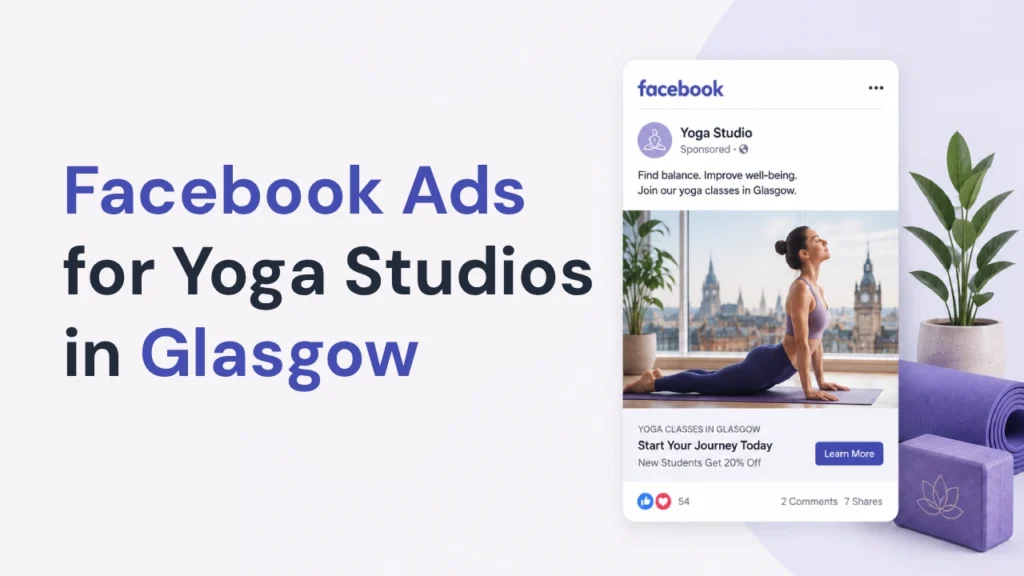
There’s a version of the Facebook Ads conversation that doesn’t apply here: the one about struggling to make a visually uninteresting product appeal on a visual platform. Yoga doesn’t have that problem. Movement photography and video are naturally compelling. A short clip of a morning flow in a warmly lit studio on a Glasgow January morning is doing more visual work than most brands can manage with a much larger budget.
The platform advantage for yoga is real, but it’s the targeting that makes social media ads for yoga worth investing in properly rather than sporadically. Meta’s audience tools are more granular than most studio owners realise. Location can be tightened to a one-mile radius from the studio. Age and demographic filters layer on top of that. Interest categories covering mindfulness, fitness, or health narrow the audience further toward people who are already receptive. Stacking these together means the people actually seeing the ads have a genuinely higher probability of converting than a boosted post sent to existing followers and their loosely connected networks.
Building a Student-Focused Audience in Glasgow
The student demographic in Glasgow is geographically concentrated enough that location targeting alone does most of the first layer of work. A radius of one to two miles around a West End studio captures the primary student residential areas: Hillhead, Partick, Dowanhill, the streets running off Great Western Road. For a studio closer to the city centre, extending the radius slightly pulls in the Strathclyde and Caledonian catchment.
Age targeting in the 18 to 26 range is the obvious demographic layer, but it’s worth not over-tightening it early on. Glasgow’s student cohort includes mature students and postgraduates, and the West End in particular has a younger professional population that has aged out of a strict student demographic but shares a lot of the same behaviour patterns and responds to similar creative. Running the audience slightly broader (18 to 32, say) and watching which age bands actually convert tends to produce more useful data than guessing in advance.
The interest layering is where local yoga advertising gets specific. Within Meta’s interest categories, combinations that tend to perform for yoga studios include fitness and wellness generally, meditation and mindfulness specifically, student-life adjacent interests, and healthy eating or plant-based diet interests, which frequently correlate with yoga receptivity in this demographic. None of those is a certainty; the combination is a way of reaching a warmer subset of the broader geographic audience, and the real optimisation happens once the campaign has run for a few weeks and actual data is available.
Lookalike audiences are worth building from the start even if they’re not used immediately. Upload an existing client list, build a custom audience from website visitors, or seed it from the studio’s existing social following. Once there are enough bookings to build a meaningful conversion audience, running a lookalike off the people who actually booked classes tends to outperform pure interest targeting at finding new clients who resemble the ones already in the room.
Ad Creative That Actually Stops the Scroll
Glasgow students scrolling through Facebook or Instagram at 9pm are not looking for an advertisement. The ads that earn attention do so because they look like content worth pausing on rather than something to swipe past.
For a yoga studio, the creative formats that tend to work at different stages of the funnel are worth understanding. Short video (under 15 seconds) of actual class atmosphere, real teachers, real students, shot with reasonable quality but not clinical production values, performs strongly for top-of-funnel awareness. The goal at this stage is simply to establish that this studio exists and has the right feel. A static image with a specific, concrete offer, something like an introductory week for a named price, tends to convert better for retargeting people who’ve already seen the studio once.
Specific ad copy examples that fit this market and this demographic:
“New to yoga in Glasgow? Our intro month is £30. Flexible scheduling, West End studio, beginner classes every day.”
“Student? We have a rate. Morning, lunchtime, and evening classes at [Studio Name], two minutes from Hillhead subway.”
The copy that works for this audience doesn’t try to be inspiring. Aspirational language about transformation and inner peace consistently underperforms against ads that simply tell someone where the studio is, what it costs, and when they can show up. Students weighing up whether to try a yoga studio are asking practical questions. The ad that answers those questions directly, without a preamble about wellness philosophy, removes the friction between seeing it and clicking through.
Budget Optimisation for a Glasgow Yoga Studio
The budget question is where a lot of studio owners get anxious, often because a previous attempt at advertising spent money without obvious result. That experience is usually a targeting or creative problem rather than a platform problem, but it leaves a lasting scepticism about whether Meta Ads are worth the spend.
For a Glasgow yoga studio running a student-focused campaign, a sensible starting structure is a modest awareness campaign (£5 to £10 per day for the first four weeks) targeting the geographic and demographic audience, with a separate retargeting campaign at a lower daily budget running alongside it for people who’ve visited the website or engaged with the studio’s social content. The awareness spend is building the pool that the retargeting campaign then converts.
The mistake worth avoiding at the start is optimising for a large reach rather than a relevant one. A campaign reaching 50,000 people in Glasgow broadly is less valuable than one reaching 8,000 students and young professionals in the West End repeatedly over a month. Frequency matters in yoga advertising in a specific way: someone who has seen the studio’s content three or four times across a few weeks is meaningfully warmer than someone who saw it once. Budget structure that prioritises a relevant, higher-frequency reach over a broad, lower-frequency one tends to produce better conversion rates from a smaller initial spend.
Where Creative Sweet Fits Into This
Running Facebook Ads that actually produce bookings rather than impressions and vague engagement is not as simple as it looks from the outside. The targeting decisions, the creative brief, the ad copy, the campaign structure, the bid strategy, the attribution setup that tells you which ads are actually driving bookings: all of these require either significant time to learn or an existing command of Meta’s advertising platform.
Creative Sweet manages Facebook and Instagram advertising campaigns for yoga studios and wellness businesses across Glasgow and the wider UK. In practice this means going into the Meta Ads account and doing the actual work: building the audience structure from scratch if there isn’t one, or finding and fixing what’s wrong with an existing account that hasn’t performed. Ad copy gets written and tested across different angles rather than running a single version and hoping. Creative gets briefed properly. Conversion tracking gets set up so there’s real data on which ads are driving actual bookings rather than just impressions. And the campaigns get managed week to week against what the numbers are saying rather than left to run unattended.
For Glasgow yoga studios, the student market is an acquisition opportunity that Facebook Ads can genuinely capture. But only when the campaign is built to actually reach the right people and the offer is framed in a way they respond to. Campaigns running on boosted posts with broad targeting tend not to get there regardless of how much is spent on them. The difference between that approach and a properly structured paid social campaign shows up fairly quickly once the data starts coming in.
The window in Glasgow’s yoga studio market is still open. A studio that builds a real paid social presence now is accumulating audience data and retargeting pools that compound in value over time, and that’s considerably harder to replicate once competitors have a year’s head start on it.
Want Facebook Ads that actually fill your Glasgow yoga classes? Creative Sweet builds and manages Meta advertising campaigns for yoga studios and wellness businesses across Scotland and the UK.