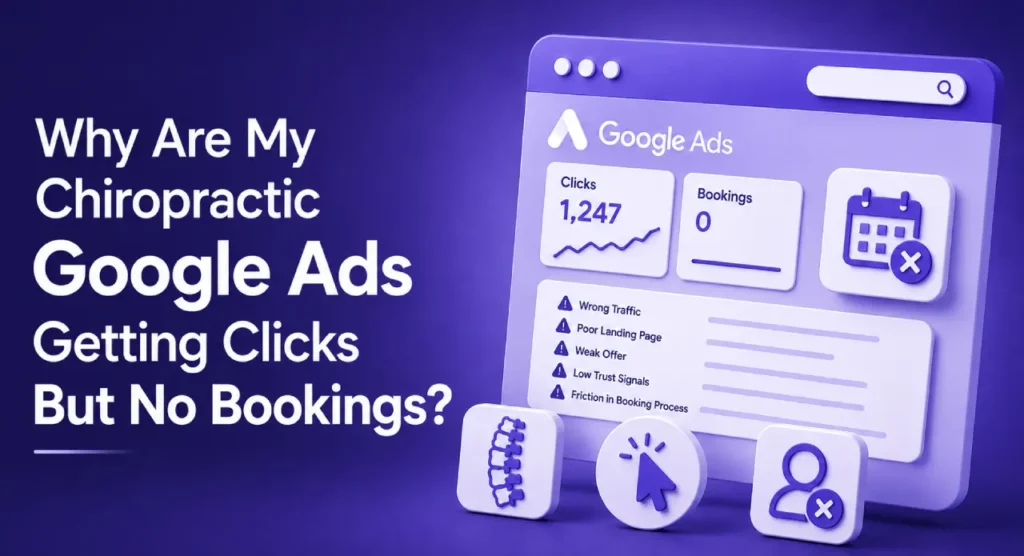
If your chiropractic Google Ads are generating clicks but not bookings, the cause almost always sits in one of three places. The click isn’t reaching the right person, the landing page or booking process loses them once they arrive, or your tracking isn’t recording the bookings you’re actually getting. This guide works through each stage in order, so you can pin down which one is actually failing instead of guessing.
Quick Diagnostic Checklist
Before reading the full breakdown, run through this list. Most accounts have one or two genuine culprits, not all ten.
- Keywords are attracting the wrong search intent
- Negative keywords aren’t filtering out irrelevant searches
- Location targeting is reaching people who can’t realistically visit
- The landing page doesn’t match what was searched
- Mobile experience is losing people before they see a call-to-action
- The booking call-to-action isn’t clear or obvious
- The booking process itself is slow or complicated
- Conversion tracking isn’t capturing real bookings
- Phone calls aren’t being tracked at all
- Enquiries arrive but nobody follows up quickly enough
The Chiropractic Google Ads Funnel: Where Do Patients Actually Drop Off?
A prospective patient moves through the same basic sequence in every chiropractic Google Ads account. A search leads to a click, the click lands somewhere on your site, that hopefully turns into an enquiry or a call, and only then does it become a booking and, eventually, a new patient. A campaign can look healthy near the top of that sequence and still fail lower down, which is why “clicks but no bookings” has several possible causes, not just one.
| Funnel Stage | What Can Go Wrong Here |
|---|---|
| Search | Someone searches with an intent your keywords weren’t built to capture |
| Click | The click happens, but it’s from the wrong location, or a search that was never going to convert |
| Landing Page | The page doesn’t match the ad, loads slowly, or doesn’t work properly on mobile |
| Enquiry or Call | The call-to-action is unclear, or a form or phone number is hard to find |
| Booking | The process to actually get an appointment in the diary is slow or confusing |
| New Patient | The enquiry sits unanswered long enough that the person books elsewhere |
Quick Diagnostic Table: Match Your Symptom to the Likely Cause
| What You’re Seeing | Likely Cause |
|---|---|
| High click volume, very few site visits look genuine | Search intent or keyword mismatch |
| People land on the site but leave almost immediately | Landing page mismatch or poor mobile experience |
| People browse the site but never enquire or call | Unclear call-to-action or booking friction |
| People enquire but few ever book an appointment | Slow follow-up or a clunky booking process |
| Google Ads shows almost no conversions despite real bookings | Conversion tracking or call tracking gap |
| Cost per click is reasonable but nothing converts anywhere | Budget or bidding strategy working against the account |
Are You Attracting the Wrong Search Intent?
Problem: broad or loosely matched keywords bring in people who were never looking to book a chiropractor, such as those researching symptoms or looking for a different type of practitioner.
How to identify it: open the Search Terms report in Google Ads and read through what people actually typed before clicking. If a good share of those terms look informational, not booking-focused, that’s your answer.
The impact: someone researching back pain in general isn’t at the same decision point as someone searching “chiropractor near me appointment today”. Both can click the same ad, but only one is close to booking.
Fix: build campaigns around booking-intent keywords specifically, and move broader, informational terms into a separate campaign with its own budget and expectations, or exclude them entirely.
Are Negative Keywords Filtering Out the Wrong Clicks?
What’s going wrong: without a proper negative keyword list, Google Ads keeps showing your ads for searches that sound related but aren’t, things like chiropractic courses, jobs or equipment.
How to check: the same Search Terms report shows this clearly. Look for anything mentioning “jobs”, “training”, “how to”, “salary” or “free” sitting alongside genuine patient searches.
The cost to you: every one of those clicks costs money and adds to your click count without ever having a realistic chance of becoming a patient, which quietly drags your whole account’s conversion rate down.
What to do about it: build a negative keyword list at account and campaign level, and put a recurring reminder in the diary to review the Search Terms report. A list built once at setup stops working within weeks.
Is Location Targeting Sending You the Wrong Clicks?
Problem: campaigns set to target an entire city or region, instead of a sensible radius around the clinic, can pull in clicks from people who were never going to travel to you.
Where to look: check the Locations report in Google Ads and compare where clicks are coming from against a realistic travel radius for your clinic.
Why this matters: a chiropractic appointment usually needs a return visit or two. Someone forty minutes away has a much lower chance of actually booking, even if the ad itself was perfectly relevant to them.
Fix: tighten geographic targeting to a realistic catchment area. Outer areas worth pursuing can get their own smaller-budget campaign instead of being folded into the main one.
Does Your Landing Page Match What Was Searched?
What’s happening: ads that send every click to a generic homepage, instead of a page built around the specific search, lose people who expected to see something relevant to what they typed.
How to identify it: click through your own ads for a handful of keywords and check whether the page you land on actually answers that search, or just talks about the clinic in general terms.
The result: someone who searched “sciatica chiropractor” and lands on a generic homepage has to hunt for anything relevant. Most people won’t bother, and they’ll just leave.
The fix: build dedicated landing pages for your highest-intent keywords, each one addressing the specific condition or service that was searched for, with a clear path to booking.
Is Your Mobile Experience Losing Patients Before They See a Call-to-Action?
The issue: most chiropractic searches happen on a phone, and a slow-loading or awkward mobile page can lose a visitor before they ever reach your booking option.
How to check: load your own landing page on a mobile phone using a standard mobile connection, not office wifi, and time how long it takes to become usable.
Why this costs bookings: every extra second of load time reduces the percentage of visitors who stick around, and a booking button that requires pinching and zooming to find rarely gets used.
What to do: treat mobile page speed and layout as its own priority. A page that looks fine on desktop doesn’t automatically work well on a phone.
Is Your Booking Call-to-Action Actually Clear?
Problem: a page can be well designed and still fail to tell a visitor what to do next, especially if the phone number, booking button and contact form are all competing for attention.
How to spot it: ask someone unfamiliar with the page to find out how to book an appointment, without giving them any hints, and watch how long it takes.
Why it matters: a visitor who’s interested but unsure what to do next usually just leaves. That’s especially true on mobile, where scrolling past the fold loses attention fast.
Fix: settle on one primary call-to-action per page, make it visually obvious near the top, and repeat it again further down the page.
Is Your Booking Process Too Slow or Complicated?
What’s happening: a long enquiry form, a booking system that requires creating an account, or a “we’ll call you back” process instead of instant booking can lose people who were ready to commit.
Where to look: go through your own booking process from start to finish as if you were a new patient, and count how many steps and fields it takes.
Why this hurts bookings: someone who clicked a paid ad is already showing intent. Every extra step between that click and a confirmed appointment is a chance for them to give up or book with a competitor instead.
The fix: cut the booking form down to fields you genuinely need, and offer instant online booking wherever you can. A callback-only process adds a delay that costs bookings.
Is Your Conversion Tracking Measuring Real Bookings, or Just Clicks and Form Fills?
The issue: many accounts count a form submission or a page view as a conversion without checking whether it became a booked patient, which can make a genuinely broken funnel look fine on paper.
How to check: compare the conversion count in Google Ads against your actual appointment book for the same period. A large gap between the two numbers tells you the tracking, not just the campaign, needs attention.
The knock-on effect: Smart Bidding and budget decisions are only as good as the data feeding them. If Google Ads optimises toward form fills that never become patients, it will keep buying more of the wrong clicks.
What to do: set up conversion tracking around genuine booking actions specifically, using Google’s enhanced conversions and, where relevant, offline conversion imports so confirmed bookings feed back into the account.
Are Phone Calls Being Tracked at All?
Problem: chiropractic enquiries very often come in by phone, and an account with no call tracking is effectively blind to a large chunk of its real results.
How to identify it: check whether your Google Ads account has call conversion tracking set up, either through call extensions or a dedicated tracking number on the website, and whether it’s reporting any data.
Why this matters: without call tracking, every phone enquiry looks like a wasted click in the reporting, which can lead to cutting a keyword or campaign that’s actually working well.
Fix: enable call conversion tracking properly, using Google’s own call tracking tools instead of a generic number, so calls are attributed back to the keyword and campaign that generated them.
Is Anyone Following Up on Enquiries Fast Enough?
What’s happening: a lead that submits a form or misses a call and doesn’t hear back quickly often books with whichever clinic responds first, since paid search leads tend to compare more than one option.
How to spot it: submit a test enquiry through your own website and time how long it takes for someone to actually respond.
Why it hurts bookings: no amount of campaign optimisation can rescue a lead that goes cold. This is a business process issue sitting downstream of the ad account, but it shows up in Google Ads as a poor conversion rate all the same.
The fix: put a clear response-time target in place for enquiries and missed calls, and consider automated confirmation messages that acknowledge a booking request immediately while a person follows up.
Could Budget or Bidding Strategy Be Working Against You?
The issue: an account switched to an automated bidding strategy such as Maximize Conversions before it has enough clean data, or one spread too thin across too many keywords, can perform worse than a simpler setup.
Where to look: check how many genuine conversions your account is recording each month. If it’s a handful or fewer, an automated strategy built for volume may not have enough data to work properly yet.
Why this costs bookings: Smart Bidding needs a reasonable flow of accurate conversions to learn from. Feed it too little, or feed it the wrong signals from the tracking issues above, and it can spend budget in the wrong places.
What to do: fix conversion tracking first, then match your bidding strategy to the amount of clean data the account generates. Automation alone won’t solve a funnel problem underneath it.
If you’ve been through this list and aren’t sure which stage is actually the problem, that’s usually a sign it’s worth having someone look at the whole funnel together, not just one setting at a time. A short Google Ads funnel audit typically finds this faster than working through each stage in isolation.
People Also Ask
Why do I get clicks but no patients?
Usually because something between the click and the booking is losing people. A landing page mismatch is the most common culprit, closely followed by an unclear call-to-action, a slow booking process, or tracking that simply isn’t capturing real bookings.
How do I know if my Google Ads conversion tracking is working properly?
Compare the conversion numbers in Google Ads against your actual appointment book for the same period. If genuine bookings are consistently higher than what Google Ads is reporting, tracking is the likely gap.
Should a chiropractor use call tracking with Google Ads?
Yes, in most cases. A large share of chiropractic enquiries come by phone, and without call conversion tracking those enquiries are invisible to the account’s reporting and optimisation.
Getting a Clear Answer on Your Own Account
Working through ten possible causes alone is manageable, but it takes time most clinic owners don’t have alongside running the practice. If you’re paying for clicks without matching bookings, have your campaign, landing pages and tracking reviewed together instead of guessing at a single fix. Get in touch if you’d like a second pair of eyes on where your funnel is losing patients.