
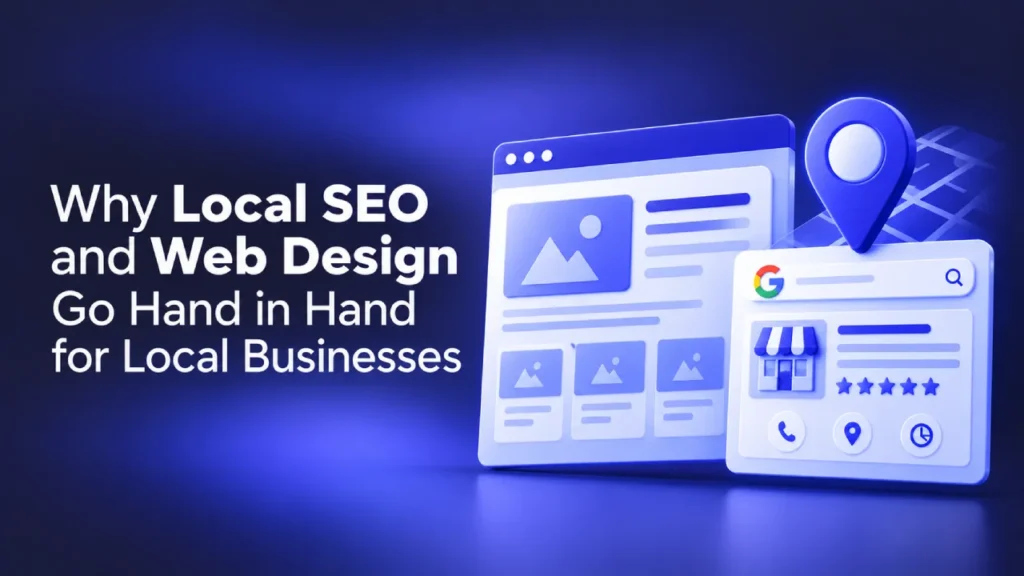
Most local businesses across Northern Ireland treat their website and their SEO as two entirely separate exercises. Somebody builds the website. Somebody else, usually months later, gets brought in to try and make it rank on Google. And by the time the SEO work starts, half of what would have made the site rank properly was quietly decided during the design phase without anybody realising it mattered. That gap between how the site was built and how it now needs to perform is where a huge amount of local marketing budget quietly disappears.
There is a better way to run this. Local SEO and web design are genuinely two halves of the same conversation, and treating them as one integrated project tends to deliver dramatically better results for a similar investment. That is what this post is about. Not why SEO matters. Not why web design matters. But specifically why the two only work properly when they are built together from the start.
Why Splitting the Two Rarely Works
A local business commissions a website in the first place, focusing quite reasonably on how it looks and what it says. The finished site then launches. Traffic ends up being disappointing. Somebody suggests bringing in an SEO consultant. That consultant looks over the new site and immediately spots problems, ones that would have been trivial to sort out during the build itself, but are now noticeably harder to fix after everything has already gone live. Both sides end up losing time and money on rework that honestly never needed to happen in the first place.
Decisions Made During Design Quietly Shape SEO Outcomes
The choice of platform. The URL structure. Whether pages are built individually or generated from a template. How content is organised and cross-linked. Every one of these looks like a design decision, and every one of them is actually shaping how well the site will rank for months and years afterwards. Getting them right when the site is being planned costs nothing extra. Getting them right after launch costs meaningfully more and often disrupts other work.
The Cost of Retrofitting Local SEO
Adding proper local SEO onto a poorly structured site is genuinely more expensive than building the site right in the first place. Redirect maps need drawing up to preserve any equity the old URLs had accumulated. Location pages need creating where none existed. Schema markup needs threading through templates that were never designed to accept it. All of that adds up to a bill that a properly integrated build would have entirely avoided.
The Web Design Elements That Actually Drive Local SEO
There is a specific set of web design decisions that directly determine how well a local business can rank in its area. Some of these are technical. Some are structural. None of them are optional if the site is meant to compete in local search.
Page Speed Sits Underneath Everything
Google treats page speed as a properly weighted ranking factor, particularly on mobile, and especially so on local searches where the user is already halfway out the door before the page has finished loading. A site loading in over four seconds on mobile is losing the ranking battle against a competitor loading in under two, before the content on either site has even come into play. Speed is not the sort of thing you sprinkle on afterwards. It gets baked in at the point the site is built, through decisions made about how images are handled, how the underlying code is written, and where the site is hosted.
The Hidden Cost of Slow Mobile Loading
For local businesses specifically, mobile performance genuinely matters more than desktop. Most “near me” searches happen on phones held by people trying to make a decision quickly. A slow-loading site actively drives those searchers to a faster competitor whose site loads before they lose patience. The impact on bookings and enquiries compounds silently over months.
Mobile UX Determines Whether Visitors Convert
Getting somebody onto your site is honestly only half of the actual job. Whether they actually go on to book with you, or pick up the phone to call, or fill in a contact form, comes down to how the mobile experience feels once they get there. Buttons that are awkwardly hard to tap on a phone kill conversion. So does text sized too small to read comfortably on a smaller screen, alongside forms that seem to assume the visitor is sitting in front of a proper desktop keyboard. Every one of these issues is quietly losing conversions from local search traffic that took real effort to get onto the site in the first place. Mobile UX is not really a nice-to-have. It is what actually determines whether the SEO work ends up paying back.
Clean URL Structure Compounds Over Time
URLs that read clearly, use the correct location keywords, and follow a logical hierarchy quietly help Google understand what each page is about. Ugly URLs full of parameters and numeric IDs make ranking meaningfully harder for reasons that never surface in the search console reports. A properly designed site handles URLs correctly from the first page onward.
Schema Markup Speaks Directly to Search Engines
Structured data telling Google exactly what your business does, along with where it operates from and when it is open, plus how somebody can go about contacting you, is honestly one of the most underused advantages available in local search today. When schema gets built into the site templates properly during the design phase, every future page you add inherits that benefit automatically. Trying to bolt it on afterwards is a different story. It means going back and editing templates that were never really designed with schema in mind, and that work almost always ends up half-finished somewhere along the way.
Why Schema Matters More in the Age of AI Search
AI search engines are increasingly leaning on structured data when they decide which businesses to actually cite inside their generated answers. ChatGPT operates this way, and Perplexity does the same thing under the hood. A site carrying proper schema is meaningfully more likely to get recommended when somebody asks their AI assistant for a local business nearby. Sites without schema are effectively invisible to this new category of search entirely, however good the underlying content on them might be.
Where Google Business Profile Meets Your Website
This is the specific integration point where local SEO and web design connect most obviously. Google Business Profile is genuinely the single most important local ranking asset for most businesses, and the way it interacts with your website determines a lot of how well the whole system performs.
The two pieces really need to be reinforcing each other properly. Your business address wants matching exactly across both, alongside the phone number, opening hours, and business categories, right down to how commas and abbreviations end up getting used. The site itself should also be surfacing your Google reviews in a way that feels native to the design, instead of coming across as something that got bolted on later. Location pages sitting on the site should link outward to your Google Business Profile, and the same profile links want threading consistently through the wider site design too. When designers work in isolation from SEO specialists, these connection points are exactly the sort of thing that quietly gets missed. When both disciplines work together from the outset, the two assets end up amplifying each other week after week.
Location Pages Are Where the Two Services Meet Most Directly
Any local business serving multiple areas benefits from dedicated pages for each place it operates in. A physiotherapy clinic covering Belfast, Lisburn, and Bangor should have three individual pages, one for each area, rather than a single “areas we cover” page listing all three together.
These pages sit exactly at the intersection of SEO and web design work. From an SEO angle, they exist to rank properly for location-specific searches. From a design angle, they need to feel genuine and useful to a real visitor, not templated and thin. Striking that balance well genuinely requires the two disciplines to be happening together in the same conversation. If a designer has never spoken to the SEO team, the writing tends to come out generic and fails to rank. On the other hand, an SEO consultant working from an already-finished site ends up shoehorning keyword-heavy copy into layouts that were never really intended to hold it, and the resulting page reads awkwardly to any human who lands on it.
What Good Location Pages Actually Look Like
A properly built location page carries useful local context that a real visitor would actually want to sit and read. That might come through as real examples of clients based in that specific area. It could be directions or parking information relevant to the location, along with a mention of local landmarks that ground the page in the real place. Nothing on the page ends up feeling padded to the reader, and nothing feels templated either, because the site design gives the content real room to breathe. This is honestly closer to craft work than to SEO checkbox filling, and it only really turns out well when both disciplines shape the page together from the start.
On-Page SEO Cannot Be Bolted On After Launch
This is the category most business owners underestimate. Effective on-page SEO covers heading hierarchy, image alt text, internal linking patterns, meta title and description structure, and how content is organised across the site. Every one of these is a design decision as much as an SEO one, and every one of them ends up compromised when the design phase finishes before the SEO work starts.
A site designed with on-page SEO in mind from the very beginning carries proper heading structure through every page template it uses. Images end up being sized down properly, along with being compressed and given descriptive alt text as a matter of routine. Internal links between related pages flow naturally out of the information architecture, because the architecture itself was built with linking already in mind. Meta fields get populated the right way from the start, instead of sitting empty waiting for somebody to come fix them later. All of this work stays essentially invisible to the visitors themselves, while being enormously valuable to the search rankings behind the scenes.
How Creative Sweet Handles Local SEO and Web Design Together
We build websites for local businesses across Belfast and Northern Ireland with SEO woven into the design phase itself, instead of being tacked on somewhere afterwards. That approach means every site we ship out arrives with its technical foundations already in place. Hosting sits on fast infrastructure by default. The underlying code is clean, schema markup runs through every one of the templates properly, location pages get built on a solid content architecture underneath, and Google Business Profile integration is set up from the outset of the project. Everything the site needs in order to rank properly is genuinely present from day one of launch, not something being retrofitted onto the site six months down the line.
Our approach with local businesses specifically works because we do not treat SEO alongside web design as two separate services that only occasionally overlap. They are honestly one integrated conversation about how the site is going to end up performing once live, and the same internal team handles both sides of that conversation. For most SME clients, this whole approach tends to end up costing less overall than commissioning a designer plus a separate SEO consultant would. The results also come out meaningfully stronger, because nothing important falls between the cracks in the handover.
If you are currently planning a new website for a local business, or you have an existing site that has just never quite delivered the local search performance you were hoping for, that is genuinely a worthwhile conversation to have. Get in touch at creativesweet.net or book yourself in for a free discovery call. We can take an honest look at where things sit today, and let you know exactly what would move the needle for your specific business.
Frequently Asked Questions About Local SEO and Web Design
Why do local SEO and web design work best together?
The technical foundations that get set during a website build directly shape how well local SEO can actually perform on the site afterwards. Where a site was built without SEO in mind, that quietly costs the owner rankings later on down the line. An SEO-first build, on the other hand, starts catching high-intent local searches genuinely from day one, rather than years further down the road.
Can I do local SEO without redesigning my website?
Yes, though how much genuine progress you can make really depends on how well the existing site was originally built. Sites carrying reasonably clean architecture underneath, and running at acceptable speed already, can honestly benefit quite a bit from local SEO work on its own. Where the picture changes is on sites carrying deeper structural issues. Those usually need at least a partial rebuild before any SEO work will start delivering meaningful returns.
What web design elements matter most for local SEO?
A handful of things sit near the top of the list here, and each one connects into how Google evaluates a local business site. Page speed is the underlying foundation of all of it. Mobile responsiveness lives right alongside that, and clean URL structure sits underneath both. Proper schema markup is another piece, along with dedicated location pages for the areas you serve, and Google Business Profile signals integrated across the site itself. Building a site with all of these already in place from day one lets any subsequent local SEO efforts compound much faster than they otherwise would.
Does mobile design affect local SEO rankings?
Yes, significantly so. The overwhelming majority of near me searches these days happen on mobile devices, and Google actively uses mobile performance as a primary ranking factor when it comes to local results. Any site that loads slowly on phones will consistently underperform a properly optimised competitor in local search. The same is true of sites that display poorly on smaller screens.
Can Creative Sweet handle both local SEO and web design together?
Yes. Creative Sweet works with local businesses across Belfast and Northern Ireland on integrated web design and local SEO projects, so the technical foundations of the site and the ongoing ranking work happen together rather than being split across separate teams. Get in touch at creativesweet.net to discuss what your business needs.