
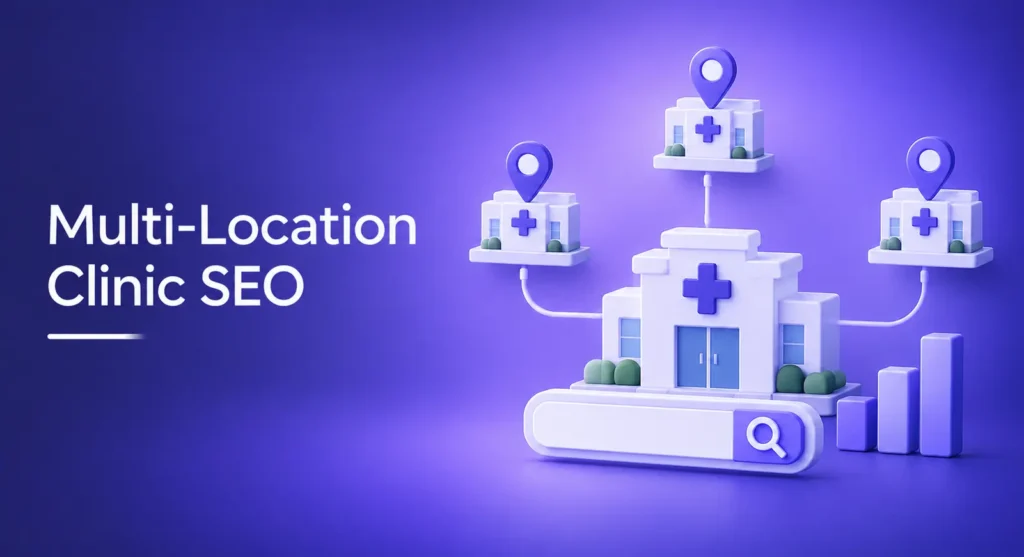
Location page cannibalisation happens when two or more branch pages on the same website target the same or overlapping keywords. Instead of each page ranking well for its own area, Google struggles to decide which one deserves to rank, and the common result is that neither performs as well as it should.
For a single-site clinic, local SEO is fairly linear: build authority, target the right terms, rank. A multi-location group has an extra variable. Every new branch page is also a new page that could accidentally compete with an existing one, and most clinic marketing advice never mentions this because it’s written for businesses with one location.
What Is Multi-Location SEO Cannibalisation?
It’s when a website’s own pages compete against each other in search results, not against outside competitors. A chiropractic group with branches in Leeds and Bradford both trying to rank for “back pain chiropractor Leeds” is a straightforward example, but it also happens more subtly: a national services page and a specific branch page chasing the same search term, or two branches in neighbouring towns both targeting an identical head-term keyword.
This differs from an ordinary local SEO problem because the fix isn’t “build more authority” or “get more reviews”. The pages themselves are working against each other, so improving one can actively push the other down.
How Do You Know If Your Branch Pages Are Competing Against Each Other?
Three checks usually reveal it. Search Console’s Performance report can be filtered by query, and if two URLs from the same domain both show impressions for the same search term, that’s a direct signal. Rankings that swap between branches from week to week, without settling, suggest Google itself is unsure which page to trust. And a manual read-through of branch pages side by side often shows the real cause: content that’s identical except for the town name.
| Symptom | Likely Cause |
|---|---|
| Two branch pages both rank on page two for the same term | Direct keyword overlap between branches |
| Rankings swap between branches week to week | Google is unsure which page to trust |
| A strong branch page can’t outrank a weaker one nearby | Internal linking imbalance |
| A new branch page never ranks at all | Thin or duplicated launch content |
Common Causes of Location Page Cannibalisation
These are the patterns that show up most often across multi-site chiropractic, physiotherapy, dental and aesthetic groups. Most sites have two or three of these running at once, not just one.
Two branches chasing the same head-term keyword
Cause: branches in the same city or nearby towns both target a broad term like “physiotherapist Manchester” instead of their own specific area. Fix: give each branch a more precise geographic target, its actual neighbourhood or postcode area, and let a single hub page hold the broader city-wide term.
Templated content with only the city name changed
What’s happening: every branch page follows an identical template, same paragraph order, same phrasing, with just the town swapped. Google can treat this as thin, duplicate content, not genuinely distinct pages. The fix is to differentiate what the page actually says, not just what it’s called.
A national services page competing with a branch page
The problem: a general “physiotherapy services” page and a specific branch page both end up ranking for the same local search, splitting relevance between them. Solution: keep the services page focused on explaining the treatment itself, and let branch pages own local intent. Link between the two instead of duplicating content across both.
Overlapping service areas in Google Business Profile
Why this happens: if two branches set service areas that overlap heavily, Google’s local algorithm has two legitimate candidates for the same map pack result and has to choose. What to do: set service areas that reflect a realistic travel radius for each branch specifically, not a generous, overlapping estimate.
Near-identical meta titles and descriptions
Cause: branch pages built from the same template often carry meta titles that differ only by town name, giving Google very little to distinguish them by at a glance. Fix: write a distinct title and description for each branch that reflects something genuinely specific to it, not a formula with one variable swapped.
Identical internal link anchor text across every branch
What’s happening: a main navigation menu that links to every branch using the exact same anchor text, such as “our clinics”, gives Google no differentiated signal about which page relates to which area. Varying anchor text to include the branch name and area helps each page build its own distinct relevance.
Blog content accidentally targeting a location page’s keyword
The issue: a blog post written to attract general traffic ends up targeting the exact keyword a branch page already owns, and the two compete without anyone intending it. Checking existing branch page targets before publishing new content avoids this fairly easily.
If several of these look familiar, it’s often faster to have someone map the overlap across the whole site than to fix pages one at a time and hope the pattern doesn’t repeat elsewhere. A Multi-Location SEO Audit typically identifies exactly which pages are competing and why within a few hours of analysis.
A Framework for Structuring Multi-Location Clinic SEO
Four elements determine whether branch pages support each other or compete. None of them work well in isolation, and most cannibalisation problems trace back to one of these being handled inconsistently across a site.
URL Structure
A consistent, hierarchical pattern such as /locations/[area]/ signals to Google that each page is a distinct entity within a clear structure, not a flat collection of similarly-named pages competing for attention. A flat structure, where branch pages sit at the same level as unrelated content with no grouping, makes it harder for Google to understand that these pages are meant to serve different areas, not the same one.
Internal Linking Architecture
Linking every branch identically from the homepage treats them all the same, which works against the goal of each one earning its own local authority. A hub-and-spoke structure works better: service pages link down to the branches most relevant to that service, and branch pages link back up to the services they actually offer. Authority then flows to the pages that genuinely need it, not uniformly across the board.
Differentiated On-Page Content
Beyond the town name, what should actually differ between branches includes practitioner bios specific to that site, real local landmarks or parking and access details a patient would genuinely want to know, and branch-specific reviews instead of a shared pool. Where services genuinely differ by branch, such as one site offering a treatment another doesn’t, that difference belongs on the page itself, not buried in a shared list.
Geo-Schema Per Branch
Each branch needs its own structured data: a distinct LocalBusiness or more specific subtype such as Physician or Dentist, with its own address, geo coordinates and areaServed value, carrying a unique @id. A single shared schema block reused across branches, or one branch’s coordinates copied onto another’s page, creates exactly the ambiguity this whole framework is trying to avoid. The website’s Organization schema can sit above these as the parent entity, linking to each branch’s own LocalBusiness markup.
What Should Multi-Location Clinics Avoid Doing?
- Copying one branch page and changing only the city name
- Running one shared Google Business Profile for multiple physical addresses
- Letting every branch target the exact same head-term keyword
- Duplicating meta titles and descriptions across branches
- Building every internal link to every branch with identical anchor text
Worked Examples Across Clinic Types
These are illustrative scenarios, not real client results, included to show how the same underlying problem looks different by clinic type.
A chiropractic group with branches fifteen minutes apart might find both pages targeting “chiropractor back pain” for the wider city, when narrowing each to its own suburb and postcode area would let both rank instead of neither.
A physiotherapy group could have a national “sports injury” service page outranking, then losing to, its own branch pages for local searches. Separating informational content from local booking intent usually resolves this.
A dental group with templated location pages, same three paragraphs, different town, might see new branches never gain traction at all. Adding genuinely local detail, practitioner names, real photos, specific services, tends to be the first fix that moves the needle.
An aesthetic group running one shared Google Business Profile for two clinics under the same brand name often finds neither shows reliably in the map pack. Separate, individually verified profiles per address usually resolves this within a few weeks of Google re-indexing.
How Do You Fix Cannibalisation Once It’s Already Happening?
Start with an audit: list every branch page against the keywords it currently ranks for, using Search Console data instead of assumptions. Where two pages genuinely serve the same audience with no real distinction, the honest fix is often consolidation, merging them into one stronger page with a redirect instead of keeping both alive artificially. Where pages should serve genuinely different areas, the work is differentiation: rewriting content, correcting schema, and fixing internal links so each page has its own clear purpose. After changes go live, watch Search Console over the following weeks, not days, since re-crawling and re-ranking takes time to settle.
Frequently Asked Questions
What is keyword cannibalisation in local SEO?
It’s when two or more pages on the same website target the same or very similar keywords, causing them to compete with each other in search results instead of one page ranking clearly.
Can two clinic locations rank for the same keyword?
Only rarely, and usually not well. Google generally shows one result per domain for a given search unless the pages are genuinely distinct enough to both be relevant, which is uncommon for nearby branches targeting the same term.
Should each clinic branch have its own landing page?
Yes, provided each page offers genuine, distinct value: real address and contact details, real content specific to that site, not a template with the town name changed.
Does duplicate content across branch pages hurt rankings?
It can. Google’s own guidance on doorway pages describes near-duplicate location pages built primarily to capture search traffic, instead of to serve a genuine local audience, as a pattern that can be demoted.
How many branches can realistically rank in the same city?
There’s no fixed number. It depends on how distinct each branch’s targeting, content and service area genuinely are from the others, not simply how many locations exist.
Should multi-location clinics use one Google Business Profile or several?
Several. Google’s guidelines require a separate, individually verified profile for each physical location rather than one shared profile representing multiple addresses.
Working through this alone across ten, twenty or more branches is realistic but slow. A proper audit maps every branch against its actual keyword targets, current rankings and schema setup in one pass, which tends to surface the pattern far faster than fixing pages one at a time. Get in touch if you’d like your branch pages reviewed against this framework.


