
SEO, AEO and GEO get used almost interchangeably in 2026, and if that leaves you unsure which one your business needs, you’re not alone. The terms overlap, and Google’s own documentation treats two of the three as extensions of the first.
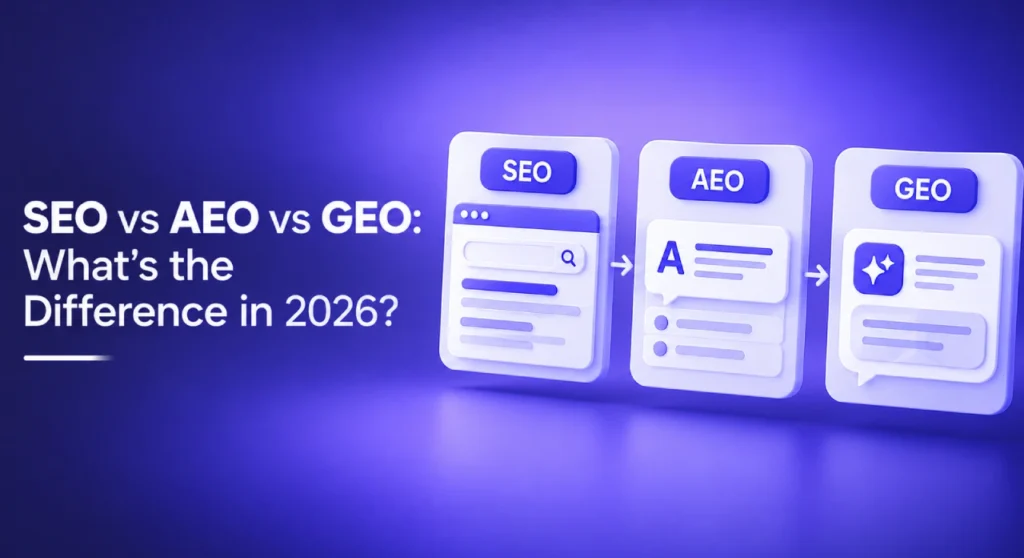
SEO improves a website’s visibility in traditional search results, plain and simple. Getting picked out as the direct answer to a specific question, in a featured snippet, a voice response or a line inside an AI Overview, is what AEO is chasing. GEO reaches further still: shaping how a brand gets represented, and possibly cited, across tools like ChatGPT, Gemini and Perplexity. None of the three replaces the others, and most businesses need a bit of all of them, depending on where their customers go looking.
What Are SEO, AEO and GEO?
SEO has a fairly stable definition after two decades. It means improving a website’s visibility, rankings and click-through in the organic results of engines like Google and Bing.
AEO and GEO are newer, and their definitions are still argued over. Wikipedia’s entry on generative engine optimisation notes that no consensus definition distinguishing GEO from AEO, AIO and LLMO existed as of early 2026, and that the terms are frequently used interchangeably in trade contexts. Google has weighed in too: its Search Central documentation, updated in mid-2026, states that optimising for generative AI search “is optimising for the search experience, and thus still SEO.”
That doesn’t make the distinction meaningless. It just means the line between them isn’t a hard technical spec. It’s more a shift in emphasis.
SEO vs AEO vs GEO: What Is the Difference?
| SEO | AEO | GEO | |
|---|---|---|---|
| Primary goal | Rank in traditional search results | Be selected as the direct answer | Be understood, cited and represented well in AI-generated answers |
| Main search experience | Google and Bing organic results | Featured snippets, People Also Ask, voice assistants | AI Overviews, AI Mode, ChatGPT, Gemini, Perplexity |
| What it optimises | Site structure, keywords, backlinks, technical health | Content structure, clarity, direct answers to specific questions | Brand entity signals, third-party corroboration, retrieval-friendly content |
| Example tactic | Fixing crawl errors, building topical authority pages | Writing a concise, quotable answer near the top of a page | Building consistent citations, reviews and mentions across the web |
| Key measurement | Rankings, organic traffic, click-through rate | Snippet ownership, PAA appearances, AI Overview citations | Brand mentions and citations across AI platforms |
| Best suited for | Businesses relying on organic search traffic and rankings | Businesses whose customers ask specific questions before buying | Businesses that want to be recognised and represented inside AI tools |
Two things are worth flagging beyond the table. The columns aren’t mutually exclusive: one well-written page can rank in traditional search, get pulled into a featured snippet, and get cited by an AI Overview, all from the same piece of content.
Measurement is probably where the three pull furthest apart, at least for now. SEO has mature, standardised metrics through Search Console. Google added a generative AI performance view there in 2026, but no other AI provider offers anything comparable, so GEO tracking mostly comes down to third-party tools of varying reliability.
What Does SEO Optimise For?
SEO is the oldest and best understood of the three, built around a fairly consistent set of levers.
A site Google can crawl and index without friction comes first. That’s clean URLs, internal links that work, decent page speed, and a layout that behaves itself on mobile. Google’s own Search Essentials guidance treats this as baseline work, done long before anything fancier.
Content is where depth and genuine relevance do the work. Keyword density for its own sake stopped mattering years ago. Google has said as much repeatedly, that its ranking systems favour content written by someone who actually knows the subject. Generic, rank-chasing filler doesn’t get the same treatment. Backlinks, mentions, a track record of getting things right: authority still comes from the same places it always has.
What Does AEO Optimise For?
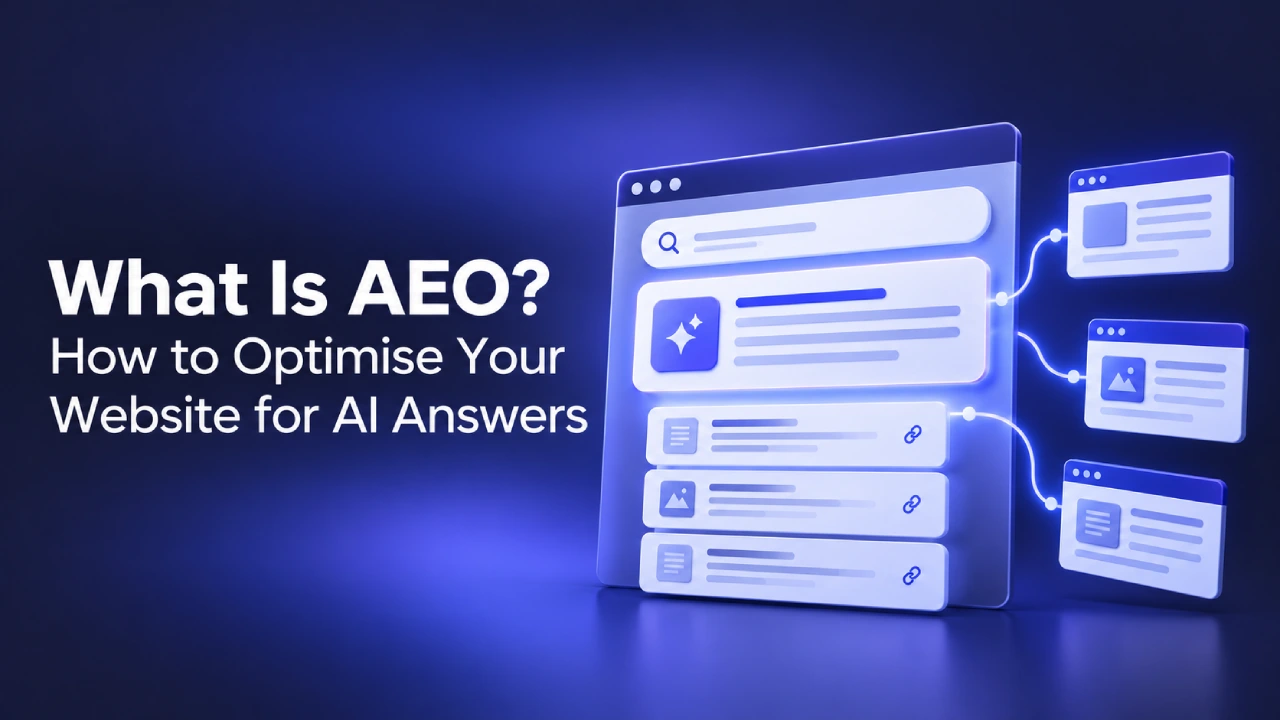
AEO is about winning the moment someone asks a specific question and gets a direct answer back, not a list of links to click through.
Is AEO part of SEO? Mostly, yes, at least in how the industry tends to frame it: strong SEO gets a page indexed and discoverable in the first place, and AEO builds on top of that by adding the structure an answer engine needs to extract and cite it cleanly.
What that looks like in practice: a clear, self-contained answer sitting near the top of the page, short enough to stand on its own as a response to the question in the heading. Beyond that, it’s worth targeting the actual questions customers ask rather than just the keywords they type, and keeping an eye on where those answers already tend to surface, featured snippets, the People Also Ask box, voice assistant responses. For more, see our companion piece, What Is AEO?
FAQ and HowTo structured data can help too, but only when it reflects content genuinely visible on the page. Markup added purely to chase a feature works against a site, not for it.
What Does GEO Optimise For?
GEO is the least settled of the three terms, and the one where it is easiest to overpromise.
What is actually documented: Google confirms AI Overviews and AI Mode use retrieval-augmented generation, drawing on the same search index used elsewhere in Search, plus a technique called query fan-out. OpenAI has said ChatGPT search works similarly, retrieval-based, drawing on third-party search providers and partner content. Neither company has published a ranking factor list, and no other major AI provider has either.
What is common industry practice: agencies and researchers generally agree that AI systems favour a genuine, first-hand point of view over rehashed material, and that consistent, corroborated brand information helps it get represented accurately. This is often called “entity” understanding: how clearly the web describes who you are.
What is professional interpretation, not established fact: how much weight any signal carries isn’t publicly known, and certainty here deserves scepticism.
What we would recommend: build genuine, verifiable expertise signals: named author bios, real case evidence, third-party coverage. Google’s 2026 guidance already says not to bother with AI text files like llms.txt or “chunking” content, since Google Search ignores them. Our Complete Guide to AI Search Visibility goes further into GEO measurement and entity building.
How Do SEO, AEO and GEO Work Together?
Is GEO replacing SEO? No. A widely shared 2025 piece in New York Magazine’s Intelligencer declared “SEO is dead” with GEO its replacement. Forrester analyst Nikhil Lai disagreed, calling AEO and similar terms “significantly, but not fundamentally, different from SEO,” and warning that some advocates exaggerate the gap to sell new services. Google’s 2026 guidance agrees with Lai.
Rather than picking a winner, it helps to think of these as layered. SEO lays the foundation that both AEO and GEO depend on, since only a page Google already trusts and can crawl becomes a realistic candidate for a featured snippet or an AI Overview citation. From there, AEO sharpens things so the useful part can be lifted out cleanly, and GEO carries the same effort outward, to how your brand gets described across the wider web AI systems draw from.
These aren’t three competing channels fighting for one budget. They’re three layers of the same work.
SEO, AEO and GEO in Action
These are illustrative examples of how one business might apply all three approaches together, not real client results.
A Private Physiotherapy Clinic
- SEO: ranking for “physiotherapist Belfast”
- AEO: answering “how much does private physiotherapy cost in the UK?” directly on a pricing page
- GEO: keeping qualifications, registration and reviews consistent across the website, Google Business Profile and relevant directories
An Accountancy Practice
- SEO: ranking for “small business accountant” plus a local area
- AEO: answering “do I need an accountant for a limited company?” within the first few lines of a page
- GEO: publishing guidance under named, credentialed accountants rather than anonymous posts
A B2B Software Company
- SEO: ranking for “invoicing software UK”
- AEO: answering “what’s the difference between invoicing and accounting software?”
- GEO: maintaining an accurate presence on third-party review platforms, since AI comparison tools tend to pull from corroborated, multi-source data
Which Should a Business Prioritise First?
There’s no universal order of priority here. Whether to start with SEO, AEO or GEO often comes down to what’s already in place: solid organic rankings usually mean AEO or GEO layered on top beats rebuilding SEO from scratch, whereas visibility that’s weak across the board is normally a sign the fundamentals need attention first, since AEO and GEO both lean on the same crawlable, trustworthy content underneath them.
Customer search behaviour matters too. If enquiries mostly come from specific questions like “how much does X cost”, AEO on those questions pays off quickly; if customers increasingly ask ChatGPT or Gemini to recommend a provider instead of searching Google, GEO matters more, even though it’s harder to measure today.
Weigh it against the competition too: in a crowded market where rivals already dominate page one, GEO can help you get noticed elsewhere, while a lighter market may still reward straightforward SEO fastest. Content quality and brand strength matter throughout, since thin content limits the return from all three equally.
How to Build an SEO + AEO + GEO Strategy
- Audit where you stand today. Pull current rankings and traffic from Search Console, check whether you’re already appearing in featured snippets or AI Overviews, and search your own brand name in ChatGPT or Gemini to see what comes back.
- Fix the technical and content foundations first. Crawl errors, thin content, slow pages: none of the later steps make up for these.
- Map the real questions customers ask. Sales calls, support tickets and search query data, not just keyword tools.
- Write direct, extractable answers. Lead relevant pages with a clear, self-contained answer, backed by more detail underneath.
- Strengthen entity and expertise signals. Publish under named, credentialed authors, keep business details consistent across your website and directories, and encourage genuine third-party mentions.
- Track what you can. Search Console’s generative AI performance report covers Google. Elsewhere, you’re mostly watching brand mentions manually or with third-party tools, and it’s worth doubting anyone promising guaranteed AI rankings.
- Review and adjust every quarter. Both AI search features and the tools used to track them keep shifting in 2026, so this works better as an ongoing habit than a one-off project.
Frequently Asked Questions
What is the difference between SEO and AEO?
SEO is about ranking your website in search results. Getting your content picked out as the direct answer to a specific question, that’s AEO. It builds on SEO; it doesn’t replace it.
Is GEO replacing SEO?
No. Google’s 2026 guidance states that optimising for generative AI search is still a form of SEO.
Is AEO part of SEO?
Largely, yes. Most industry commentary treats it as an extension of SEO built around answer-driven formats. It isn’t usually treated as a wholly separate discipline.
Do businesses need SEO, AEO and GEO?
Most benefit from strong SEO fundamentals, since AEO and GEO both depend on them. Whether dedicated work on either is needed depends on customer search behaviour and current AI visibility.
How does GEO work?
GEO focuses on how AI systems retrieve and represent information about a brand. Both Google and OpenAI rely on retrieval-based techniques, but no ranking factor list has been published.
How can I optimise my website for AI search?
Start with strong SEO fundamentals. Write clear, quotable answers to real customer questions. Keep business information consistent across your website and third-party sources.
Most businesses know roughly where they rank on Google. Few know how AI tools describe them when someone asks for a recommendation. A structured look across organic search, answer visibility and AI visibility is usually the faster way to find the gaps.